
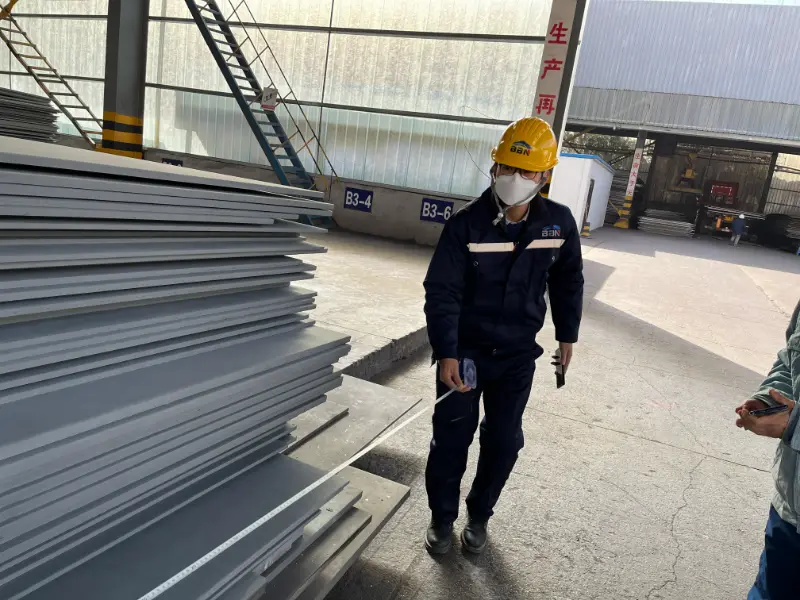
StE285 Automotive Structure Steel Plate
DIN 17102 StE285 Fine Grain Structural Steel for Automotive & Heavy Plate Applications
Comprehensive technical data for StE285 steel under DIN 17102: chemical composition, mechanical properties, physical characteristics, equivalent grades, and application guidance for structural engineering and automotive components.
Hot rolling, normalizing, normalizing rolling, cold forming (within limits), welding (all common methods), machining
- Phone : +8618037372205
- Email : [email protected]
- WhatsApp: Contact via Whtsapp
- WeChat: +8618037372205
StE285 Automotive Structure Steel Plate Introduction
DIN 17102 StE285 is a weldable fine grain structural steel with a minimum yield strength of 285 MPa, primarily supplied in plate and wide flat form. It belongs to the normalized or normalized rolled delivery condition, offering excellent weldability, good toughness, and reliable cold forming properties. The fine grain practice (killed, with aluminum and/or microalloying elements) ensures homogeneous mechanical properties even in thicker sections. Typical applications include frames, chassis, crane booms, and heavy transport equipment where a balance of strength, ductility, and weldability is required. This grade is now largely superseded by EN 10025-3 S275N/NL and EN 10025-4 S275M/ML, but remains a reference in legacy designs.
StE285 Automotive Structure Steel Plate Chemical Composition
The ladle analysis according to DIN 17102 for thickness ≤ 100 mm. The steel is fully killed and fine grain treated with Al and/or Nb, V, Ti to achieve the required mechanical properties.
- Carbon equivalent (CEV) is typically limited for weldability.
- Optional addition of up to 0.15% Mo and 0.60% Ni may be agreed upon.
| Element | Value (%) | Remarks |
|---|---|---|
| C | ≤ 0.20 | Ladle analysis; lower limits may be specified for improved toughness |
| Si | ≤ 0.50 | Deoxidation; higher values by agreement |
| Mn | 0.90 – 1.65 | Contributes to strength and toughness |
| P | ≤ 0.035 | Maximum; for cold forming applications ≤ 0.025 is common |
| S | ≤ 0.030 | Maximum; for improved lamellar tearing resistance ≤ 0.010 by agreement |
| Al (total) | ≥ 0.02 | Grain refining; acid-soluble aluminum can be specified alternatively |
| Nb | ≤ 0.05 | Microalloying for grain refinement and precipitation hardening |
| V | ≤ 0.10 | Optional microalloying element |
| Ti | ≤ 0.10 | Optional; combines with nitrogen for grain refinement |
| N | ≤ 0.012 | Typically lower when Ti or other nitride formers are added |
| Cu | ≤ 0.55 | Residual element; if Cu exceeds 0.40, hot shortness may occur unless Ni is added |
| Cr | ≤ 0.30 | Residual; not intentionally added but permitted |
| Ni | ≤ 0.30 | Residual; up to 0.60 allowed by agreement |
| Mo | ≤ 0.10 | Residual; up to 0.15 allowed by agreement |
StE285 Automotive Structure Steel Plate Thermal & Electrical Physical Properties
The following physical properties are typical for normalized fine grain structural steel at ambient temperature unless otherwise noted. These values are for general design guidance and are not part of the mandatory standard.
- Values are influenced by the exact chemical composition and heat treatment condition.
- For thermal expansion, average coefficients between 20°C and the indicated temperature are given.
| Property | Value | Unit | Test Condition / Remarks |
|---|---|---|---|
| Density (ρ) | 7.85 | kg/dm³ | At 20°C |
| Elastic modulus (E) | 210 | GPa | At 20°C |
| Shear modulus (G) | 81 | GPa | Calculated from E and Poisson ratio |
| Poisson's ratio (ν) | 0.3 | — | In elastic range |
| Thermal expansion coefficient (α) | 12.0 × 10⁻⁶ | K⁻¹ | Between 20°C and 100°C |
| Thermal expansion coefficient (α) | 13.0 × 10⁻⁶ | K⁻¹ | 20°C to 200°C |
| Thermal expansion coefficient (α) | 14.0 × 10⁻⁶ | K⁻¹ | 20°C to 300°C |
| Thermal conductivity (λ) | 48 | W/(m·K) | At 20°C |
| Specific heat capacity | 460 | J/(kg·K) | At 20°C |
| Electrical resistivity (ρ_e) | 0.23 – 0.27 | Ω·mm²/m | At 20°C (typical for C-Mn steel) |
StE285 Automotive Structure Steel Plate Mechanical Properties
Minimum values for the normalized delivery condition at room temperature, unless otherwise stated. Impact energy requirements depend on the quality designation: StE285 (basic), StE285 K (KV 40J at 0°C), StE285 KE (KV 40J at -20°C or -50°C).
- Bend test mandrel diameter ≤ 2t for thickness ≤ 16 mm.
- Through-thickness properties may be agreed upon.
| Property | Value | Unit | Test Condition |
|---|---|---|---|
| Yield strength (ReH) | ≥ 285 | MPa | Nominal thickness ≤ 16 mm, transverse |
| Yield strength (ReH) | ≥ 275 | MPa | 16 < t ≤ 40 mm |
| Yield strength (ReH) | ≥ 265 | MPa | 40 < t ≤ 63 mm |
| Yield strength (ReH) | ≥ 255 | MPa | 63 < t ≤ 80 mm |
| Yield strength (ReH) | ≥ 245 | MPa | 80 < t ≤ 100 mm |
| Tensile strength (Rm) | 450 – 610 | MPa | Thickness ≤ 40 mm |
| Tensile strength (Rm) | 440 – 600 | MPa | 40 < t ≤ 100 mm |
| Elongation (A) | ≥ 19 | % | Longitudinal, gauge length 5.65√So, thickness ≤ 40 mm |
| Elongation (A) | ≥ 18 | % | 40 < t ≤ 100 mm |
| Impact energy (KV) | ≥ 40 | J | Longitudinal, Charpy-V, +20°C (basic quality) |
| Impact energy (KV) | ≥ 40 | J | 0°C (K quality) |
| Impact energy (KV) | ≥ 40 | J | -20°C (KE quality) |
| Bend test (bend angle 180°) | d ≤ 2t | — | Mandrel diameter for tensile side, thickness ≤ 16 mm |
StE285 Automotive Structure Steel Plate Fully Equivalent Material Standards & Substitutable Grades
StE285 has been officially replaced by European standards, but the following grades are considered technically identical in composition and mechanical properties for normalized delivery.
| Country/Region | Standard | Grade | Remarks |
|---|---|---|---|
| Europe | EN 10025-3:2019 | S275N | Normalized, fine grain, min. ReH 275 MPa – direct replacement for StE285 basic |
| Europe | EN 10025-3:2019 | S275NL | Normalized, fine grain, low temperature impact (‑50°C) – close to StE285 KE |
| Europe | EN 10025-4:2019 | S275M | Thermomechanical rolled, comparable strength, may substitute with agreement |
| Europe | EN 10025-4:2019 | S275ML | TM rolled with low temperature toughness, alternative to StE285 KE |
| Germany | DIN 17102 (withdrawn) | StE285 | Original standard; refer to EN equivalent for new designs |
StE285 Automotive Structure Steel Plate Application Introduction
StE285 is designed for welded structures requiring guaranteed minimum yield strength in the normalized condition. The fine grain microstructure ensures good toughness and resistance to brittle fracture. Key application areas:
- Automotive frames and heavy‑duty vehicle components (chassis, subframes, booms).
- Structural steelwork in buildings and industrial plants.
- Earthmoving and agricultural machinery.
- Crane and lifting equipment, including hooks and booms.
- Pressure vessels for low to medium pressure (subject to design codes).
- Bridge construction and offshore structural parts (secondary).
Product Applications: Automobile structural chassis frames, Crane booms and lattice booms, Earthmoving equipment arms and bodies, Trailer frames and undercarriages, Bridge beams and structural sections, Pressure vessel shells (non‑lethal service)
Processed into products: Welded H‑beams and box columns, Bent and formed frame rails, Cut and machined gussets, brackets, Laser‑cut parts for heavy equipment, Welded nodes and joints for tubular structures
Application industries: Automotive & heavy transport, Construction & civil engineering, Mining & earthmoving machinery, Lifting & material handling, Shipbuilding (secondary structures), General mechanical engineering
StE285 Automotive Structure Steel Plate Similar/Approximate Substitute Materials
The following grades offer comparable strength and weldability but may have different delivery conditions or impact properties. They are often used in similar structural applications and can be considered with engineering assessment.
| Country/Region | Standard | Grade | Remarks |
|---|---|---|---|
| Germany | DIN 17100 | St 44‑2 / St 44‑3 | Older standard structural steel; Rm 430‑580 MPa, not fine grain treated, lower toughness |
| Europe | EN 10025‑2 | S275JR/J0/J2 | Non‑fine grain, slightly lower yield; may replace StE285 for non‑critical applications |
| China | GB/T 1591 | Q345B / Q345C | Mn‑alloyed, higher strength (ReH ≥ 345 MPa), weldable, often used for bridges and vehicles |
| Japan | JIS G3106 | SM400B / SM400C | Weldable structural steel; ReH ≥ 235‑245 MPa, lower strength, required section size check |
| USA | ASTM A572 | Gr. 42 / Gr. 50 | High‑strength low‑alloy; Gr.42 (290 MPa) close match, Gr.50 (345 MPa) over‑matches |
| India | IS 2062 | E275 A / B / C | Hot rolled structural steel; similar carbon‑manganese basis, impact class choice required |
Notes:
Additional remarks:
- For new designs, always consult current European standards (EN 10025‑3 and EN 10025‑4) and select the appropriate grade based on thickness and required impact energy.
- Welding: Preheating is generally not required for thicknesses up to 30 mm when using low‑hydrogen processes; consult EN 1011‑2 for thicker sections.
- This grade has limited availability under the old designation; suppliers typically offer S275N or S275NL.
- When substituting with thermomechanically rolled steel (M), the forming and heat treatment limitations of TMCP steels must be considered.
- Share



