
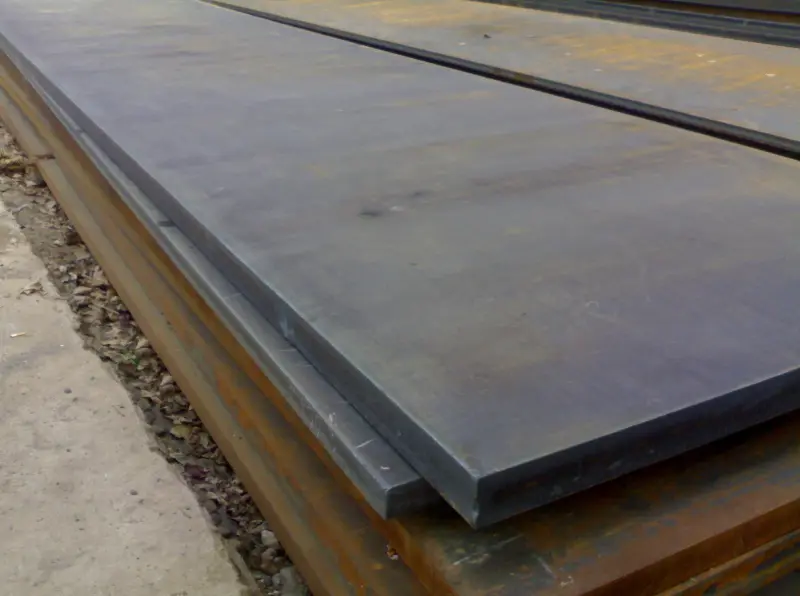
DIN 17102 WStE285 Automotive Structure Steel
DIN 17102 WStE285 Automotive Structure Steel: Fine-Grain Weldable Grade
Explore the properties, chemical composition, mechanical and thermal data of DIN 17102 WStE285 steel plate. Find equivalent grades, applications in automotive structural parts, and detailed technical reference.
Hot rolling, cold forming, bending, deep drawing, punching, gas/arc welding, resistance welding
- Phone : +8618037372205
- Email : [email protected]
- WhatsApp: Contact via Whtsapp
- WeChat: +8618037372205
DIN 17102 WStE285 Automotive Structure Steel Introduction
DIN 17102 WStE285 is a weldable fine-grain structural steel primarily designed for automobile body and chassis components. It belongs to the micro-alloyed hot-rolled steel family with a minimum yield strength of 285 MPa, offering an optimal balance between strength, formability, and weldability. The steel is produced via controlled rolling and aluminum or micro-alloy (niobium, vanadium, titanium) grain refinement to achieve fine ferrite-pearlite microstructure. Its low carbon equivalent ensures excellent cold forming and welding suitability without preheating, while maintaining good toughness at low temperatures. Typical applications include
- longitudinal members
- cross members
- reinforcement plates
- wheel discs
in commercial vehicles and passenger cars. The standard DIN 17102 has been largely superseded by EN 10149-2, but WStE285 remains widely referenced for existing designs.
DIN 17102 WStE285 Automotive Structure Steel Chemical Composition
The ladle analysis limits according to DIN 17102 for WStE285 (all values in %). The steel is micro-alloyed with aluminum, niobium, vanadium, and titanium to achieve fine grain size and high strength.
- Carbon content is kept low (≤0.12%) to ensure weldability.
- Manganese up to 1.50% contributes to solid solution strengthening.
- Aluminum (≥0.015%) guarantees grain refinement and deoxidation.
- Nb, V, and Ti are optional grain refiners with indicated maximum limits.
| Element | Standard Value (max, %) | Remarks |
|---|---|---|
| C (Carbon) | 0.12 | Max |
| Si (Silicon) | 0.50 | Max |
| Mn (Manganese) | 1.50 | Max |
| P (Phosphorus) | 0.030 | Max |
| S (Sulfur) | 0.025 | Max |
| Al (Aluminum, total) | ≥0.015 | Minimum; acid-soluble Al |
| Nb (Niobium) | 0.09 | Max (optional) |
| V (Vanadium) | 0.20 | Max (optional) |
| Ti (Titanium) | 0.22 | Max (optional) |
| Nb+V+Ti | ≤0.22 | Combined total if all added |
DIN 17102 WStE285 Automotive Structure Steel Thermal and Electrical Physical Properties
The values given are approximate, typical for low-carbon micro-alloyed steels and are not part of the DIN 17102 normative requirements. They are useful for design calculations involving thermal expansion, heat transfer, and electrical conductivity. Actual values may vary slightly with exact composition and processing history.
| Property | Typical Value | Unit | Test Condition / Remarks |
|---|---|---|---|
| Density (ρ) | 7.85 | g/cm³ | Room temperature |
| Modulus of Elasticity (E) | 210 | GPa | Room temperature |
| Shear Modulus (G) | 81 | GPa | Room temperature |
| Poisson's Ratio (ν) | 0.3 | - | Room temperature, elastic range |
| Thermal Expansion Coefficient (α) | 12.0 × 10⁻⁶ | K⁻¹ | 20 – 100 °C |
| Thermal Expansion Coefficient (α) | 12.5 × 10⁻⁶ | K⁻¹ | 20 – 200 °C |
| Thermal Expansion Coefficient (α) | 13.0 × 10⁻⁶ | K⁻¹ | 20 – 300 °C |
| Thermal Conductivity (λ) | 50 | W/(m·K) | At 20 °C |
| Thermal Conductivity (λ) | 47 | W/(m·K) | At 100 °C |
| Specific Heat Capacity (cp) | 460 | J/(kg·K) | At 20 – 100 °C |
| Electrical Resistivity (ρe) | 0.15 – 0.20 | μΩ·m | At 20 °C |
DIN 17102 WStE285 Automotive Structure Steel Mechanical Properties
Mechanical properties as per DIN 17102 for WStE285 at room temperature, valid for thickness ≤ 16 mm. Values vary with product thickness; here the minimum guaranteed figures for the most common gauges are shown. The steel exhibits good ductility and bendability, essential for automotive cold forming. Impact toughness is verified at -20°C with a minimum of 27 J longitudinal, confirming suitability for low-temperature service.
| Property | Standard Requirement | Unit | Test Condition |
|---|---|---|---|
| Yield Strength (ReH) | 285 (min) | MPa | Thickness ≤ 16 mm, transverse |
| Yield Strength (ReH) | 275 (min) | MPa | Thickness >16 to ≤ 40 mm, transverse |
| Yield Strength (ReH) | 265 (min) | MPa | Thickness >40 to ≤ 63 mm, transverse |
| Tensile Strength (Rm) | 380 – 530 | MPa | All thicknesses |
| Elongation after fracture (A) | 24 (min) | % | Longitudinal, gauge length L₀ = 5.65√S₀, thickness ≤ 40 mm |
| Elongation after fracture (A) | 22 (min) | % | Longitudinal, thickness >40 to ≤ 63 mm |
| Elongation after fracture (A) | 20 (min) | % | Transverse, all thicknesses |
| Bend Test (mandrel diameter) | 2t (bending angle 180°) | - | t = specimen thickness, crack-free |
| Impact Energy (KV₂) | 27 (min) | J | Longitudinal, -20 °C, V-notch |
DIN 17102 WStE285 Automotive Structure Steel Completely Equivalent Standards and Replaceable Grades
| Country/Region | Standard | Grade | Remarks |
|---|---|---|---|
| Europe | EN 10149-2 | S315MC | Direct successor; slightly higher yield strength (315 MPa) but identical application area. Chemical and mechanical properties slightly adjusted to new European standard. |
| Japan | JIS G3113 | SAPH370 | Comparable hot-rolled automotive structural steel with min. yield strength 225–305 MPa depending on thickness; often used as substitute. |
| China | GB/T 3273 | SAPH370 | Derived from JIS, similar to SAPH370, widely used in automobile frames. |
| USA | ASTM A1011/A1011M | HSLAS Grade 50 Class 1 | Approximate; min. yield 345 MPa, but formability and welding characteristics are analogous. Requires thickness adjustment. |
DIN 17102 WStE285 Automotive Structure Steel Application Introduction
DIN 17102 WStE285 is specifically tailored for load-bearing components in vehicles that require forming, welding, and good low-temperature toughness. Its balanced mechanical properties allow weight savings and reliable performance under dynamic loads. It is predominantly used in the automotive and transportation industries.
Product Applications: Chassis frames and sub-frames, Longitudinal and cross members, Suspension arms and brackets, Wheel rims and disc wheels, Bumper reinforcements, Support structures for truck bodies
Processed into products: Stamped and deep-drawn panels, Bent and roll-formed sections, Laser-cut and welded assemblies, Cold-formed tubular profiles, Press-hardened parts (when applied with appropriate heat treatment), Reinforcement plates and gussets
Application industries: Automotive manufacturing (commercial and passenger vehicles), Trailer and semi-trailer construction, Earth-moving and agricultural machinery, Crane and lifting equipment, Railway wagon components, General welded structures subjected to moderate dynamic loads
DIN 17102 WStE285 Automotive Structure Steel Similar or Approximately Equivalent Materials
| Country/Region | Standard | Grade | Remarks |
|---|---|---|---|
| Europe | EN 10025-4 | S275M | Thermomechanically rolled fine-grain steel with min. yield 275 MPa and excellent toughness. Used when strength requirement is slightly lower. |
| Europe | EN 10149-2 | S355MC | Higher strength alternative (min. yield 355 MPa) for weight reduction. Requires more powerful forming equipment. |
| Germany | DIN 17100 (obsolete) | St37-3 / St44-3 | Traditional structural steels with lower strength and toughness; not grain-refined but sometimes used in less demanding automotive parts. |
| USA | ASTM A572/A572M | Grade 50 | HSLA steel with min. yield 345 MPa; good weldability, used in structural applications but must verify fatigue and impact requirements. |
Notes:
- Due to the standard's obsolescence, DIN 17102 WStE285 is typically ordered today under EN 10149-2 S315MC with appropriate supplementary requirements (e.g., Z-quality, grain refinement).
- The steel is suitable for galvanizing and other protective coatings without risk of liquid metal assisted cracking due to very low silicon content.
- When welding, low hydrogen practices and matching filler metals of class G 42 4 M21 or equivalent are recommended.
- For fatigue-critical ap plications, surface condition and edge quality after cutting must be controlled according to EN 1090 or automaker factory standards.
- Share



