
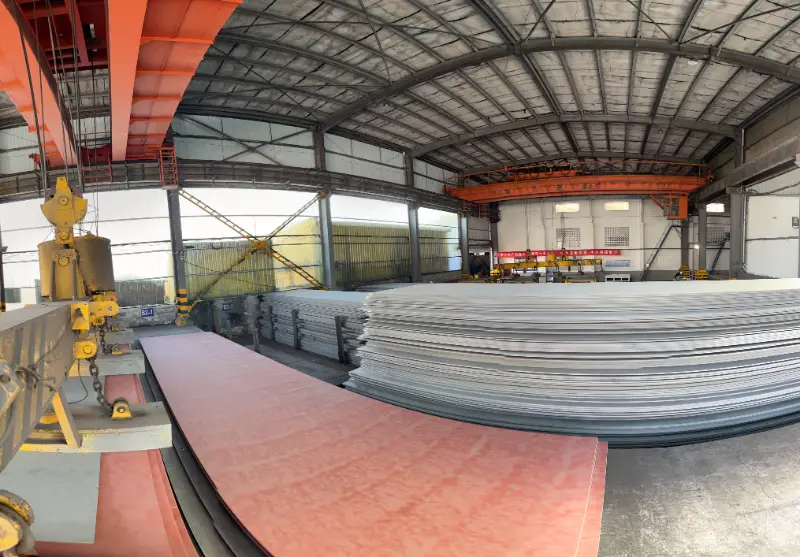
QStE460TM Steel
QStE460TM Steel: High-Strength Automotive Structural Plate per Q/BQB 310-2009
Detailed data sheet for QStE460TM automobile structure steel plate, including composition, mechanical properties, thermal properties, equivalents, and applications.
Cutting, bending, stamping, roll forming, welding, machining
- Phone : +8618037372205
- Email : [email protected]
- WhatsApp: Contact via Whtsapp
- WeChat: +8618037372205
QStE460TM Steel Introduction
QStE460TM is a hot-rolled high-strength low-alloy (HSLA) steel specified in Baosteel standard Q/BQB 310-2009 for automotive structural applications. It features a minimum yield strength of 460 MPa, good weldability, and high formability for weight reduction and safety. Key characteristics:
- Excellent strength-to-weight ratio
- Good cold formability for bending and roll forming
- Weldable by conventional methods
- Supplied as-rolled or controlled-rolled condition
Typically used in chassis, suspension, and structural reinforcements.
QStE460TM Steel Chemical Composition
Chemical composition according to Q/BQB 310-2009 for QStE460TM. The steel is micro-alloyed with niobium, vanadium, and titanium to achieve fine grain strengthening. Maximum total micro-alloying elements (Nb+V+Ti) is limited to 0.22% to ensure good weldability and formability. Residual elements such as Cr, Ni, Mo, Cu are not intentionally added but may be present up to 0.10% each.
| Chemical Element | Standard Value (wt%) | Remarks |
|---|---|---|
| Carbon (C) | ≤0.12 | |
| Silicon (Si) | ≤0.50 | |
| Manganese (Mn) | ≤1.60 | |
| Phosphorus (P) | ≤0.025 | |
| Sulfur (S) | ≤0.015 | |
| Aluminum (Al) | ≥0.015 | Total aluminum |
| Niobium (Nb) | ≤0.09 | |
| Vanadium (V) | ≤0.20 | |
| Titanium (Ti) | ≤0.15 | |
| Nb+V+Ti | ≤0.22 | Sum of micro-alloying elements |
QStE460TM Steel Thermal and Electrical Physical Properties
These physical properties are typical values for hot-rolled HSLA steel at room temperature, not specified in Q/BQB 310-2009. Thermal properties such as heat capacity and conductivity vary slightly with temperature. Electrical resistivity is influenced by alloying content and microstructure.
| Property | Typical Value | Unit | Condition |
|---|---|---|---|
| Density (ρ) | 7.85 | g/cm³ | At 20 °C |
| Elastic modulus (E) | 210 | GPa | At 20 °C |
| Shear modulus (G) | 80 | GPa | At 20 °C |
| Poisson's ratio (ν) | 0.3 | - | At 20 °C |
| Thermal expansion coefficient (α) | 12.0 | 10⁻⁶/K | 20 - 100 °C |
| Thermal conductivity (λ) | 50 | W/(m·K) | At 20 °C |
| Specific heat capacity | 460 | J/(kg·K) | At 20 °C |
| Electrical resistivity (ρ_e) | 0.22 | μΩ·m | At 20 °C |
QStE460TM Steel Mechanical Properties
Mechanical property requirements for QStE460TM as per Q/BQB 310-2009. Tensile test conducted on transverse specimens unless otherwise specified. Bend test is carried out at 180° with mandrel diameter (d) specified below. Charpy-V impact test at -20°C is not mandatory; a typical absorbed energy of 27 J can be achieved when tested.
| Property | Standard Required Value | Unit | Test Condition |
|---|---|---|---|
| Yield strength (ReH) | ≥460 | MPa | Plate thickness t ≤ 16 mm |
| Tensile strength (Rm) | 530 - 720 | MPa | Plate thickness t ≤ 16 mm |
| Elongation after fracture (A) | ≥14 | % | t < 3 mm (gauge length 80 mm) |
| Elongation after fracture (A) | ≥17 | % | 3 mm ≤ t ≤ 6 mm (gauge length 5.65√S₀) |
| Elongation after fracture (A) | ≥19 | % | 6 mm < t ≤ 16 mm (gauge length 5.65√S₀) |
| Bend test (180°) | d = 0a | - | t ≤ 6 mm, a = specimen thickness |
| Bend test (180°) | d = 0.5a | - | t > 6 mm |
QStE460TM Steel Fully Equivalent Material Standards and Substitutable Grades
| Country/Region | Standard | Grade | Remarks |
|---|---|---|---|
| Europe | EN 10149-2 | S460MC | Complete equivalent in chemical and mechanical requirements |
| International | ISO 6930-2 | S460MC | Identical to EN standard, global use |
| China | GB/T 20887.1 | HR460F | Closely matches yield strength; minor differences in elongation limits |
| Japan | JIS G 3134 | SPFH540 | Similar strength range, often used for automotive forming; confirm by analysis |
| USA | ASTM A1011/A1011M | HSLAS Grade 70 [480] | Comparable strength grade (485 MPa min yield); weldability equivalent |
QStE460TM Steel Application Introduction
QStE460TM is designed for cold-formed structural and safety components in automotive and commercial vehicles. Its high yield strength combined with good elongation allows weight reduction without sacrificing load-bearing capacity. Processing notes:
- Excellent weldability with typical arc and resistance welding methods (low carbon equivalent)
- Bending radius should be at least 1.0x thickness for tight radii to avoid cracking
- Thermomechanical rolling ensures fine grain size and uniform properties
- Parts can be hot-dip galvanized or electro-galvanized for corrosion protection
Product Applications: Chassis frames and subframes, Suspension control arms, Bumper reinforcement beams, C-pillar reinforcements, Wheel housings, Structural cross members, Seat brackets and mounts
Processed into products: Longitudinal beams with formed hat sections, Spring brackets and shackles, Engine cradle (K-frame) components, Shock absorber mounting plates, Tow hooks and recovery points, Brake pedal brackets
Application industries: Automotive manufacturing, Commercial vehicle chassis, Construction equipment, Agriculture machinery
QStE460TM Steel Recommended Similar / Alternative Materials
| Country/Region | Standard | Grade | Remarks |
|---|---|---|---|
| Europe | EN 10149-2 | S420MC | Lower yield strength (420 MPa), better formability for less demanding parts |
| Europe | EN 10149-2 | S500MC | Higher yield strength (500 MPa), suitable when greater strength is needed |
| China | Q/BQB 310-2009 | QStE420TM | Lower strength grade within same standard, good formability |
| China | Q/BQB 310-2009 | QStE500TM | Higher strength grade in same standard, may require more forming force |
| International | ISO 6930-2 | S500MC | Higher strength alternative, globally recognized |
Notes:
QStE460TM is a Baosteel proprietary grade; for export, it is commonly cross-referenced to S460MC per EN 10149-2. When ordering, specify plate thickness and intended forming operations. Corrosion protection may require coating after forming. For complex deep-drawing operations, a lower strength grade (e.g., QStE420TM) may be more suitable. The steel can be supplied with a protective oil coating or pickled and oiled finish.
- Share



