
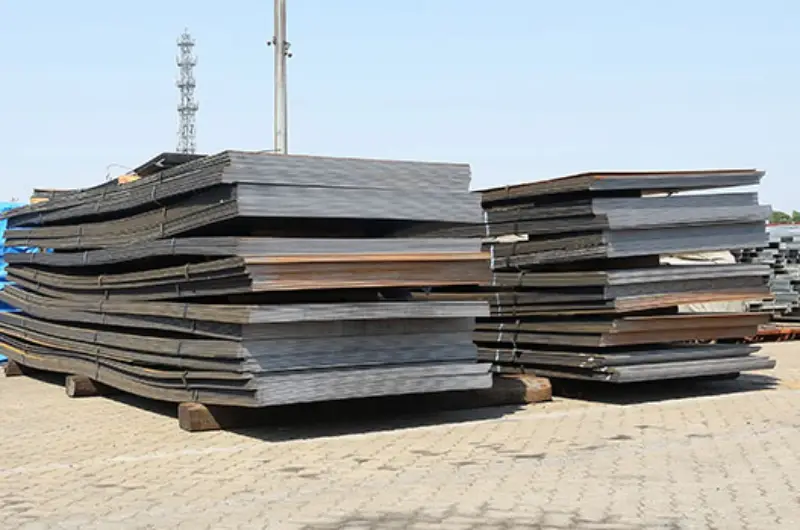
QStE420TM Steel
QStE420TM Automotive Structural Steel – Q/BQB 310-2009 Properties & Equivalents
Comprehensive material data for QStE420TM thermomechanical rolled steel under Baosteel standard Q/BQB 310-2009, including chemical composition, mechanical properties, thermal and electrical physical properties, and international equivalents.
Cold forming, bending, stamping, welding, limited machining (suitable for parts requiring high formability)
- Phone : +8618037372205
- Email : [email protected]
- WhatsApp: Contact via Whtsapp
- WeChat: +8618037372205
QStE420TM Steel Introduction
QStE420TM is a high-strength low-alloy steel grade produced by thermomechanical rolling, conforming to Baosteel enterprise standard Q/BQB 310-2009. It is primarily used for automotive structural components requiring excellent formability and high fatigue resistance. The steel offers a minimum yield strength of 420 MPa for thicknesses up to 8 mm, combined with good weldability and impact toughness. Its fine grain structure, achieved through controlled rolling and microalloying with niobium, vanadium, and titanium, ensures a balance of strength and ductility. Typical delivery condition is as-rolled or thermomechanical rolled, with surfaces optionally pickled and oiled.
QStE420TM Steel Chemical Composition
The chemical composition of QStE420TM is designed to provide high yield strength through microalloying and controlled rolling. Carbon content is kept low to ensure good weldability. Manganese contributes to strength, while niobium, vanadium, and titanium provide precipitation strengthening and grain refinement.
- Aluminum is added for deoxidation and grain size control.
- Maximum sulphur and phosphorus levels are restricted for formability and toughness.
| Element | Standard Value (max, %) | Remarks |
|---|---|---|
| C | 0.12 | For thickness ≤ 8 mm |
| Si | 0.50 | |
| Mn | 1.60 | |
| P | 0.030 | |
| S | 0.025 | |
| Alt (total Al) | ≥ 0.015 | Minimum |
| Nb | 0.09 | May be added individually or in combination |
| V | 0.20 | May be added individually or in combination |
| Ti | 0.15 | May be added individually or in combination |
| Nb+V+Ti | 0.22 | Sum of microalloying elements |
| Others (Cr, Ni, Mo, Cu) | Not specified | Residual elements should be controlled |
QStE420TM Steel Thermal and Electrical Physical Properties
Physical properties are generic for low-carbon microalloyed steels. Values may vary slightly depending on exact composition and processing conditions.
- Density and elastic moduli are essential for FE simulations of forming and crash behaviour.
- Thermal expansion and conductivity influence welding and heat treatment responses.
| Property | Standard Value | Unit | Test Conditions |
|---|---|---|---|
| Density (ρ) | 7.85 | g/cm³ | 20°C |
| Elastic modulus (E) | 210 | GPa | 20°C |
| Shear modulus (G) | 81 | GPa | 20°C |
| Poisson's ratio (ν) | 0.3 | – | 20°C |
| Thermal expansion coefficient (α) | 12.0 × 10⁻⁶ | 1/K | 20–100°C |
| Thermal conductivity (λ) | 45 | W/(m·K) | 20°C |
| Specific heat capacity | 460 | J/(kg·K) | 20°C |
| Electrical resistivity (ρ_e) | 0.15 – 0.20 | μΩ·m | 20°C |
QStE420TM Steel Mechanical Properties
Mechanical properties are valid for thermomechanical rolled condition and thicknesses 1.5–14 mm. Yield strength decreases slightly for thicker gauges. Minimum bend radius of 0.5t (t=thickness) is recommended for 180° bending. Impact toughness values are not mandatory but are typically guaranteed for safety-relevant automotive applications.
- Elongation A80 is for specimens with gauge length 80 mm for thickness < 3 mm; A5 for thickness ≥ 3 mm.
- Test pieces prepared according to Q/BQB 301.
| Property | Standard Value | Unit | Test Conditions |
|---|---|---|---|
| Yield strength (ReH) | ≥ 420 | MPa | Thickness ≤ 8 mm, transverse |
| Yield strength (ReH) | ≥ 400 | MPa | Thickness 8–14 mm, transverse |
| Tensile strength (Rm) | 480 – 620 | MPa | All thicknesses, transverse |
| Elongation A80 | ≥ 19 | % | Thickness < 3 mm, transverse |
| Elongation A5 | ≥ 24 | % | Thickness ≥ 3 mm, transverse |
| Bend test (180°) | d = 0.5t | – | No cracks; mandrel diameter = 0.5 × thickness |
| Impact toughness KV2 | ≥ 40 | J | At -20°C, longitudinal (typical guarantee, not mandatory) |
QStE420TM Steel Exact Equivalents
| Country/Region | Standard | Grade | Remarks |
|---|---|---|---|
| European Union | EN 10149-2:2013 | S420MC | Direct equivalent; same mechanical and chemical requirements |
| International | ISO 6930-2:2004 | S420MC | Technically equivalent to EN grade |
| China (Baosteel) | Q/BQB 310-2009 | QStE420TM | Original grade |
| China (National) | GB/T 20887.1 (possible reference) | HR420/780HE? Not exact | No direct GB equivalent; QStE420TM is closer to EN system |
QStE420TM Steel Application Introduction
QStE420TM is optimized for cold-formed automotive structural parts that require a combination of high strength, good fatigue resistance, and adequate formability. Typical applications include underbody components, side impact beams, seat frames, and wheel rims. The steel is weldable by common methods, including spot and arc welding, with low carbon equivalent ensuring no preheating is normally needed. For severe forming, a minimum bending radius of 0.5t is recommended.
- Can be used for lightweight designs as an upgrade from S355MC or similar grades.
- Not recommended for hot forming due to loss of thermomechanical strengthening.
Product Applications: Passenger car chassis members, Suspension arms and sub-frames, Wheel rims (discs and rims), Longitudinal beams and cross members in truck frames, Tubular seat structures, Brackets and reinforcement plates
Processed into products: Formed longitudinal beams, Stamped cross members, Bent and welded tubular parts, Laser-welded blanks for tailored properties, Cold-rolled wheel rim profiles (via slitting and forming), Chassis subframe assemblies
Application industries: Automotive (OEM and Tier 1 suppliers), Commercial vehicle manufacturing, Agricultural and construction machinery, Railway wagon components
QStE420TM Steel Similar/Alternative Material Recommendations
| Country/Region | Standard | Grade | Remarks |
|---|---|---|---|
| European Union | EN 10149-2 | S355MC | Lower strength grade (YS ≥355 MPa); suitable if 420 MPa not needed, with better formability |
| European Union | EN 10149-2 | S500MC | Higher strength grade (YS ≥500 MPa); for weight reduction but reduced formability |
| Japan | JIS G 3134:2018 | SPFH540 | HSLA steel with similar strength (YS ≥355 MPa, TS ≥540 MPa); not direct match but used in similar applications |
| USA | ASTM A1011/A1011M | HSLAS Grade 60 (410) | Grade 60 (minimum YS 410 MPa) close in strength; Grade 70 (480 MPa) higher; chemical composition may differ |
| Germany (historical) | DIN EN 10149-2 | QStE420TM | Older designation; identical to current S420MC |
Notes:
The material is supplied in thermomechanical rolled condition; subsequent hot forming or annealing above 580°C may reduce strength. Surface quality is according to Q/BQB 310: class A or B for exposed/unexposed parts. Dimensional tolerances follow Q/BQB 301 or can be agreed as per EN 10051. For critical fatigue applications, the steel can be specified with controlled inclusion shape (e.g., calcium treatment). Charpy impact values are typically agreed upon for stamping and crashworthiness requirements. The steel meets EU ELV directive for recyclability. For welding, a carbon equivalent CEV ≤ 0.22% ensures excellent cold cracking resistance.
- Share



