
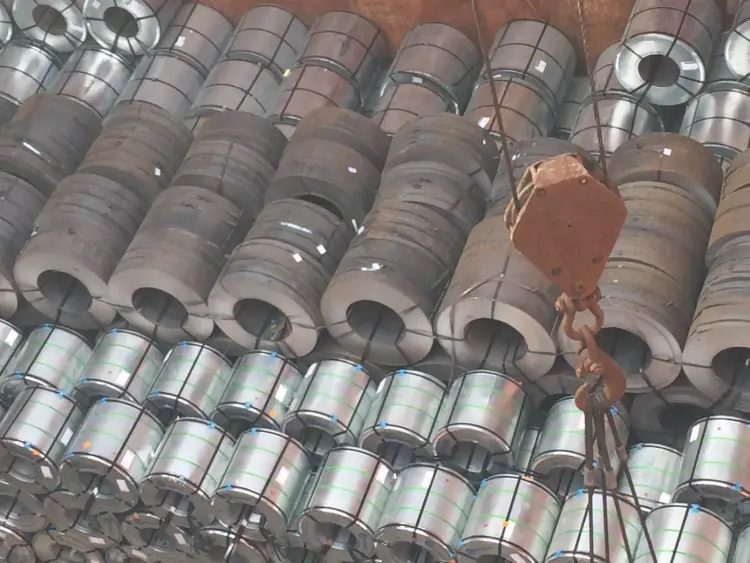
DIN 17155 HI Steel Coil for Gas Vessels
DIN 17155 HI Steel Coil for Gas Vessels – Properties, Equivalents & Applications
Comprehensive material data sheet for DIN 17155 HI steel: chemical composition, mechanical properties, thermal and electrical physical properties, international equivalents, and application guidance for gas vessels.
Normalizing, controlled rolling, hot forming, welding
- Phone : +8618037372205
- Email : [email protected]
- WhatsApp: Contact via Whtsapp
- WeChat: +8618037372205
DIN 17155 HI Steel Coil for Gas Vessels Introduction
DIN 17155 HI is a German standard heat-resistant carbon steel coil intended for use in pressure vessels, particularly gas vessels operating at elevated temperatures up to approximately 400°C. It belongs to the group of unalloyed steels with good weldability and moderate strength. HI grade is typically supplied in the normalized or controlled rolled condition.
- Good high-temperature strength and ductility
- Suitable for welded structures in boiler and pressure vessel construction
- Reliable performance in gas storage and transportation applications
DIN 17155 HI Steel Coil for Gas Vessels Chemical Composition
The chemical composition of DIN 17155 HI steel is as per standard ladle analysis. Main alloying elements: carbon and manganese provide the required strength, while silicon is limited for good surface quality. Phosphorus and sulfur are strictly controlled to ensure ductility and weldability.
- Carbon content is kept low to maintain toughness
- Manganese range optimizes strength and resistance to high-temperature oxidation
| Chemical Element | Standard Value (wt%) | Remarks |
|---|---|---|
| Carbon (C) | ≤ 0.20 | Max |
| Silicon (Si) | ≤ 0.35 | Max |
| Manganese (Mn) | 0.50 – 1.30 | |
| Phosphorus (P) | ≤ 0.035 | Max |
| Sulfur (S) | ≤ 0.030 | Max |
| Iron (Fe) | Balance | As remainder |
DIN 17155 HI Steel Coil for Gas Vessels Thermal and Electrical Physical Properties
Physical properties are typical reference data for unalloyed carbon steel of this grade. These values are not mandated by DIN 17155 but are important for engineering design.
- Density is standard for carbon steel
- Thermal expansion and conductivity values are typical for elevated-temperature design
- Electrical resistivity is provided for reference
| Property | Typical Value | Unit | Test Condition / Temperature |
|---|---|---|---|
| Density (ρ) | 7.85 | g/cm³ | 20°C |
| Modulus of elasticity (E) | 210 | GPa | 20°C |
| Shear modulus (G) | 81 | GPa | 20°C |
| Poisson's ratio (ν) | 0.30 | – | 20°C |
| Thermal expansion coefficient (α) | 11.1 | 10^(-6)/K | 20 – 100°C |
| Thermal expansion coefficient (α) | 12.1 | 10^(-6)/K | 20 – 200°C |
| Thermal expansion coefficient (α) | 12.9 | 10^(-6)/K | 20 – 300°C |
| Thermal expansion coefficient (α) | 13.5 | 10^(-6)/K | 20 – 400°C |
| Thermal conductivity (λ) | 52 | W/(m·K) | 20°C |
| Specific heat capacity | 450 | J/(kg·K) | 20°C |
| Electrical resistivity (ρ_e) | approx. 0.15 | µΩ·m | 20°C |
DIN 17155 HI Steel Coil for Gas Vessels Mechanical Properties
Mechanical properties according to DIN 17155 for transverse test pieces. Values depend on the nominal thickness of the product in the delivery condition (normalized). Tensile testing performed at room temperature.
- Minimum yield strength decreases slightly with increasing thickness
- Elongation ensures adequate formability for vessel fabrication
- No mandatory impact test in the base standard; impact energy may be agreed upon
| Property | Standard Requirement | Unit | Test Condition / Thickness |
|---|---|---|---|
| Upper yield strength (ReH) or proof strength (Rp0.2) | ≥ 235 | MPa | t ≤ 16 mm, transverse |
| Upper yield strength (ReH) or proof strength (Rp0.2) | ≥ 225 | MPa | 16 mm < t ≤ 40 mm, transverse |
| Tensile strength (Rm) | 350 – 480 | MPa | t ≤ 16 mm, transverse |
| Tensile strength (Rm) | 350 – 480 | MPa | 16 mm < t ≤ 40 mm, transverse |
| Elongation after fracture (A) | ≥ 25 | % | t ≤ 16 mm, transverse, gauge length 5.65√So |
| Elongation after fracture (A) | ≥ 24 | % | 16 mm < t ≤ 40 mm, transverse, gauge length 5.65√So |
DIN 17155 HI Steel Coil for Gas Vessels Fully Equivalent Material Standards and Grade Replacements
| Country/Region | Standard | Grade | Remarks |
|---|---|---|---|
| Europe (EN) | EN 10028-2 | P235GH | Direct successor to DIN 17155 HI; nearly identical strength, slightly tighter P/S limits. |
| International (ISO) | ISO 2604-2 | P1 | Equivalent heat-resistant carbon steel; often specified for pressure vessels. |
| Japan | JIS G3103 | SB410 | Similar composition and strength; used for boilers and pressure vessels. |
| United Kingdom (old) | BS 1501-161 | 161 Gr. 28/28H | Historically comparable; now superseded by EN standards. |
DIN 17155 HI Steel Coil for Gas Vessels Application Introduction
DIN 17155 HI steel is designed for welded pressure equipment operating at temperatures up to about 400°C. It is particularly common in the gas industry for storage and transport vessels.
- Good weldability with standard procedures
- Readily formed into cylindrical shells and heads
- Delivered in normalized condition ensures uniform mechanical properties
Product Applications: Gas vessels (LPG, natural gas, industrial gases), Pressure tanks and receivers, Heat exchangers, Boiler drums, Separators and filter housings
Processed into products: Vessel shell courses (rolled from coil), Dished heads and end closures, Flanges and nozzles (integral or welded), Support saddles and brackets, Internal trays and baffles
Application industries: Oil & Gas, Chemical processing, Power generation, Pressure vessel manufacturing, Industrial gas storage
DIN 17155 HI Steel Coil for Gas Vessels Similar / Alternative Materials with close performance
| Country/Region | Standard | Grade | Remarks |
|---|---|---|---|
| USA | ASTM A285 / A285M | Grade C | Lower carbon, similar tensile; used for low-intermediate pressure vessels. |
| USA | ASTM A516 / A516M | Grade 60 | Higher strength, better notch toughness; suitable for moderate temperature. |
| China | GB 713 | Q245R | Similar carbon steel for pressure vessels; equivalent to P235GH in EN context. |
| Russia | GOST 5520 | 20K | Comparable boiler steel with similar strength level. |
Notes:
- Supplementary requirements (e.g., impact testing at 0°C or -20°C) may be agreed between purchaser and manufacturer.
- Ultrasonic testing and other non-destructive examinations are commonly specified for safety-critical gas vessels.
- When ordering, always refer to the latest edition of DIN 17155 or its replacement standard EN 10028-2 for updated chemistry and testing requirements.
- Share



