
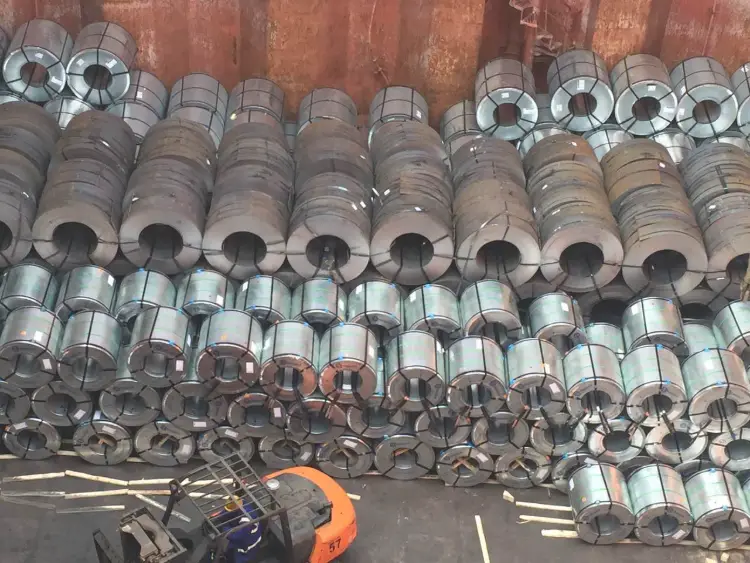
DIN 17155 HII Steel Coil for Gas Vessels
DIN 17155 HII Steel Coil for Gas Vessels – Composition, Properties & Equivalents
Comprehensive material data for DIN 17155 HII steel used in gas vessels: chemical composition, mechanical & thermal properties, fully equivalent grades, and application guidance.
Welding, bending, forming, machining, normalising
- Phone : +8618037372205
- Email : [email protected]
- WhatsApp: Contact via Whtsapp
- WeChat: +8618037372205
DIN 17155 HII Steel Coil for Gas Vessels Introduction
DIN 17155 HII is a carbon‑manganese steel originally specified for unfired pressure vessels, including gas containers and storage tanks. It features a balanced composition with controlled carbon, manganese and aluminium, ensuring good weldability and toughness at room temperature. The material is typically supplied in the normalised condition and exhibits a minimum yield strength of 265 MPa for thinner gauges. This grade has been historically used across European boiler and pressure equipment industries. The current replacement standard is EN 10028‑2:2017 under the designation P265GH, which maintains the same technical delivery conditions and mechanical requirements, allowing seamless substitution in most applications. Typical delivery forms include hot‑rolled coils and plates with improved surface quality suitable for forming and welding.
DIN 17155 HII Steel Coil for Gas Vessels Chemical Composition
Typical ladle analysis according to DIN 17155. Limits conform to the requirements for HII grade. Aluminium is added as grain refiner; residual elements are controlled to ensure weldability and notch toughness. Trace elements (Cr, Cu, Ni, Mo) are present only as impurities.
| Element | Standard Value | Remarks |
|---|---|---|
| C | ≤ 0.20 | maximum |
| Si | ≤ 0.35 | maximum |
| Mn | 0.50 – 1.40 | range |
| P | ≤ 0.030 | maximum |
| S | ≤ 0.025 | maximum |
| Al | ≥ 0.020 (acid‑soluble) | total aluminium may be higher |
| Cr | ≤ 0.30 | residual |
| Cu | ≤ 0.30 | residual |
| Ni | ≤ 0.30 | residual |
| Mo | ≤ 0.10 | residual |
| Nb | ≤ 0.01 | residual; not intentionally added |
| Ti | ≤ 0.03 | residual |
| V | ≤ 0.02 | residual |
DIN 17155 HII Steel Coil for Gas Vessels Thermal and Electrical Physical Properties
Typical values for carbon‑manganese steel relevant to gas vessel design. These data are not mandatory in the standard but represent commonly accepted reference values at room temperature unless a temperature range is given.
- Density is used for weight calculation.
- Elastic modulus and Poisson's ratio are essential for stress analysis.
- Thermal expansion and conductivity influence thermal stress and heat transfer.
- Electrical resistivity is provided for completeness.
| Property | Standard Reference Value | Unit | Test Condition |
|---|---|---|---|
| Density (ρ) | 7.85 | g/cm³ | at 20 °C |
| Elastic modulus (E) | 210 | GPa | at 20 °C |
| Shear modulus (G) | 81 | GPa | at 20 °C, calculated from E and ν |
| Poisson's ratio (ν) | 0.30 | — | at 20 °C, elastic range |
| Thermal expansion coefficient (α) | 11.5 × 10⁻⁶ | K⁻¹ | between 20 °C and 100 °C |
| Thermal conductivity (λ) | 50 | W/(m·K) | at 20 °C |
| Specific heat capacity (cp) | 460 | J/(kg·K) | at 20 °C to 100 °C |
| Electrical resistivity (ρₑ) | 0.18 × 10⁻⁶ | Ω·m | at 20 °C |
DIN 17155 HII Steel Coil for Gas Vessels Mechanical Properties
Properties obtained from normalised condition at room temperature, transverse test pieces. The values vary with product thickness.
- Yield strength (ReH) and tensile strength (Rm) decrease with increasing thickness.
- Elongation (A) is measured on a gauge length of 5.65√S₀ (proportional test piece).
- Impact energy (KV) is the minimum average of three Charpy‑V specimens at +20 °C.
- Bend test: mandrel diameter = 2.0 × thickness, 180° angle, no cracks allowed.
| Property | Standard Required Value | Unit | Test Condition |
|---|---|---|---|
| Yield strength (ReH) – t ≤ 16 mm | ≥ 265 | MPa | transverse, room temp. |
| Yield strength (ReH) – 16 < t ≤ 40 mm | ≥ 255 | MPa | transverse, room temp. |
| Yield strength (ReH) – 40 < t ≤ 60 mm | ≥ 245 | MPa | transverse, room temp. |
| Yield strength (ReH) – 60 < t ≤ 100 mm | ≥ 215 | MPa | transverse, room temp. |
| Tensile strength (Rm) – t ≤ 100 mm | 410 – 530 | MPa | transverse, room temp. |
| Elongation (A) – t ≤ 16 mm | ≥ 22 | % | proportional test piece L0=5.65√S₀ |
| Elongation (A) – 16 < t ≤ 40 mm | ≥ 22 | % | proportional test piece L0=5.65√S₀ |
| Elongation (A) – 40 < t ≤ 60 mm | ≥ 21 | % | proportional test piece L0=5.65√S₀ |
| Elongation (A) – 60 < t ≤ 100 mm | ≥ 21 | % | proportional test piece L0=5.65√S₀ |
| Charpy impact energy (KV₂) +20 °C | ≥ 27 (min. average) | J | transverse, 10×10 mm specimen |
| Bend test (180°) | d = 2.0t | — | no cracks, transverse specimen |
DIN 17155 HII Steel Coil for Gas Vessels Fully Equivalent Material Standards and Replacement Grades
| Country/Region | Standard | Grade | Remarks |
|---|---|---|---|
| European Union | EN 10028‑2:2017 | P265GH | Direct successor to DIN 17155 HII; identical chemical and mechanical requirements |
| United Kingdom | BS 1501‑1 | 161‑430A / 161‑430B | Historic grade with same strength class; 430A as‑rolled, 430B normalised |
| France | NF A36‑205 | A42CP | Pressure vessel steel; similar composition, normalised condition |
| USA / International | ASTM A516 | Grade 60 (or Gr. 415) | Carbon steel for moderate‑ and lower‑temperature service; min. tensile 415 MPa |
| Japan | JIS G3115 | SPV235 | Steel for pressure vessels at room temperature; yield ≥ 235 MPa, tensile 400‑510 MPa |
DIN 17155 HII Steel Coil for Gas Vessels Application Introduction
DIN 17155 HII has been extensively applied in the pressure vessel industry, particularly for the manufacture of gas storage cylinders and tanks where welding, forming and normalising are routine. It is suitable for moderate operating temperatures (typically –10 °C to +400 °C) and non‑corrosive service.
- Coil form enables efficient fabrication of cylindrical shells and heads by rolling and pressing.
- The guaranteed impact toughness at room temperature ensures safe performance under static and cyclic loads.
- Modern equivalents like EN 10028‑2 P265GH allow continued use under current pressure equipment directives.
Product Applications: Above‑ground LPG storage tanks, Underground gas vessels, Air receivers (compressed air storage), Boiler steam drums, Process columns and knock‑out drums
Processed into products: Cylindrical shell courses (rolled and welded from coil/plate), Dished and hemispherical heads (pressed or spun), Nozzle reinforcements and manway plates, Support skirts and saddles, Flanges and backing rings (when machined from plate)
Application industries: Oil & gas (storage and transportation of LPG, LNG, industrial gases), Chemical/petrochemical (reactors, separators, buffer vessels), Power generation (boiler drums, feedwater tanks), Industrial gas supply (air receivers, nitrogen tanks), Cryogenics (only for non‑low‑temperature applications)
DIN 17155 HII Steel Coil for Gas Vessels Closely Similar Alternative Materials
| Country/Region | Standard | Grade | Remarks |
|---|---|---|---|
| European Union | EN 10028‑2 | P295GH | Higher strength (ReH ≥ 295 MPa); weldability similar but requires adjusted welding parameters |
| USA / International | ASTM A516 | Grade 65 (Gr. 450) | Higher tensile strength range (450‑585 MPa); may require design re‑approval |
| USA / International | ASME SA‑516 | Grade 70 (Gr. 485) | Widely used for pressure vessels; stronger than HII, needs verification for gas vessel codes |
| China | GB/T 713 | Q245R | Carbon steel for pressure vessels; very close chemistry, but strength slightly lower (Rm 400‑520 MPa) |
Notes:
Important note: DIN 17155 was officially withdrawn and replaced by EN 10028‑2. When specifying HII for new designs, use the current EN 10028‑2 grade P265GH. For existing equipment, revision documents are still acceptable.
- Welding consumables should match the base metal strength, e.g., E7018 or ER70S‑6 type electrodes.
- Post‑weld heat treatment may be required depending on thickness and service code.
- Third‑party certification (e.g., TÜV, Lloyd's Register) was often mandated for pressure‑retaining parts.
- Share



