
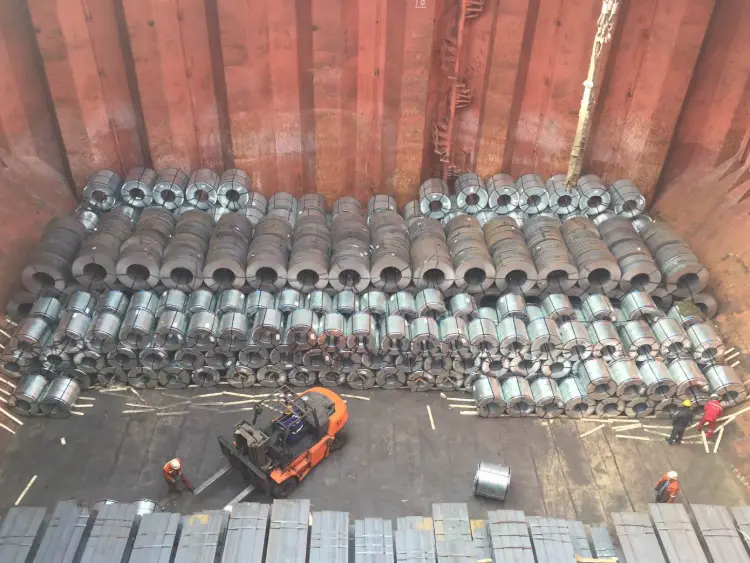
DIN 17155 17Mn4 Steel Coil for Gas Vessels
DIN 17155 17Mn4 Steel Coil for Gas Vessels - Properties, Equivalents & Applications
Comprehensive datasheet of DIN 17155 17Mn4 steel coil for gas vessels: chemical composition, mechanical and physical properties, international equivalents, and industry-specific applications.
Hot rolling, Normalizing, Cold forming, Welding, Machining
- Phone : +8618037372205
- Email : [email protected]
- WhatsApp: Contact via Whtsapp
- WeChat: +8618037372205
DIN 17155 17Mn4 Steel Coil for Gas Vessels Introduction
DIN 17155 17Mn4 is a normalizing fine-grain carbon-manganese steel originally specified in the German standard DIN 17155 for elevated-temperature pressure vessels and gas storage applications. It offers a balanced combination of strength, ductility, and weldability, with a minimum yield strength of 275 MPa in thinner sections and a tensile strength range of 460–580 MPa. The steel is typically supplied in the normalized condition (N) to guarantee uniform mechanical properties and fine grain structure. Its chemical composition is carefully controlled: carbon content is limited to max 0.20%, manganese between 0.90–1.50%, and low residuals of phosphorus and sulfur. Aluminum is often added as a grain refiner.
- Designed for service temperatures up to about 400°C
- Good notch toughness at ambient and moderately low temperatures
- Excellent forming and welding characteristics
- Widely used for cylindrical shells, dished ends, and flat plates of gas vessels and boilers
The standard has been superseded by EN 10028-2, where the nearest equivalent is P295GH.
DIN 17155 17Mn4 Steel Coil for Gas Vessels Chemical Composition
The chemical composition of 17Mn4 according to DIN 17155 is a controlled C-Mn steel with micro-alloying. Carbon is kept low to ensure weldability, while manganese provides strength. Phosphorus and sulfur are restricted to prevent hot shortness and improve toughness. Aluminum is often added to obtain a fine austenitic grain size. Residual elements such as Cr, Ni, Cu, and Mo are limited.
| Chemical Element | Standard Value (wt%) | Remarks |
|---|---|---|
| Carbon (C) | ≤0.20 | Typical range 0.14–0.20 |
| Silicon (Si) | 0.10–0.40 | |
| Manganese (Mn) | 0.90–1.50 | Key strengthening element |
| Phosphorus (P) | ≤0.035 | Maximum value |
| Sulfur (S) | ≤0.030 | Maximum value |
| Chromium (Cr) | ≤0.30 | Residual element |
| Nickel (Ni) | ≤0.30 | Residual element |
| Molybdenum (Mo) | ≤0.08 | Residual element |
| Copper (Cu) | ≤0.30 | Residual element |
| Aluminum (Al total) | ≥0.020 | Often 0.020–0.050 for grain refinement |
| Nitrogen (N) | ≤0.012 | Max, if not bound by Al |
| Vanadium (V) | ≤0.02 | Usually not intentionally added |
| Niobium (Nb) | ≤0.01 | Residual |
| Titanium (Ti) | ≤0.03 | Residual |
DIN 17155 17Mn4 Steel Coil for Gas Vessels Thermal and Electrical Physical Properties
These physical data are typical for C-Mn pressure vessel steel like 17Mn4. Values vary with temperature; the table shows the most commonly used ranges. Density is assumed constant. Modulus of elasticity and shear modulus decrease slightly with temperature. Thermal conductivity and specific heat capacity are important for heat-transfer calculations in vessel design.
| Property | Typical Value | Unit | Test Condition |
|---|---|---|---|
| Density (ρ) | 7.85 | g/cm³ | at 20 °C |
| Modulus of elasticity (E) | 210 | GPa | at 20 °C |
| Modulus of elasticity (E) | 205 | GPa | at 200 °C |
| Modulus of elasticity (E) | 195 | GPa | at 300 °C |
| Modulus of elasticity (E) | 185 | GPa | at 400 °C |
| Shear modulus (G) | 81 | GPa | at 20 °C |
| Poisson's ratio (ν) | 0.3 | – | at 20 °C |
| Thermal expansion coefficient (α) | 12.0 x 10⁻⁶ | K⁻¹ | 20–100 °C |
| Thermal expansion coefficient (α) | 12.5 x 10⁻⁶ | K⁻¹ | 20–200 °C |
| Thermal expansion coefficient (α) | 13.0 x 10⁻⁶ | K⁻¹ | 20–300 °C |
| Thermal expansion coefficient (α) | 13.5 x 10⁻⁶ | K⁻¹ | 20–400 °C |
| Thermal expansion coefficient (α) | 14.0 x 10⁻⁶ | K⁻¹ | 20–500 °C |
| Thermal conductivity (λ) | 51 | W/(m·K) | at 20 °C |
| Thermal conductivity (λ) | 50 | W/(m·K) | at 100 °C |
| Thermal conductivity (λ) | 48 | W/(m·K) | at 200 °C |
| Thermal conductivity (λ) | 45 | W/(m·K) | at 300 °C |
| Thermal conductivity (λ) | 42 | W/(m·K) | at 400 °C |
| Thermal conductivity (λ) | 38 | W/(m·K) | at 500 °C |
| Specific heat capacity (c) | 460 | J/(kg·K) | at 20 °C |
| Specific heat capacity (c) | 480 | J/(kg·K) | at 100 °C |
| Specific heat capacity (c) | 500 | J/(kg·K) | at 200 °C |
| Specific heat capacity (c) | 530 | J/(kg·K) | at 300 °C |
| Specific heat capacity (c) | 570 | J/(kg·K) | at 400 °C |
| Specific heat capacity (c) | 610 | J/(kg·K) | at 500 °C |
| Electrical resistivity (ρ_e) | 0.20 | μΩ·m | at 20 °C |
DIN 17155 17Mn4 Steel Coil for Gas Vessels Mechanical Properties
These properties apply to 17Mn4 plates and coils in the normalized (+N) delivery condition. Yield strength and tensile strength decrease with increasing product thickness. Elongation is measured on a gauge length of 5.65√S₀. Bend test is performed with 180° bending; the mandrel diameter depends on thickness. Impact energy is often required for pressure vessels; the value shown is a common specification at room temperature.
| Property | Standard Requirement | Unit | Test Condition / Thickness |
|---|---|---|---|
| Yield strength (ReH) | ≥275 | MPa | t ≤ 16 mm |
| Yield strength (ReH) | ≥265 | MPa | 16 < t ≤ 40 mm |
| Yield strength (ReH) | ≥255 | MPa | 40 < t ≤ 60 mm |
| Yield strength (ReH) | ≥235 | MPa | 60 < t ≤ 100 mm |
| Yield strength (ReH) | ≥215 | MPa | 100 < t ≤ 150 mm |
| Tensile strength (Rm) | 460–580 | MPa | t ≤ 40 mm |
| Tensile strength (Rm) | 440–570 | MPa | 40 < t ≤ 60 mm |
| Tensile strength (Rm) | 430–560 | MPa | 60 < t ≤ 100 mm |
| Tensile strength (Rm) | 420–550 | MPa | 100 < t ≤ 150 mm |
| Elongation (A) | ≥22 | % | t ≤ 40 mm (transverse, L₀ = 5.65√S₀) |
| Elongation (A) | ≥21 | % | 40 < t ≤ 60 mm |
| Elongation (A) | ≥20 | % | 60 < t ≤ 100 mm |
| Elongation (A) | ≥19 | % | 100 < t ≤ 150 mm |
| Bend test (mandrel diameter) | d = 2a | t ≤ 60 mm, 180° no cracks | |
| Bend test (mandrel diameter) | d = 3a | 60 < t ≤ 100 mm | |
| Bend test (mandrel diameter) | d = 4a | 100 < t ≤ 150 mm | |
| Impact energy (KV, transverse) | ≥27 | J | at 20 °C (if specified, typical for thickness ≥ 10 mm) |
DIN 17155 17Mn4 Steel Coil for Gas Vessels Identical/Equivalent Material Standards and Grades
| Country / Region | Standard | Grade | Remarks |
|---|---|---|---|
| Europe | EN 10028-2 | P295GH | Direct successor; also for pressure purposes, room/elevated temperature |
| International | ISO 9328-2 | P295 | Similar chemical and mechanical requirements |
| France | NF A36-205 | A 42 CP | Former French boiler steel, closely related |
| United Kingdom | BS 1501 | 224-460A | Historical UK equivalent for boilers (now obsolete) |
| Italy | UNI 5869 | Fe 460-2 KW | Comparable Italian pressure vessel steel |
| Japan | JIS G3103 | SB 450 | Approximate equivalent (yield and tensile similar) |
DIN 17155 17Mn4 Steel Coil for Gas Vessels Application Introduction
17Mn4 steel coil (plate) is primarily designed for welded pressure vessels and gas storage systems operating at elevated temperatures. Its good hot formability, weldability, and reliable elevated-temperature strength make it suitable for a range of industrial equipment. Typical service temperature up to 400°C. It can be used in both onshore and offshore installations where moderate notch toughness is required.
Product Applications: Gas cylinders and storage tanks (horizontal and vertical), Air receivers and compressed air vessels, Boiler drums, shells and pressure chambers, Heat exchanger shells and tube sheets, Autoclaves and sterilizers, Industrial separators and knock-out drums
Processed into products: Cylindrical vessel shells (rolled and welded), Dished ends (torispherical, hemispherical, ellipsoidal), Flat ends (circular blanks), Flanges (slip-on, weld neck, blind), Manholes and reinforcement pads, Internal support structures and baffles, Hexagonal or rectangular plate packs for modular vessels
Application industries: Oil & gas processing, Petrochemical and chemical plants, Power generation (boilers, heat recover steam generators), Industrial gas manufacturing and storage, LPG / LNG transportation and storage, Water treatment pressure vessels
DIN 17155 17Mn4 Steel Coil for Gas Vessels Approximate Alternative Materials
| Country / Region | Standard | Grade | Remarks |
|---|---|---|---|
| USA | ASTM A516 / A516M | Grade 65 | Slightly higher carbon, similar strength; used for moderate/low-temperature vessels |
| China | GB/T 713 | Q245R | Carbon-manganese steel boiler/ pressure vessel plate; yield ~245 MPa |
| Japan | JIS G3103 | SB410 | Lower strength class, but often used for similar applications with adjustments |
| Russia | GOST 5520 | 16K | Similar carbon-manganese steel for boilers and vessels |
| India | IS 2002 | Gr. 410 / Gr. 450 | C-Mn steels for pressure vessels, partial match |
Notes:
Important notices:
- DIN 17155 has been officially withdrawn; the current standard for pressure vessel plates is EN 10028-2, with grade P295GH. When ordering, use the EN designation unless a customer's specification explicitly calls for the old DIN grade.
- Normalizing is mandatory to achieve notch toughness and grain refinement. If hot forming is performed, re-normalizing may be required.
- For hydrogen service (e.g., wet H₂S), additional requirements such as HIC/SSC testing per NACE MR0175 may be needed.
- The welding procedure should use low-hydrogen electrodes or filler metals and may require preheating (typically 100–150°C) depending on thickness.
- Post-weld heat treatment (PWHT) is often applied to relieve residual stresses, especially for thick sections.
- Share



