
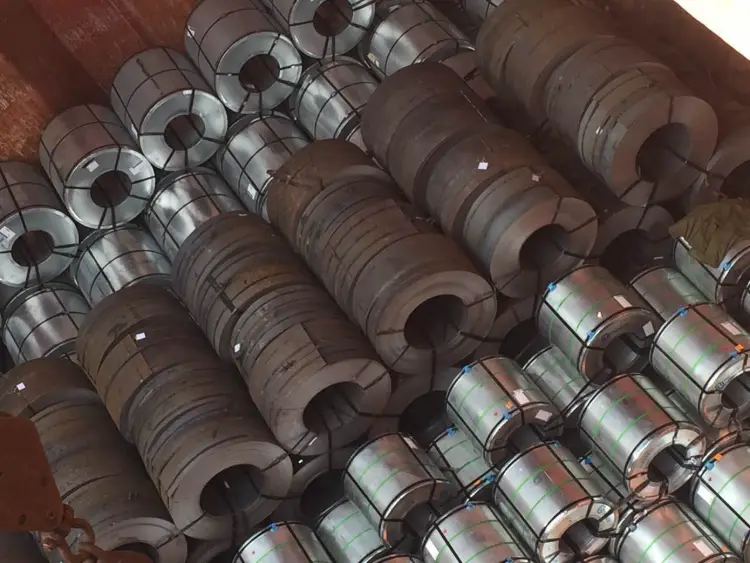
EN 10120 P355NB Steel Coil
P355NB Steel Coil: EN 10120 for Welded Gas Cylinders
Detailed analysis of P355NB steel grade according to EN 10120, including composition, mechanical and physical properties, equivalents, and application guide for welded gas cylinders.
Welding, cold and hot forming, deep drawing, bending, normalizing
- Phone : +8618037372205
- Email : [email protected]
- WhatsApp: Contact via Whtsapp
- WeChat: +8618037372205
EN 10120 P355NB Steel Coil Introduction
P355NB is a weldable fine-grain structural steel grade defined in EN 10120, specifically designed for the manufacture of welded gas cylinders. It is supplied in the normalized or normalizing rolled condition ('NB'), ensuring a uniform microstructure with excellent toughness, ductility, and weldability. Typical applications include cylinders for industrial gases, medical oxygen, and liquefied petroleum gas (LPG). The steel offers a minimum yield strength of 355 MPa for thicknesses up to 16 mm, coupled with guaranteed impact energy at -20°C, making it suitable for pressure vessels subjected to moderate stress and low temperatures. Its chemical composition is microalloyed with niobium, vanadium, and/or titanium for grain refinement, achieving a fine-grained structure that enhances both strength and fracture resistance. The delivery condition is usually as-rolled and normalized or normalizing rolled, with surfaces suitable for subsequent forming and welding operations.
EN 10120 P355NB Steel Coil Chemical Composition
The following chemical composition is based on EN 10120:2008 for steel grade P355NB. The steel is typically aluminum-killed and microalloyed with niobium, vanadium, and/or titanium to achieve fine grain refinement and improve mechanical properties. Residual elements are strictly controlled to ensure weldability and toughness.
| Chemical Element | Standard Value (wt%) | Remarks |
|---|---|---|
| Carbon (C) | ≤ 0.20 | Ladle analysis |
| Silicon (Si) | ≤ 0.40 | Deoxidation and strength |
| Manganese (Mn) | 0.90 – 1.65 | Enhances strength and hardenability |
| Phosphorus (P) | ≤ 0.025 | Strictly limited for toughness |
| Sulfur (S) | ≤ 0.015 | Low sulfur for improved cleanliness |
| Aluminum (Al_total) | ≥ 0.020 | Grain refining and deoxidation; total content |
| Niobium (Nb) | ≤ 0.05 | Grain refinement and precipitation strengthening |
| Vanadium (V) | ≤ 0.02 | Optional microalloying element |
| Titanium (Ti) | ≤ 0.04 | Optional grain refiner and nitrogen scavenger |
| Nitrogen (N) | ≤ 0.012 | Controlled to avoid strain aging |
| Chromium + Copper + Nickel + Molybdenum (Cr+Cu+Ni+Mo) | ≤ 0.70 | Residual elements; sum controlled for weldability |
| * | Nb+V+Ti ≤ 0.12 | Sum of microalloying elements if added in combination |
EN 10120 P355NB Steel Coil Thermal and Electrical Physical Properties
The following physical properties are typical for P355NB steel at room temperature (20°C) unless otherwise noted. These values are based on generic data for carbon‑manganese steels and are not mandated by the standard but are essential for design and manufacturing. Variations may occur due to actual composition and heat treatment.
| Property | Typical Value | Unit | Test Condition |
|---|---|---|---|
| Density (ρ) | 7.85 | g/cm³ | Room temperature |
| Modulus of elasticity (E) | 210 | GPa | Tension, 20°C |
| Shear modulus (G) | approx. 80 | GPa | 20°C |
| Poisson's ratio (ν) | 0.3 | — | Elastic range |
| Thermal expansion coefficient (α) | 11.1 | 10⁻⁶/K | 20–100°C |
| Thermal expansion coefficient (α) | 12.1 | 10⁻⁶/K | 20–200°C |
| Thermal expansion coefficient (α) | 13.1 | 10⁻⁶/K | 20–300°C |
| Thermal conductivity (λ) | 50 – 52 | W/(m·K) | 20°C |
| Specific heat capacity (cp) | 460 – 480 | J/(kg·K) | 20°C |
| Electrical resistivity (ρ_e) | approx. 0.22 | 10⁻⁶ Ω·m | 20°C |
EN 10120 P355NB Steel Coil Mechanical Properties
Mechanical properties according to EN 10120 for grade P355NB in normalized or normalizing rolled condition. Values are guaranteed for transverse test specimens (unless stated otherwise) and apply to steel with thicknesses as indicated. The steel demonstrates a good balance of strength, ductility, and low-temperature toughness.
| Property | Standard Requirement | Unit | Test Condition |
|---|---|---|---|
| Yield strength (ReH) | ≥ 355 | MPa | Transverse, nominal thickness ≤ 16 mm |
| Yield strength (ReH) | ≥ 345 | MPa | Transverse, 16 mm < t ≤ 40 mm |
| Tensile strength (Rm) | 490 – 630 | MPa | Transverse, all thicknesses up to 40 mm |
| Elongation (A) | ≥ 22 (longitudinal); ≥ 20 (transverse) | % | Gauge length 5.65√So or 80 mm, t ≤ 40 mm |
| Bend test | D = 2a, 180° no cracking | — | Bend test mandrel diameter (a = specimen thickness) |
| Impact energy (KV) at -20°C | ≥ 27 (longitudinal) | J | Thickness ≥ 6 mm; longitudinal direction |
| Impact energy (KV) at -20°C | ≥ 16 (transverse) | J | Thickness ≥ 6 mm; transverse direction |
EN 10120 P355NB Steel Coil Fully Equivalent Standards and Substitute Grades
The following international standards and grades are fully equivalent to P355NB according to EN 10120. They are designed for the same application—welded gas cylinders—and share identical chemical and mechanical requirements.
| Country/Region | Standard | Grade | Remarks |
|---|---|---|---|
| International | ISO 4978:2018 | PH355 | Identical; direct replacement for EN 10120 P355NB |
| Germany | DIN EN 10120 | P355NB | National adoption of European standard |
| United Kingdom | BS EN 10120 | P355NB | Identical under British standard |
| France | NF EN 10120 | P355NB | Identical under French standard |
| Italy | UNI EN 10120 | P355NB | Identical under Italian standard |
| Spain | UNE EN 10120 | P355NB | Identical under Spanish standard |
EN 10120 P355NB Steel Coil Application Introduction
P355NB steel is purpose-designed for the fabrication of welded gas cylinders where reliable pressure containment, good impact toughness at low temperatures, and excellent weldability are essential. The normalized microstructure ensures homogeneous properties across thicknesses, making it ideal for cold and hot forming processes such as deep drawing of cylinder shells and forming of heads.
Product Applications: High-pressure welded cylinders for oxygen, acetylene, argon, helium, LPG storage and transport cylinders, CNG type 1 (all-steel) cylinders for vehicles, Refillable fire extinguisher bodies, Intermediate bulk containers and tonners for compressed industrial gases
Processed into products: Cylinder shell (body) manufactured by rolling and longitudinal welding, Cold-formed or hot-pressed cylinder heads (bottom and top parts), Neck rings and embossed base plates, Cylinder body segments for multi-piece welded designs, Seamless ring segments for certain cylinder types (when welded from plate)
Application industries: Industrial gas manufacturing and distribution, Medical and healthcare gas supply (oxygen, nitrogen, nitrous oxide), Liquefied Petroleum Gas (LPG) for domestic and commercial use, Compressed Natural Gas (CNG) for automotive fuel storage, Fire extinguisher and safety equipment production
EN 10120 P355NB Steel Coil Similar or Substitution Materials
In cases where an exact P355NB equivalent is not available, the following grades offer comparable strength and toughness, though they may differ in specific application requirements or certification for gas cylinder use.
| Country/Region | Standard | Grade | Remarks |
|---|---|---|---|
| Europe | EN 10028-3 | P355N | Pressure vessel steel with same minimum yield strength (355 MPa) and impact properties at -20°C; may require additional verification for gas cylinder codes. |
| China | GB/T 6653 | HP345 | Welded gas cylinder steel with yield strength ≥ 345 MPa and similar weldability; slightly lower strength compared to P355NB but widely used for LPG cylinders. |
| USA | ASTM A414 / A414M | Grade D (275 MPa yield) / Grade E (310 MPa yield) | Pressure vessel sheet. Significantly lower strength levels; only partial substitute when design allows; typically not recognized for gas cylinder fabrication without additional qualification. |
| Japan | JIS G3116 | SG365 | Steel sheet for gas cylinders with minimum tensile strength 500 MPa and yield approx. 365 MPa; chemistry and impact values differ, but suitable for some welded cylinder applications after assessment. |
Notes:
Additional Information:
- The steel is normally supplied in the as-normalized or normalizing rolled condition; additional heat treatment after welding (e.g., stress relieving) may be required depending on cylinder design codes (e.g., TPED, DOT, ISO 9809-1).
- Surface quality and internal integrity are governed by EN 10120, ensuring freedom from laminations and defects that could compromise pressure vessel safety.
- For cylinder manufacturing, post-weld heat treatment (PWHT) at 580–620°C is commonly applied to relieve residual stresses and restore toughness.
- The steel can be used for cylinder operating temperatures down to -20°C (or -50°C with additional process qualification) because of its guaranteed impact toughness at low temperatures.
- Fabrication processes such as welding, deep drawing, bending, and re-rolling are all compatible, provided forming temperatures remain below the normalizing temperature to avoid grain coarsening.
- Share



