
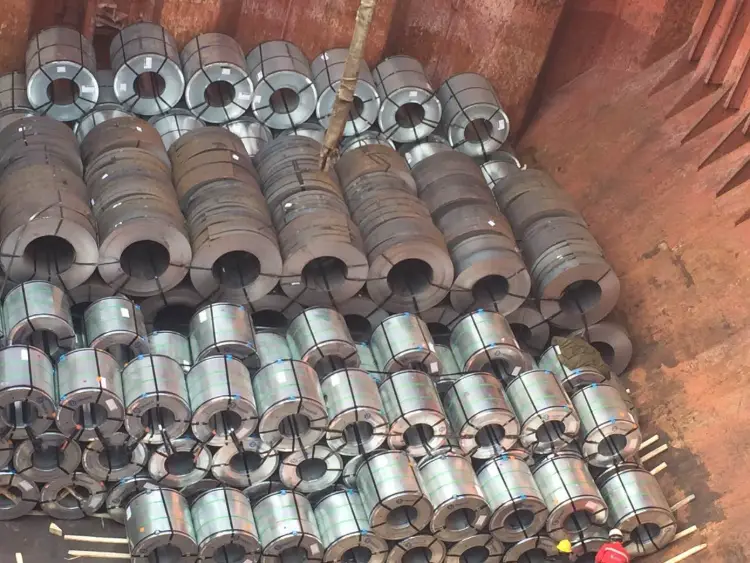
EN 10120 P310NB Steel Coil
EN 10120 P310NB Steel Coil: High-Strength Gas Cylinder Steel for Welded Pressure Vessels
P310NB is a normalized rolled fine–grain steel for welded gas cylinders, offering a minimum yield strength of 310 MPa combined with excellent formability and low–temperature toughness.
Normalized rolling (+N); suitable for cold forming, deep drawing, bending, and all common welding processes (MAG, SAW, resistance welding)
- Phone : +8618037372205
- Email : [email protected]
- WhatsApp: Contact via Whtsapp
- WeChat: +8618037372205
EN 10120 P310NB Steel Coil Introduction
EN 10120 P310NB is a weldable fine–grain carbon–manganese steel supplied as coils or sheets for the manufacture of welded gas cylinders. It is produced in a normalized or normalized rolled condition (+N) to achieve a uniform ferritic–pearlitic microstructure. The steel guarantees a minimum yield strength of 310 MPa for thicknesses up to 16 mm and tensile strength in the range of 440–560 MPa. Its chemistry is microalloyed with niobium, vanadium, and titanium to refine the grain size, thereby improving both strength and notch toughness. Typical applications include LPG cylinders, industrial gas bottles, and pressure accumulators. The material complies with the essential safety requirements of the European Pressure Equipment Directive (PED) and is readily formable by deep drawing, bending, and welding, making it a preferred choice for high–volume cylinder production.
EN 10120 P310NB Steel Coil Chemical Composition
The ladle analysis according to EN 10120:2008 ensures fine–grain strengthening and good weldability. Residual elements are controlled to maintain the specified mechanical properties and to avoid cracking during cold forming.
- Carbon is limited to 0.20 % max for weldability.
- Manganese provides solid–solution strengthening with a typical range of 0.50–1.20 %.
- Microalloying elements Nb, V, and Ti are added singly or in combination to achieve a minimum grain–size index of 6 or finer; their sum is restricted to 0.12 % max.
- Aluminium is required as a fine–grain refiner and deoxidising agent (Altot ≥ 0.015 %).
| Element | Standard Value (max unless range given) | Remarks |
|---|---|---|
| C (Carbon) | ≤ 0.20 | Required for hardenability; low level aids weldability |
| Si (Silicon) | ≤ 0.40 | Deoxidising element |
| Mn (Manganese) | 0.50 – 1.20 | Solid–solution strengthener |
| P (Phosphorus) | ≤ 0.025 | Residual; kept low for toughness |
| S (Sulfur) | ≤ 0.015 | Residual; reduced for HIC resistance |
| Altot (Total Aluminium) | ≥ 0.015 | Fine–grain practice |
| Nbb (Niobium) | ≤ 0.05 | Microalloying (optional) |
| Vb (Vanadium) | ≤ 0.02 | Microalloying (optional) |
| Tib (Titanium) | ≤ 0.03 | Microalloying (optional) |
| Nb+V+Tib | ≤ 0.12 | Combined sum limit |
| Cr (Chromium)c | ≤ 0.30 | Residual element |
| Ni (Nickel)c | ≤ 0.30 | Residual element |
| Mo (Molybdenum)c | ≤ 0.10 | Residual element |
| Cu (Copper)c | ≤ 0.35 | Residual element; Cu+10Sn ≤ 0.45% |
EN 10120 P310NB Steel Coil Thermal and Electrical Physical Properties
The data below represent typical values for fine–grain carbon–manganese steels in the normalized condition at ambient temperature unless a temperature range is stated. Slight variations may occur depending on actual heat analysis and processing history.
- Density is assumed to be 7.85 g/cm³ for all weight calculations.
- Young's modulus and shear modulus are standard for constructional steels.
- The mean coefficient of thermal expansion (α) is given for distinct temperature intervals relevant to welding and heating during forming.
- Thermal conductivity and electrical resistivity are temperature–dependent; the values at 20 °C and elevated temperatures illustrate the trend.
| Property | Typical Value | Unit | Test Condition / Temperature |
|---|---|---|---|
| Density (ρ) | 7.85 | g/cm³ | At 20 °C |
| Modulus of elasticity (E) | 210 | GPa | At 20 °C |
| Shear modulus (G) | 81 | GPa | At 20 °C |
| Poisson's ratio (ν) | 0.3 | – | At 20 °C |
| Coefficient of thermal expansion (α, mean) | 11.5 | 10⁻⁶/K | 20 – 100 °C |
| Coefficient of thermal expansion (α, mean) | 12.5 | 10⁻⁶/K | 20 – 200 °C |
| Coefficient of thermal expansion (α, mean) | 13.0 | 10⁻⁶/K | 20 – 300 °C |
| Thermal conductivity (λ) | 52 | W/(m·K) | At 20 °C |
| Thermal conductivity (λ) | 48 | W/(m·K) | At 200 °C |
| Thermal conductivity (λ) | 42 | W/(m·K) | At 400 °C |
| Specific heat capacity | 470 | J/(kg·K) | At 20 °C |
| Specific heat capacity | 520 | J/(kg·K) | At 300 °C |
| Electrical resistivity (ρ_e) | 0.22 | µΩ·m | At 20 °C |
EN 10120 P310NB Steel Coil Mechanical Properties
Mechanical properties are guaranteed at room temperature on the basis of transverse test pieces, unless otherwise specified. For coil material, tests are performed on flattened specimens. The EN 10120 standard defines property classes linked to the nominal thickness t (in mm).
- Yield and tensile values are valid for thicknesses up to 63 mm; the most common gas–cylinder thickness is ≤ 16 mm.
- Absorbed energy (KV) is measured on Charpy–V longitudinal specimens at –20 °C as a minimum, though a test at –40 °C may be agreed upon.
- Bend test using a 180° angle with a mandrel diameter related to the thickness confirms adequate formability.
| Property | Standard Requirement | Unit | Test Condition |
|---|---|---|---|
| Upper yield strength (ReH) | ≥ 310 | MPa | Thickness ≤ 16 mm, transverse |
| Upper yield strength (ReH) | ≥ 300 | MPa | 16 < t ≤ 40 mm |
| Upper yield strength (ReH) | ≥ 290 | MPa | 40 < t ≤ 63 mm |
| Tensile strength (Rm) | 440 – 560 | MPa | All thicknesses, transverse |
| Elongation after fracture (A) | ≥ 22 | % | L₀ = 5.65√S₀, t ≤ 16 mm |
| Elongation after fracture (A) | ≥ 21 | % | 16 < t ≤ 40 mm |
| Elongation after fracture (A) | ≥ 20 | % | 40 < t ≤ 63 mm |
| Charpy–V notch impact energy (KV) | ≥ 27 | J | –20 °C, longitudinal, average of 3 tests |
| Charpy–V notch impact energy (KV) | ≥ 40 (agreed) | J | Optional –40 °C test |
| Bend test (180°) | d = 2a | – | Mandrel diameter d = 2× thickness a, for t ≤ 16 mm |
| Bend test (180°) | d = 3a | – | For 16 < t ≤ 63 mm |
EN 10120 P310NB Steel Coil Exact Equivalent Material Standards and Substitutable Grades
| Country/Region | Standard | Grade | Remarks |
|---|---|---|---|
| International (ISO) | ISO 4978 | P310NB | Identical chemical and mechanical requirements; fully interchangeable |
| European Union | EN 10120:2008 | P310NB | Original standard; also covered by UKCA and pending national withdrawals |
| Germany | DIN EN 10120 | P310NB | European standard adopted as DIN EN 10120 |
| France | NF EN 10120 | P310NB | French national adoption; identical requirements |
| Italy | UNI EN 10120 | P310NB | Italian adoption |
| Spain | UNE EN 10120 | P310NB | Spanish adoption |
EN 10120 P310NB Steel Coil Application Introduction
P310NB steel coil is purpose–designed for the high–volume production of welded gas cylinders. Its balanced combination of strength and ductility, along with excellent low–temperature impact toughness, makes it safe and economical for pressure vessels containing liquefied or compressed gases.
- The fine–grain structure permits deep drawing and cold forming of cylinder halves without intermediate annealing.
- Excellent weldability allows for high–speed automated welding of longitudinal and circumferential seams, often without preheating for thicknesses up to 10–12 mm.
- Strict impurity control (low S and P) and microalloying ensure a long service life under cyclic pressure loading.
Product Applications: Domestic and commercial LPG cylinders (standard and composite designs), High–pressure seamless–welded industrial gas bottles (up to 150–200 bar working pressure), Acetylene dissolved cylinders (10–40 L water capacity), Ammonia storage and transport vessels, Fire extinguisher steel bodies (CO₂, powder, foam types)
Processed into products: Cylinder shell halves (deep–drawn cups), Flash–butt welded cylindrical sections (longitudinal seams), Circumferential girth–welded assemblies (shell + base ring + collar), Cylinder end caps and foot rings (stamped and welded), Valve bosses and neck ring components (high–strength filler wire needed for welding)
Application industries: LPG cylinder manufacturing, Welded industrial gas cylinder production (oxygen, nitrogen, argon, acetylene), Fire extinguisher shell production, Pressure accumulator and hydraulic tank fabrication, Automotive CNG/LNG cylinder production (secondary regulation may apply)
EN 10120 P310NB Steel Coil Similar / Alternative Materials Recommendation
| Country/Region | Standard | Grade | Remarks |
|---|---|---|---|
| China | GB/T 6653-2017 | HP325 | Yield ≥ 325 MPa, tensile 460–590 MPa; slightly higher strength; commonly used for welded gas cylinders in China |
| Japan | JIS G3116:2020 | SG325 | Yield ≥ 325 MPa, tensile ≥ 460 MPa; for gas cylinders for LPG and similar services; similar weldability and formability |
| USA | ASTM A414/A414M | Grade G | Yield ≥ 310 MPa, tensile 485–620 MPa; pressure vessel steel for moderate and lower temperature service; available but not specifically a gas cylinder standard |
| USA | ASTM A455 | Type II | High–strength C–Mn steel plate intended for pressure vessels; yield ≥ 290 MPa (thickness–dependent); need careful assessment if used for gas cylinders |
| Korea | KS D 3631 | SG325 | Korean adoption of JIS G3116; identical grade designation |
| India | IS 6240 | Grade 325 | Steel plates for LPG cylinders; yield ≥ 325 MPa; often produced to comparable chemistry |
Notes:
Additional Information:
- P310NB is typically supplied with a 3.1 inspection certificate according to EN 10204, confirming compliance with EN 10120 and any supplementary requirements.
- For thickness > 8 mm and demanding service (e.g., low–temperature or high–cyclic fatigue), step cooling (normalizing heat treatment) after forming may be specified by the cylinder design code.
- Standard coil width ranges from 900 mm to 2000 mm, with thickness from 1.4 mm up to 6.0 mm (coil) and additionally up to 40 mm in cut–to–length sheets for thicker components.
- Surface quality: class A or B as per EN 10163-2; when ordering, confirm the required surface condition (e.g., shot–blasted and oiled) to avoid rust during transit.
- If the cylinder will be subjected to sour gas service (H₂S), additional limits on S ≤ 0.003 % and hydrogen–induced cracking (HIC) testing per NACE TM0284 may be required, which must be negotiated at the time of enquiry and order.
- Share



