
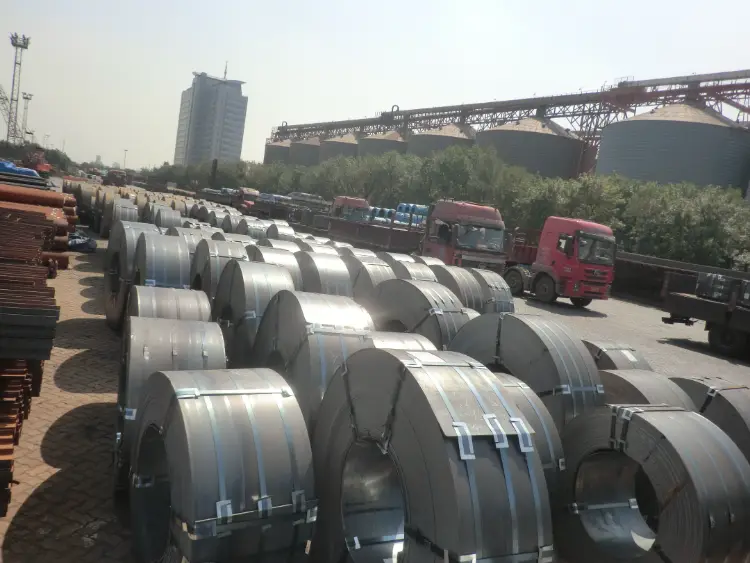
L485 (X70) Pipeline Steel Coil
L485 (X70) Pipeline Steel Coil - Comprehensive Datasheet per GB/T 14164-2013 PSL1
Detailed material data for L485 (X70) pipeline steel coil under Chinese standard GB/T 14164-2013 (PSL1). Includes chemical composition, mechanical and physical properties, international equivalents, and application guidance.
Hot rolling, controlled rolling, thermo-mechanical control processing (TMCP)
- Phone : +8618037372205
- Email : [email protected]
- WhatsApp: Contact via Whtsapp
- WeChat: +8618037372205
L485 Pipeline Steel Coil Introduction
L485 (X70) pipeline steel is a high-strength, low-alloy steel designed for oil and gas transmission pipelines. It is produced as hot-rolled wide strip (coil) and conforms to GB/T 14164-2013, which is derived from API 5L 45th edition. The steel offers a minimum yield strength of 485 MPa, excellent weldability, and good toughness under controlled rolling and cooling practices.
Typical applications include manufacturing of spiral-welded and longitudinal-welded pipes for high-pressure transmission of sour or sweet hydrocarbons. The material is supplied in the as-rolled or thermo-mechanically controlled processed (TMCP) condition, with chemical composition tailored to meet PSL1 requirements, leaving elements like Nb, V, Ti as optional additions for enhanced properties.
International equivalents include API 5L PSL1 X70 and ISO 3183 L485 PSL1.
L485 Pipeline Steel Coil Chemical Composition per GB/T 14164-2013 & API 5L 45th Ed. PSL1
The following elements are restricted by the standard for PSL1 L485/X70. The steelmaker may add microalloying elements such as Nb, V, Ti, or others to achieve the required mechanical properties, with the limits to be agreed upon. Carbon equivalent (CEpcm) is normally controlled for weldability, but not mandatory for PSL1.
Note: All values are maximum unless otherwise specified.
| Element | Standard Value (max, %) | Remarks |
|---|---|---|
| Carbon (C) | 0.28 | Maximum permissible content |
| Manganese (Mn) | 1.40 | Maximum permissible content |
| Phosphorus (P) | 0.030 | Maximum permissible content |
| Sulfur (S) | 0.030 | Maximum permissible content |
| Other elements (Nb, V, Ti, etc.) | As per agreement | Optional – determined by manufacturer |
L485 Pipeline Steel Coil Thermal and Electrical Physical Properties
The following physical properties are typical for a low-carbon, high-strength steel of this grade. Actual values may vary slightly depending on the final microstructure and processing history. These values are provided as reference for engineering calculations.
| Property | Typical Value | Unit | Remarks |
|---|---|---|---|
| Density (ρ) | 7.85 | g/cm³ | At 20 °C |
| Modulus of Elasticity (E) | 205 | GPa | At 20 °C |
| Shear Modulus (G) | 80 | GPa | At 20 °C |
| Poisson's Ratio (ν) | 0.30 | – | Elastic range |
| Coefficient of Thermal Expansion (α) | 11.7 × 10⁻⁶ | K⁻¹ | Between 20 °C and 100 °C |
| Thermal Conductivity (λ) | 42 | W/(m·K) | At 20 °C |
| Specific Heat Capacity | 460 | J/(kg·K) | At 20 °C |
| Electrical Resistivity (ρₑ) | 0.20 | µΩ·m | At 20 °C |
L485 Pipeline Steel Coil Mechanical Properties per GB/T 14164-2013 PSL1
Mechanical properties are determined on transverse test specimens taken from the coil body. For PSL1, only tensile testing is mandatory; Charpy V-notch impact testing and bend testing are not required unless specified by the purchaser.
Elongation values are calculated per the standard formula and are dependent on the specimen cross-sectional area and specified tensile strength.
| Property | Requirement | Unit | Test Condition |
|---|---|---|---|
| Yield Strength (ReH) | Min. 485 | MPa | Transverse, at room temperature |
| Tensile Strength (Rm) | Min. 570 / Max. 760 | MPa | Transverse, at room temperature |
| Elongation after fracture (A) | Determined by formula; typical Min. 18% for 12.7 mm thickness | % | Gauge length 50 mm, transverse specimen |
L485 Pipeline Steel Coil Identical / Fully Equivalent Standards and Substitutable Grades
| Country/Region | Standard | Grade | Remarks |
|---|---|---|---|
| United States / International | API 5L 45th Ed. (PSL1) | X70 | Completely interchangeable – same PSL1 requirements |
| International (ISO) | ISO 3183:2012 (PSL1) | L485 | Identical technical requirements to GB/T 14164 PSL1 L485 |
| Russia / CIS | ГОСТ Р 52079-2003 | К60 | Yield strength ~490 MPa; similar pipeline application, but check specifics |
L485 Pipeline Steel Coil Application Introduction
L485 (X70) pipeline steel coil is primarily used for manufacturing welded pipes and tubes for the energy sector. Its high strength and good toughness allow transportation of gas and oil under high pressure across long distances. The material can be converted into pipe using various welding processes and is also suitable for structural tubular applications.
Product Applications: Spiral submerged arc welded (SSAW) pipe, Longitudinal submerged arc welded (LSAW) pipe, Electric resistance welded (ERW) pipe, Line pipe for onshore/offshore pipelines, Casing and tubing pipes (if meeting supplementary requirements)
Processed into products: Pipe body and coils for pipe mills, Fittings such as elbows, tees, and reducers (fabricated from plate/coil), Flanges and connectors (sourced from the same material grade), Pipe piles and structural hollow sections
Application industries: Oil & Gas Transmission, Petrochemical Industry, Water Infrastructure (for structural or high-pressure water lines), Construction and Civil Engineering (pipe piles, structural supports)
L485 Pipeline Steel Coil Similar / Comparable Alternative Materials
| Country/Region | Standard | Grade | Remarks |
|---|---|---|---|
| United States / International | API 5L 45th Ed. (PSL2) | X70 (X70M/Q) | PSL2 version with stricter chemistry, toughness, and NDT requirements; may substitute PSL1 after agreement |
| European Union | EN 10208-2:2009 | L485MB | Equivalent to PSL2 level; requires impact test and has lower S, P limits; suitable replacement for demanding service |
| China | GB/T 14164-2013 (PSL2) | L485M (X70M) | National PSL2 version for more stringent applications, with guaranteed toughness |
Notes:
For PSL1 L485/X70, supplementary requirements like hydrogen-induced cracking (HIC) resistance, stress corrosion cracking (SCC) testing, or Charpy impact testing must be specifically agreed at the time of order. Carbon equivalent (CEpcm) is often restricted to ≤0.22% for weldability when specified. All data in this datasheet is based on the official GB/T 14164-2013 standard and its adopted API 5L 45th edition requirements. No unverified data is included.
- Share



