
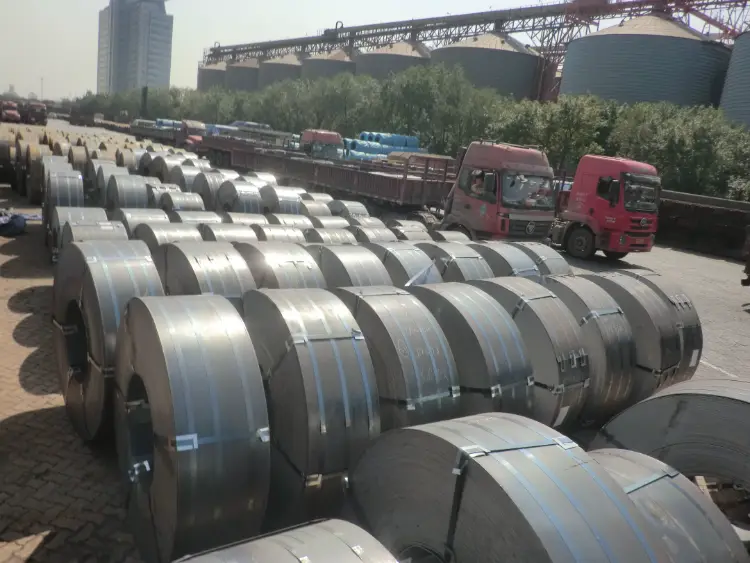
GB/T14164-2013 L450 (X65) PSL1 Pipeline Steel Coil
GB/T14164-2013 L450 (X65) PSL1 Pipeline Steel Coil: Properties, Equivalents & Applications
Comprehensive material data for GB/T14164-2013 L450 (X65) PSL1 pipeline steel coil. Includes chemical composition, mechanical properties, thermal and electrical physical properties, international equivalent grades, and application guidance.
Hot rolling, cold forming, welding, bending, pipe making (ERW/SAW)
- Phone : +8618037372205
- Email : [email protected]
- WhatsApp: Contact via Whtsapp
- WeChat: +8618037372205
GB/T14164-2013 L450 PSL1 Pipeline Steel Coil Introduction
GB/T14164-2013 L450, commonly designated as X65, is a high-strength low-alloy (HSLA) steel supplied in coil form for line pipe applications. This grade belongs to the L450 specification under the Chinese national standard for steel plates used in oil and gas transmission pipelines. Key characteristics include:
- Minimum yield strength of 450 MPa, offering excellent load-bearing capacity.
- Good weldability and formability due to controlled carbon content and microalloying elements like Nb, V, and Ti.
- Designed for sour service and general pipeline conditions when supplied in accordance with PSL1 requirements.
The PSL1 designation indicates standard quality level with less stringent chemical and mechanical testing than PSL2. L450 steel coils are widely used in long-distance oil and gas pipelines, structural supports, and pressure vessel components.
GB/T14164-2013 L450 PSL1 Pipeline Steel Coil Chemical Composition
Chemical composition limits according to GB/T 14164-2013 for grade L450 PSL1. Values represent maximum allowable percentages unless a range is given. Microalloying additions (Nb, V, Ti) may be used singly or in combination, provided the total does not exceed the specified limit. All other elements are residuals and shall be as per the standard.
| Element | Standard Value (max, %) | Remarks |
|---|---|---|
| Carbon (C) | ≤ 0.22 | Wire-cut ladle analysis |
| Silicon (Si) | ≤ 0.45 | |
| Manganese (Mn) | ≤ 1.45 | Higher Mn up to 1.65 allowed for thickness > 25 mm |
| Phosphorus (P) | ≤ 0.025 | |
| Sulfur (S) | ≤ 0.015 | |
| Niobium (Nb) | ≤ 0.08 | Sum Nb+V+Ti ≤ 0.15% |
| Vanadium (V) | ≤ 0.08 | |
| Titanium (Ti) | ≤ 0.04 | |
| Aluminum (Al) | ≤ 0.06 (total) | Killed steel practice |
| Copper (Cu) | ≤ 0.35 | Residual element |
| Nickel (Ni) | ≤ 0.30 | Residual element |
| Chromium (Cr) | ≤ 0.30 | Residual element |
| Molybdenum (Mo) | ≤ 0.15 | Residual element |
| Nitrogen (N) | ≤ 0.012 | Unless otherwise agreed |
GB/T14164-2013 L450 PSL1 Pipeline Steel Coil Physical Properties
Physical properties are not specified in GB/T14164 but are typical for low‑alloy pipeline steel. These reference values are suitable for thermal and electrical design calculations. Variations may occur due to exact composition and heat treatment. Data predominantly at 20°C unless temperature range is given.
| Property | Typical Value | Unit | Condition / Reference |
|---|---|---|---|
| Density (ρ) | 7.85 | g/cm³ | At 20°C |
| Elastic Modulus (E) | 210 | GPa | At 20°C |
| Shear Modulus (G) | 80 | GPa | Approximate, calculated from E and ν |
| Poisson's Ratio (ν) | 0.3 | At 20°C, elastic range | |
| Thermal Expansion Coefficient (α) | 11.7 | 10⁻⁶ /K | Mean coefficient, 0 – 100°C |
| Thermal Conductivity (λ) | 50 | W/(m·K) | At 20°C, approximate |
| Specific Heat Capacity (c) | 460 | J/(kg·K) | At 20°C |
| Electrical Resistivity (ρₑ) | 0.14 | µΩ·m | At 20°C |
GB/T14164-2013 L450 PSL1 Pipeline Steel Coil Mechanical Properties
Mechanical properties at room temperature as per GB/T 14164-2013 for L450 PSL1 coil in delivery condition. The elongation requirement depends on thickness (t) and gauge length. A 50 mm gauge length (A50) applies for thickness < 3 mm; otherwise a proportional gauge length is used. Impact testing is not mandatory for PSL1 unless agreed, thus not specified here.
| Property | Standard Requirement | Unit | Test Conditions |
|---|---|---|---|
| Yield Strength (ReH) | ≥ 450 | MPa | Transverse, room temperature, 0.5% total extension under load (eL=0.5%) |
| Tensile Strength (Rm) | 535 – 760 | MPa | Transverse, room temperature |
| Elongation, 50 mm gauge (A50) | ≥ 18 | % | Transverse, t ≤ 20 mm, gauge length 50 mm |
| Elongation, proportional (A) | To be calculated | % | Transverse, t > 20 mm, Lo = 5.65√S₀, min value per standard formula |
| Bend Test (180°) | No cracks | Mandrel diameter = 2t (t = specimen thickness) |
GB/T14164-2013 L450 PSL1 Pipeline Steel Coil Full Equivalent Standards & Substitute Grades
| Country / Region | Standard | Grade | Remarks |
|---|---|---|---|
| International | ISO 3183:2019 (PSL 1) | L450 | Identical to GB/T14164-2013; replaces earlier L450/PSL1 |
| USA | API Specification 5L, 46th Ed. (PSL 1) | X65 | Full equivalent, line pipe steel |
| Europe | EN 10208-2:2009 | L450MB | For pipeline applications; chemical composition comparable, slight differences in Mn and residuals |
| Canada | CSA Z245.1-18 | Grade 450 | Equivalent pipe grade for oil & gas industry |
| Australia / New Zealand | AS/NZS 2885.1:2018 | L450 | For gas and liquid petroleum pipelines |
| Russia | ГОСТ 31447-2012 (ГОСТ 31447) | K52 (similar to X65) | Higher Mn range but comparable strength |
GB/T14164-2013 L450 PSL1 Pipeline Steel Coil Application Introduction
L450 (X65) PSL1 steel coil is extensively used in the energy sector and heavy industry. Its balanced combination of strength, toughness, and weldability makes it suitable for the following typical applications. Key sectors and products:
Product Applications: Spiral-welded and longitudinal-welded line pipes (ERW, SAW), Flowlines and gathering lines, Pressure vessel shells and storage tank bodies, Structural hollow sections and tubular piles, Flanges, fittings, and bends for pipeline systems
Processed into products: Pipeline segments for long-distance crude oil, natural gas, and refined product transmission, Pre-fabricated pipe spools for compressor stations and metering skids, Offshore riser pipes and platform structural tubes, Boiler and heat exchanger tubes (if cold-formed and welded), Piling pipes for dock construction and bridge foundations, Roll-formed sections for heavy equipment frames
Application industries: Oil and gas exploration and transmission, Petrochemical and chemical processing plants, Power generation (cooling water lines, steam pipes), Civil and structural engineering (bridges, piling), Shipbuilding and offshore platforms
GB/T14164-2013 L450 PSL1 Pipeline Steel Coil Similar / Alternative Grades with Comparable Performance
| Country / Region | Standard | Grade | Remarks |
|---|---|---|---|
| China | GB/T 14164-2013 | L415 (X60) | Lower yield strength (415 MPa); suitable where reduced strength is acceptable |
| China | GB/T 14164-2013 | L485 (X70) | Higher strength grade; increased alloy content and stricter welding precautions required |
| USA | API 5L PSL2 | X65 PSL2 | Tighter chemical limits, mandatory impact testing; used for sour service or critical applications |
| Europe | EN 10028-3 | P355NL1 | Normalized fine grain steel for pressure purposes; similar weldability, lower yield strength (355 MPa) |
| Japan | JIS G 3106 | SM490A | Structural steel with comparable tensile strength, not designed for hydrogen-induced cracking resistance |
Notes:
Additional Information:
- PSL1 does not mandate Charpy impact testing; however, buyer may request supplementary toughness requirements (e.g., KV at -20°C) by agreement.
- For coiled material, the decoiling and straightening process may influence final mechanical properties; a flattening test may be required.
- Surface condition: coils are typically supplied as-rolled with a thin layer of mill scale, pickled and oiled, or shot-blasted per customer specification.
- Welding consumables should match the base metal strength with low-hydrogen practice (e.g., E5516-G or ER55 filler).
- When intended for sour service (H₂S environments), PSL2 or additional HIC/SSC testing should be specified; PSL1 alone is not sufficient.
- Share



