
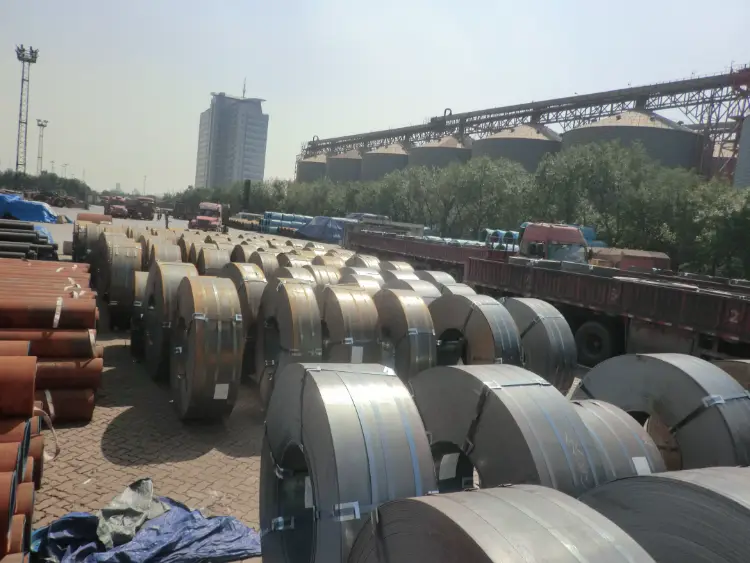
GB/T14164-2013 L415 (X60) Pipeline Steel Coil
GB/T14164-2013 L415 (X60) Pipeline Steel Coil - Full Material Datasheet
Comprehensive material data for L415 (X60) pipeline steel coil according to GB/T14164-2013, including chemical composition, mechanical and thermal properties, equivalent grades, and application guide.
Hot rolling, controlled rolling, thermomechanical controlled processing (TMCP); suitable for spiral-welded or longitudinal-welded pipe forming.
- Phone : +8618037372205
- Email : [email protected]
- WhatsApp: Contact via Whtsapp
- WeChat: +8618037372205
GB/T14164-2013 L415 Pipeline Steel Coil Introduction
L415, commonly designated as X60, is a high-strength low-alloy (HSLA) steel primarily used for line pipe in oil, gas, and water transportation. Conforming to GB/T14164-2013 (equivalent to API 5L PSL1), this grade offers a minimum yield strength of 415 MPa and good weldability.
- Produced as hot-rolled coil suitable for subsequent pipe manufacturing.
- Typical microstructure consists of ferrite and pearlite with controlled grain refinement via microalloying.
- Designed for moderate sour service and high-pressure transmission applications.
- Excellent balance of strength, toughness, and formability under controlled rolling conditions.
GB/T14164-2013 L415 Pipeline Steel Coil Chemical Composition
Values are maximum unless a range is given. The steel is microalloyed with Nb, V, and/or Ti to achieve mechanical properties. The sum of Nb+V+Ti shall not exceed 0.15%. Other elements may be present but are not intentionally added.
- Carbon equivalent (CEIIW) typically ≤0.43 to ensure good field weldability.
- Strictly controlled P and S for improved toughness and resistance to hydrogen-induced cracking.
| Element | Content (wt%) | Notes |
|---|---|---|
| C | ≤0.26 | Max for both heat and product analysis |
| Mn | ≤1.40 | Product analysis max 1.45 % |
| Si | ≤0.40 (typical 0.15–0.35) | Added for deoxidation; not mandatory |
| P | ≤0.030 | Max for improved toughness |
| S | ≤0.030 | Max for resistance to cracking |
| Nb+V+Ti | ≤0.15 | Sum of microalloying elements; individual limits per manufacturer |
| Cu | ≤0.50 | Only if added intentionally |
| Ni | ≤0.50 | Only if added intentionally |
| Cr | ≤0.50 | Only if added intentionally |
| Mo | ≤0.50 | Only if added intentionally |
| Others | Balance Fe | Trace elements as per standard residual limits |
GB/T14164-2013 L415 Pipeline Steel Coil Physical & Thermal Properties
Values are approximate and depend on exact chemical composition and temperature. They serve as engineering references for design calculations.
- Density is typical for low-alloy ferritic steel.
- Thermal expansion coefficient is the mean value between 20°C and 100°C.
| Property | Typical Value | Unit | Test Condition / Remarks |
|---|---|---|---|
| Density (ρ) | 7.85 | g/cm³ | At 20°C |
| Elastic Modulus (E) | 207 | GPa | At 20°C |
| Shear Modulus (G) | 80 | GPa | At 20°C |
| Poisson's Ratio (ν) | 0.30 | — | At 20°C |
| Thermal Expansion Coefficient (α) | 11.7 × 10⁻⁶ | /K | Mean coefficient, 20°C to 100°C |
| Thermal Conductivity (λ) | 45 | W/(m·K) | At 20°C |
| Specific Heat Capacity (c) | 500 | J/(kg·K) | At 20°C |
| Electrical Resistivity (ρ_e) | 0.15 | μΩ·m | At 20°C |
GB/T14164-2013 L415 Pipeline Steel Coil Mechanical Properties
Properties are representative for hot-rolled coil or pipe body in the final heat treatment condition.
- Elongation is measured on a gauge length of 50 mm (2 in) or calculated per API 5L formula for rectangular specimens.
- Charpy V-notch impact values are not mandatory for PSL1 but are often specified by purchaser (typical values given).
- Bend test: 180° bend around a diameter = 3T (T = specimen thickness) for wall thickness ≤12.7 mm.
| Property | Min / Typical Value | Unit | Condition / Remarks |
|---|---|---|---|
| Yield Strength (ReH, Rp0.2) | 415 – 565 | MPa | Transverse, at room temperature |
| Tensile Strength (Rm) | 520 – 758 | MPa | Transverse, at room temperature |
| Elongation (A) | ≥22 (typical 25) | % | 50 mm gauge length, longitudinal specimen |
| Yield to Tensile Ratio (ReH/Rm) | ≤0.90 (typical 0.80–0.85) | — | Ratio controlled for deformation capacity |
| Charpy Impact Energy (KV, transverse) | ≥27 (typical 40–60) | J | At 0°C, full-size specimen (10×10 mm) |
| Hardness | ≤220 HV10 (typical 180) | HV10 | As-rolled or TMCP condition |
| Bend Test | No cracks after 180° bend | — | Bend diameter = 3T, T ≤ 12.7 mm |
GB/T14164-2013 L415 Pipeline Steel Coil Fully Equivalent Material Standards & Designations
| Country / Region | Standard | Grade / Designation | Remarks |
|---|---|---|---|
| International | ISO 3183:2019 | L415 | Identical strength and quality level |
| USA | API Spec 5L (46th Ed.) | PSL1 X60 | Same yield and tensile requirements |
| China | GB/T 14164-2013 | L415 (X60) | Original standard; also used in GB/T 9711 |
| Europe | EN 10208-2:2009 | L415MB | Closest equivalent; MB = normalized heat treatment, check ordering options; requirements slightly differ in chemical composition |
GB/T14164-2013 L415 Pipeline Steel Coil Application Introduction
L415 (X60) pipeline steel coil is primarily used for manufacturing large-diameter line pipes for oil, gas, and water transmission. Its balance of weldability, strength, and ductility makes it suitable for both onshore and offshore projects.
- Normally supplied in coil form for continuous pipe production processes (Spiral Submerged Arc Welding or Electric Resistance Welding).
- Preferred for high-pressure gas transmission systems where toughness at low ambient temperature is not the primary design driver.
- Can be used in slightly sour environments following HIC/SSC testing if purchaser specifies additional requirements.
Product Applications: Spiral-welded steel pipe (SSAW), Longitudinal submerged arc welded pipe (LSAW), Electric resistance welded pipe (ERW), Offshore riser pipe (with additional qualification), Piling pipe (structural application)
Processed into products: Main trunk line pipe sections (e.g., 20–56 inch diameter), Field bends (cold bends and factory hot bends), Pipe fittings (induction bends, tees, reducers), Pipeline flanges (when cut from pipe), Pump station and compressor station interconnecting piping
Application industries: Oil & Gas Transportation, Water Supply & Wastewater, Petrochemical and Refining, Offshore Structural Piping, Mining Slurry Pipelines
GB/T14164-2013 L415 Pipeline Steel Coil Similar / Alternative Materials
| Country / Region | Standard | Grade | Remarks |
|---|---|---|---|
| China / International | GB/T 14164 / ISO 3183 | L450 (X65) | Higher strength (450 MPa min yield); typical upgrade for heavier wall or higher pressure lines. |
| International | API Spec 5L | X52 (L360) | Lower strength (360 MPa min yield); may be used for lower pressure systems. |
| Europe | EN 10208-2 | L360MB | Lower strength, similar toughness concept; suitable where lower design strength is acceptable. |
| Russia | GOST R 52079 | К52 (K52) | Strength class K52 (≈X52), not identical but often used in CIS countries. |
Notes:
The data above reflect the minimum requirements of GB/T 14164-2013 PSL1. For sour service or low-temperature applications, additional testing and stricter chemistry (e.g., lower C, P, S and controlled hardness) are required.
- PSL1 does not mandate Charpy testing; values shown are typical if impact test is ordered.
- Dimensional tolerances and surface quality are per the standard for strip/coil intended for pipe manufacturing.
- Refer to the purchase specification for specific supplementary requirements (e.g., HIC test, DWTT).
- Share



