
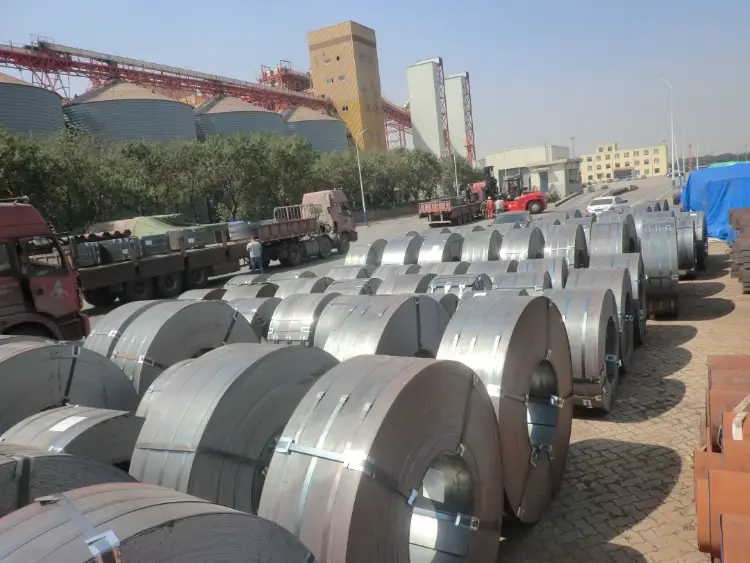
GB/T 14164-2013 L390 (X56) Pipeline Steel Coil
GB/T 14164-2013 L390 (X56) Pipeline Steel Coil - Data Sheet & Equivalents
Detailed material data for L390 (X56) pipeline steel: chemical composition, mechanical & physical properties, international equivalents, and applications according to GB/T 14164-2013.
Hot rolling, controlled rolling, thermomechanical controlled processing (TMCP)
- Phone : +8618037372205
- Email : [email protected]
- WhatsApp: Contact via Whtsapp
- WeChat: +8618037372205
GB/T 14164-2013 L390 Pipeline Steel Coil Introduction
L390 (X56) is a high-strength low-alloy (HSLA) pipeline steel grade defined in GB/T 14164-2013, primarily used for oil and gas transmission pipelines. It offers a minimum yield strength of 390 MPa with good weldability, excellent low-temperature toughness, and resistance to ductile fracture propagation. Typically supplied as hot-rolled coil in as-rolled, normalized, or thermomechanically controlled processed (TMCP) condition, this grade meets the demands of modern high-pressure, large-diameter pipeline projects. Its chemical composition is designed with microalloying elements (Nb, V, Ti) for grain refinement and precipitation strengthening, ensuring a fine balance of strength and ductility.
GB/T 14164-2013 L390 Pipeline Steel Coil Chemical Composition
Typical chemical composition limits for L390 (X56) according to GB/T 14164-2013. Values are maximum unless a range is specified. Microalloying elements Nb, V, Ti are added to achieve the required strength and toughness. Residual elements are controlled to ensure weldability and resistance to hydrogen-induced cracking.
| Element | Standard Value (wt%) | Remarks |
|---|---|---|
| C | ≤ 0.20 | Controlled for weldability |
| Si | ≤ 0.45 | Deoxidant residue |
| Mn | ≤ 1.60 | Strength and hardenability |
| P | ≤ 0.025 | Max for cleanliness |
| S | ≤ 0.015 | Max for low inclusion content |
| Nb | ≤ 0.05 | Grain refiner (part of Nb+V+Ti sum ≤0.15) |
| V | ≤ 0.08 | Precipitation strengthener (sum limit applied) |
| Ti | ≤ 0.04 | Grain refinement and sulfide shape control |
| Nb+V+Ti | ≤ 0.15 | Sum of microalloying elements |
| Cu | ≤ 0.35 | Residual element, may raise corrosion resistance |
| Ni | ≤ 0.30 | Residual element |
| Cr | ≤ 0.30 | Residual element |
| Mo | ≤ 0.15 | Residual element |
| Al (total) | ≥ 0.015 | Fine grain practice |
GB/T 14164-2013 L390 Pipeline Steel Coil Physical Properties
Typical physical properties for L390 (X56) carbon-manganese steel. These values are provided as reference for engineering design and are not mandatory requirements of the standard. Properties vary slightly with exact chemical composition and processing route. All values at room temperature (≈20°C) unless noted.
| Property | Typical Value | Unit | Test Condition / Remarks |
|---|---|---|---|
| Density (ρ) | 7.85 | g/cm³ | Ambient temperature |
| Modulus of Elasticity (E) | 207 | GPa | Tension, ambient |
| Shear Modulus (G) | 80 | GPa | Calculated from E and ν |
| Poisson ratio (ν) | 0.30 | — | Elastic range |
| Thermal Expansion Coefficient (α) | 11.7 (20-100 °C) | 10⁻⁶/K | Linear mean coefficient |
| Thermal Conductivity (λ) | 45 | W/(m·K) | At 20 °C |
| Specific Heat Capacity (c) | 500 | J/(kg·K) | At 20 °C |
| Electrical Resistivity (ρₑ) | 0.15 | µΩ·m | At 20 °C |
GB/T 14164-2013 L390 Pipeline Steel Coil Mechanical Properties
Tensile and impact properties for L390 (X56) as per GB/T 14164-2013, PSL1 base requirements. Values are for longitudinal strip/coil specimens unless noted. Elongation applies to standard test pieces (L₀=50 mm or 5.65√S₀). Bending test uses transverse specimens. Impact energy is commonly specified in supplementary requirements for low-temperature service.
| Property | Standard Requirement | Unit | Test Condition |
|---|---|---|---|
| Yield Strength (ReH / Rt0.5) | ≥ 390 | MPa | Longitudinal, room temperature |
| Tensile Strength (Rm) | 490 - 660 | MPa | Longitudinal, room temperature |
| Elongation (A) | ≥ 22 | % | Longitudinal, gauge length 50 mm, t ≤ 25 mm |
| Elongation (A) | ≥ 24 (for t > 25 mm) | % | Longitudinal, gauge length 50 mm |
| Bend Test (180°) | No cracks | — | Transverse, bend diameter = 2a (a = thickness) |
| Impact Energy (KV₂) at 0 °C | ≥ 27 (average), ≥ 20 (single) | J | Transverse, full-size (10×10 mm) – optional / PSL2 typical |
| Impact Energy (KV₂) at -20 °C | ≥ 27 (average), ≥ 20 (single) | J | Transverse, full-size – optional for low-temp service |
GB/T 14164-2013 L390 Pipeline Steel Coil Fully Equivalent International Standards and Grades
| Country/Region | Standard | Grade Designation | Remarks |
|---|---|---|---|
| China | GB/T 14164-2013 | L390 | This grade, also called X56 |
| USA / International | API 5L (46th Ed.) | X56 (PSL1 or PSL2) | PSL1 corresponds to basic requirements; PSL2 with tighter chemistry & mandatory tests |
| International | ISO 3183:2012 | L390 | Identical technical delivery conditions |
| Europe | EN 10208-2 | L390MB | L390MB is TMCP condition, equivalent to M delivery |
| Canada | CSA Z245.1 | Grade 386 | Yield strength in MPa (386 MPa ≈ 56 ksi) |
GB/T 14164-2013 L390 Pipeline Steel Coil Application Introduction
L390 (X56) pipeline steel is widely used in the energy sector where high strength and good low-temperature toughness are essential. Its balanced properties enable cost-effective design of high-pressure gas and oil transportation systems.
Product Applications: Long-distance cross-country pipelines, Gathering lines and flowlines, High-pressure water injection lines, Pipe fittings (bends, tees, reducers), Offshore risers, Pressure vessels and storage tanks (when rolled into plate)
Processed into products: Line pipe (seamless or welded), Induction bends and forged fittings, Flanges and connectors, Valves and pig launchers/receivers, Riser pipes and J-tubes, Compressor station piping
Application industries: Oil & Gas transmission and distribution, Petrochemical processing, Water transmission (long-distance aqueducts), Structural and civil engineering (pipe piling, casing), Offshore and subsea pipelines
GB/T 14164-2013 L390 Pipeline Steel Coil Similar / Nearby Alternative Grades
| Country/Region | Standard | Grade | Remarks |
|---|---|---|---|
| China / International | GB/T 14164 / API 5L | L415 (X60) | Higher strength grade (415 MPa min YS); similar welding behavior, slightly reduced toughness may be compensated by lower wall thickness |
| China / International | GB/T 14164 / API 5L | L360 (X52) | Lower strength grade (360 MPa min YS); greater ductility and toughness, often used where pressure requirements are moderate |
| Europe | EN 10208-2 | L360MB | Comparable to X52, suitable for less demanding service |
| Russia | GOST 1050 or equivalent | 17G1S | Similar Mn content but may lack microalloy refinement; use with caution for demanding pipeline projects |
Notes:
Additional considerations:
- For sour service (H2S-containing environments), special heat treatment and chemistry adjustments (e.g., Ca treatment, low S) may be required – consult supplementary standard like NACE MR0175/ISO 15156.
- Thicker gauges (>25 mm) may require a slightly lower elongation acceptance limit and adjusted impact requirements.
- TMCP delivery condition (M) can achieve superior toughness compared to normalized (N) grades.
- Share



