
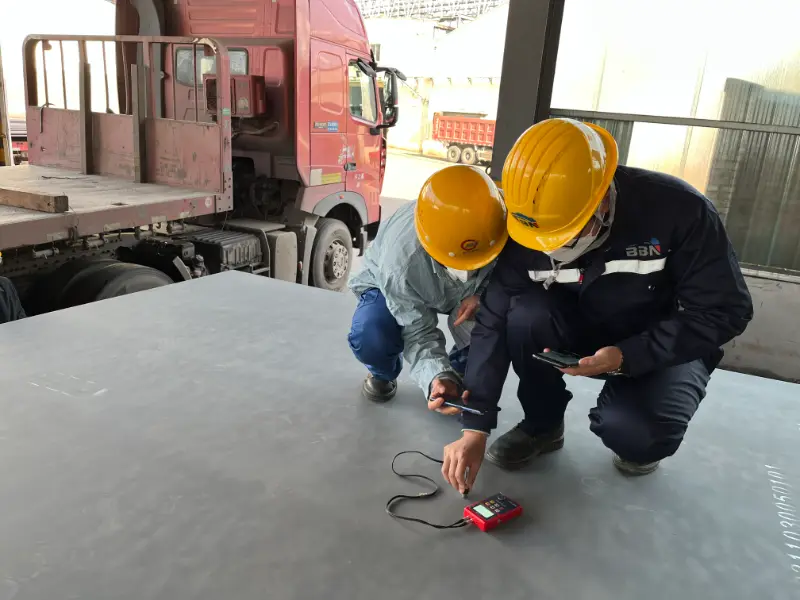
Q/BQB 310-2009 QStE500TM: High-Strength Low-Alloy Automotive Structural Steel Plate
Q/BQB 310-2009 QStE500TM: High-Strength Low-Alloy Automotive Structural Steel Plate - Enhanced Formability & Weldability
In-depth technical data for QStE500TM (Q/BQB 310-2009), a thermomechanically rolled high-strength low-alloy steel for automotive structural applications, featuring chemical composition, mechanical & physical properties, equivalent grades, and application guidance.
Cold forming (bending, stamping, roll forming), welding (MIG/MAG, resistance spot, laser), limited hot forming
- Phone : +8618037372205
- Email : [email protected]
- WhatsApp: Contact via Whtsapp
- WeChat: +8618037372205
Q/BQB 310-2009 QStE500TM: High-Strength Low-Alloy Automotive Structural Steel Plate Introduction
QStE500TM is a thermomechanically rolled high-strength low-alloy (HSLA) steel grade defined in Baosteel enterprise standard Q/BQB 310-2009. It is specifically designed for cold-formed automotive structural parts and reinforcements, offering a minimum yield strength of 500 MPa with excellent cold formability, weldability, and fatigue resistance. The fine-grained microstructure is achieved through controlled rolling and accelerated cooling, resulting in a favourable strength-to-weight ratio that enables lightweight vehicle design. Key characteristics:
- High yield strength (≥500 MPa) for improved crash performance and structural rigidity
- Good elongation (A80 ≥ 12%) for demanding forming operations
- Low carbon content and microalloy additions (Nb, V, Ti) ensure good weldability
- Tight dimensional tolerances and surface quality suitable for exposed applications
- Available in thicknesses from 1.5 mm to 12 mm as hot-rolled pickled and oiled or as-rolled condition
Q/BQB 310-2009 QStE500TM: High-Strength Low-Alloy Automotive Structural Steel Plate Chemical Composition
The chemical composition of QStE500TM is carefully balanced to achieve high strength via grain refinement and precipitation hardening while maintaining excellent weldability and formability. The steel is fully killed and treated for inclusion shape control.
- Low carbon content (≤0.12%) ensures good toughness and weldability.
- Microalloying with niobium, vanadium, and titanium provides precipitation strengthening and grain refinement.
- Low sulfur and phosphorus levels guarantee cleanliness and consistent mechanical properties.
- Total microalloy content (Nb+V+Ti) is limited to 0.22% max to avoid excessive hardening during welding.
| Element | Standard Value (max, unless range) | Remarks |
|---|---|---|
| C | ≤ 0.12 | Carbon |
| Si | ≤ 0.50 | Silicon |
| Mn | ≤ 1.70 | Manganese |
| P | ≤ 0.025 | Phosphorus |
| S | ≤ 0.015 | Sulfur |
| Altot | ≥ 0.015 | Total aluminium, for deoxidation |
| Nb | ≤ 0.09 | Niobium |
| V | ≤ 0.20 | Vanadium |
| Ti | ≤ 0.15 | Titanium |
| Nb+V+Ti | ≤ 0.22 | Sum of microalloying elements |
| Mo | ≤ 0.50 | Molybdenum (optional) |
| B | ≤ 0.005 | Boron (optional) |
Q/BQB 310-2009 QStE500TM: High-Strength Low-Alloy Automotive Structural Steel Plate Physical, Thermal & Electrical Properties
Physical property data are derived from general HSLA steel characteristics and are not part of the standard specification. They are provided for design calculations.
- Density is typical for structural steels (7.85 kg/dm³).
- Elastic and shear moduli are assumed isotropic; Poisson's ratio ~0.3.
- Coefficient of thermal expansion increases slightly with temperature.
- Thermal conductivity and electrical resistivity are within the range expected for low-alloy ferritic steels.
| Property | Typical Value | Unit | Condition / Temperature |
|---|---|---|---|
| Density (ρ) | 7.85 | kg/dm³ | 20 °C |
| Elastic modulus (E) | 210 | GPa | 20 °C, static |
| Shear modulus (G) | 80 | GPa | 20 °C, calculated |
| Poisson's ratio (ν) | 0.30 | – | Elastic range |
| Thermal expansion coefficient (α) | 12.0 | 10⁻⁶/K | 20–100 °C |
| Thermal expansion coefficient (α) | 12.5 | 10⁻⁶/K | 20–200 °C |
| Thermal expansion coefficient (α) | 13.2 | 10⁻⁶/K | 20–400 °C |
| Thermal conductivity (λ) | 50 | W/(m·K) | 20 °C |
| Specific heat capacity (cp) | 460 | J/(kg·K) | 20 °C |
| Electrical resistivity (ρₑ) | 0.18 | μΩ·m | 20 °C |
Q/BQB 310-2009 QStE500TM: High-Strength Low-Alloy Automotive Structural Steel Plate Mechanical Properties
Mechanical properties are guaranteed for thickness ranges as specified in Q/BQB 310-2009. The steel is characterized by a distinct yield phenomenon and excellent ductility for its strength class.
- Minimum yield strength depends on thickness: ≥500 MPa for t ≤ 8 mm, and ≥480 MPa for 8 < t ≤ 12 mm.
- Tensile strength is controlled within a narrow range (550–700 MPa) to ensure consistent forming behaviour.
- Elongation is measured on A80 or A5 gauge lengths depending on thickness; values shown are minimums.
- Bending performance is guaranteed by a 180° bend test with no cracking; mandrel diameter increases with thickness.
| Property | Required Value | Unit | Test Condition |
|---|---|---|---|
| Yield strength (ReH) | ≥ 500 | MPa | Thickness ≤ 8 mm |
| Yield strength (ReH) | ≥ 480 | MPa | 8 < Thickness ≤ 12 mm |
| Tensile strength (Rm) | 550 – 700 | MPa | Thickness ≤ 8 mm |
| Tensile strength (Rm) | 500 – 650 | MPa | 8 < Thickness ≤ 12 mm |
| Elongation (A80) | ≥ 12 | % | Thickness < 3 mm, gauge 80 mm |
| Elongation (A5) | ≥ 14 | % | Thickness ≥ 3 mm, gauge 5.65√S₀ |
| Bend test (180°) | No cracks | Mandrel diameter = 0.5t (t ≤ 8 mm) | |
| Bend test (180°) | No cracks | Mandrel diameter = 1.0t (8 < t ≤ 12 mm) |
Q/BQB 310-2009 QStE500TM: High-Strength Low-Alloy Automotive Structural Steel Plate Exactly Equivalent Material Standards & Replaceable Grades
| Country/Region | Standard | Grade | Remarks |
|---|---|---|---|
| Europe | EN 10149-2 | S500MC | Identical in strength and chemistry concept; thermomechanically rolled HSLA steel for cold forming. |
| International | ISO 6930-2 | S500MC | Harmonized with EN 10149-2; directly interchangeable. |
| Sweden | SSAB internal | Domex 500 MC | Commercial product based on EN S500MC philosophy; may have slight proprietary adjustments. |
Q/BQB 310-2009 QStE500TM: High-Strength Low-Alloy Automotive Structural Steel Plate Application Introduction
QStE500TM is ideally suited for safety-critical and load-bearing automotive structural parts where a balance of high strength, good formability, and excellent weldability is required. Its consistent mechanical properties across the strip width and length allow precise process control in stamping and welding lines.Typical processing routes:
- Cold forming: bending, drawing, roll forming, and progressive die stamping; springback compensation may be needed.
- Welding: GMAW, resistance spot welding, and laser welding are fully applicable; low carbon equivalent ensures crack-free joints.
- Surface treatment: pickled and oiled surface is ready for e-coating or painting; may be phosphate treated.
Product Applications: Longitudinal chassis beams and frame rails, Cross members and subframes, Suspension control arms and panhard rods, Bumper reinforcements and door intrusion beams, Seat frames and backrest supports, Wheel rims and hub components, Engine cradle and transmission brackets
Processed into products: Cold-stamped chassis brackets and gussets, Roll-formed profiles for body-in-white reinforcements, Welded assemblies (e.g., cross-member to frame side member), Progressive die formed seat runners and mechanisms, Laser-welded tailored blanks (when combined with mild steel inserts)
Application industries: Automotive (passenger cars, light commercial vehicles, heavy trucks), Trailer and semi-trailer manufacturing, Agricultural and construction machinery, Railway rolling stock (non-pressure vessel parts), Material handling equipment (forklifts, storage racks)
Q/BQB 310-2009 QStE500TM: High-Strength Low-Alloy Automotive Structural Steel Plate Similar or Substitute Materials with Comparable Performance
| Country/Region | Standard | Grade | Remarks |
|---|---|---|---|
| China (Baosteel) | Q/BQB 310-2009 | QStE460TM | Slightly lower yield strength (≥460 MPa); for less demanding applications; can be used with design adjustment. |
| China (Baosteel) | Q/BQB 310-2009 | QStE550TM | Higher yield strength (≥550 MPa); requires more robust forming tools; may replace QStE500TM with down-gauging. |
| Europe | EN 10149-2 | S550MC | Higher strength level; more limited formability; suitable for weight reduction when design permits. |
| USA | ASTM A1011/A1011M | HSLAS-F Grade 70 [480] | Comparable yield strength (≥480 MPa) but different chemistry; requires qualification before substitution. |
| Japan | JIS G3134 | SPFH590 | Yield strength ~390 MPa; not a direct substitute; may be used with thickness increase. |
Notes:
All data are based on Baosteel standard Q/BQB 310-2009. The physical properties are typical literature values and may vary slightly with actual production conditions. For welded structures, a suitable preheating and interpass temperature control (not usually required for this low CET) should be evaluated for thick sections (>8 mm). The material is not intended for long-term service above 400 °C. Dimension and flatness tolerances follow Q/BQB 301 for hot-rolled products unless otherwise agreed. For specific requirements on surface quality (e.g., critical outer panels), additional agreements with the mill are recommended.
- Share



