
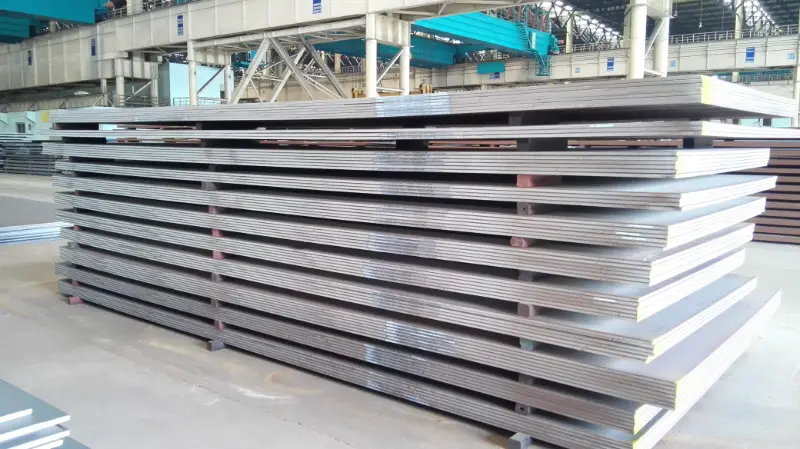
B330CL Automobile Structure Steel
B330CL Automobile Structure Steel: Baosteel Q/BQB 310 Analysis & Equivalent Grades
Comprehensive analysis of B330CL steel under Baosteel Q/BQB 310-2009: chemical composition, mechanical properties, thermal properties, international equivalents, and application guide for automotive structural parts.
Blanking, stamping, deep drawing, bending, roll forming, welding, phosphating, coating
- Phone : +8618037372205
- Email : [email protected]
- WhatsApp: Contact via Whtsapp
- WeChat: +8618037372205
B330CL Automobile Structure Steel Introduction
B330CL is a hot-rolled automobile structure steel plate/coil specified in Baosteel enterprise standard Q/BQB 310-2009. It is designed for structural and forming applications in the automotive industry, offering a good balance of strength, formability, and weldability. The grade exhibits a minimum yield strength of 225 MPa and tensile strength ranging from 330 to 450 MPa, with excellent elongation (≥33% for thin gauges) that enables deep drawing and bending operations. Its low carbon content and controlled micro-alloying ensure reliable cold forming performance without cracking. Typical delivery condition is as-rolled, with the surface quality suitable for unexposed structural parts such as wheel rims, discs, chassis members, and reinforcements. The steel can be processed by blanking, stamping, roll forming, welding, and coating. B330CL is closely equivalent to SAPH370 in JIS G3113 and can be considered a cost-effective alternative for many non-exposed automotive structures.
B330CL Automobile Structure Steel Chemical Composition
The chemical composition according to Q/BQB 310-2009 is designed to provide low carbon equivalent for excellent weldability and formability. Aluminum is added as a deoxidizer and grain refiner. Micro-alloying elements such as Nb or Ti may be present but are not mandatory in the standard, optionally improving strength without compromising ductility. Tight control of phosphorus and sulfur ensures good surface quality and toughness.
| Element | Standard Value (max, unless stated) | Remark |
|---|---|---|
| C | 0.10% | Maximum for weldability |
| Si | 0.30% | Maximum |
| Mn | 1.00% | Maximum |
| P | 0.030% | Maximum |
| S | 0.025% | Maximum |
| Alt (total Al) | ≥ 0.015% | Minimum, fully killed steel |
| Others (Nb, Ti, etc.) | Optional | May be added for strength improvement |
B330CL Automobile Structure Steel Physical and Thermal Properties
The following physical constants are representative of low-carbon hot-rolled steel similar to B330CL. They are not specifically required by Q/BQB 310 but are useful for design and simulation. Density and elastic modulus are essentially composition-independent for this class of steel. Thermal expansion and thermal conductivity vary slightly with temperature; values at 20°C and 100°C are given. Specific heat and electrical resistivity are also typical of structural steel.
| Property | Typical Value (Range) | Unit | Temperature / Condition |
|---|---|---|---|
| Density (ρ) | 7.85 | g/cm³ | 20°C |
| Elastic Modulus (E) | 210 | GPa | 20°C, static |
| Shear Modulus (G) | 81 | GPa | Approximate from E and ν |
| Poisson's Ratio (ν) | 0.30 | - | Elastic range |
| Thermal Expansion (α) | 11.5 – 12.5 | 10⁻⁶/K | 20–100°C |
| Thermal Conductivity (λ) | 53 (typical at 20°C) | W/(m·K) | At 20°C |
| Thermal Conductivity (λ) | 50 (at 100°C) | W/(m·K) | At 100°C |
| Specific Heat Capacity (c) | 460 | J/(kg·K) | 20–100°C |
| Electrical Resistivity (ρₑ) | 0.14 – 0.18 | μΩ·m | 20°C |
B330CL Automobile Structure Steel Mechanical Properties
These properties apply to test pieces taken transverse to the rolling direction. Yield strength (ReH) and tensile strength (Rm) are guaranteed within the specified range. Elongation is measured on a gauge length of 50 mm (or 80 mm for thickness <3.0 mm) according to ISO or JIS standards. The bend test (180° bending over a specified diameter) must show no cracks on the outer surface. The values are valid for a limited thickness range up to 8.0 mm (plate); for thicker products, consult the full standard.
| Property | Requirement | Unit | Test Condition |
|---|---|---|---|
| Yield Strength (ReH) | ≥ 225 | MPa | Upper yield, transverse, thickness ≤ 8.0 mm |
| Tensile Strength (Rm) | 330 – 450 | MPa | Transverse, room temperature |
| Elongation (A) | ≥ 33 (for thickness < 3.0 mm) | % | Gauge length 80 mm (JIS 5 type), thickness < 3.0 mm |
| Elongation (A) | ≥ 30 (for thickness 3.0–6.0 mm) | % | Gauge length 50 mm, thickness 3.0–6.0 mm |
| Bend Test | d = 0a (180°) | - | Bend diameter = 0 x thickness, width ≥ 35 mm, no cracks |
B330CL Automobile Structure Steel Fully Equivalent Standards & Substitutable Grade Recommendations
| Country/Region | Standard | Designation | Remarks |
|---|---|---|---|
| Japan | JIS G3113 | SAPH370 | Closest commercial equivalent; SAPH370 has slightly higher tensile strength (min 370 MPa) but similar formability and chemistry. Often used interchangeably for automotive structural parts. |
| Europe | EN 10149-2 | S315MC | High-strength low-alloy (HSLA) grade with a higher yield strength (min 315 MPa). Suitable substitute when higher strength is acceptable and formability is sufficient. |
B330CL Automobile Structure Steel Application Introduction
B330CL is optimized for automotive structural applications where moderate strength and excellent formability are required. It is widely accepted by automotive manufacturers and tier-1 suppliers for both passenger and commercial vehicles. The typical thickness range is 1.5 mm to 8.0 mm. Its good weldability (CEV ≈ 0.22) supports resistance spot welding and gas metal arc welding. The surface quality is suitable for parts that are not exposed to direct view (non-class-A surfaces) or that receive e-coating and painting.
Product Applications: Vehicle wheels (rims, discs), Chassis subframes and cross members, Suspension brackets and control arms, Reinforcement plates and seat structural parts, Engine mounting brackets, Longitudinal beams and crossmembers for light trucks
Processed into products: Wheel rim (outer/inner rim), Wheel disc (hub mounting face), Floor cross member, Front/rear bumper beam (non-impact absorbing), Spring seat and saddle, Tow hook reinforcement, Differential bracket, Steering knuckle support (light duty)
Application industries: Automotive (passenger cars, light commercial vehicles), Automotive components and aftermarket spare parts, Agricultural and construction machinery (structural brackets), General fabrication of formed metal parts
B330CL Automobile Structure Steel Similar or Alternative Grade Recommendations
| Country/Region | Standard | Designation | Remarks |
|---|---|---|---|
| Japan | JIS G3113 | SAPH310 | Lower strength variant (min tensile 310 MPa); could be used if strength requirements permit, with slightly better formability. |
| Japan | JIS G3113 | SAPH400 | Higher strength variant (min tensile 400 MPa) for heavier-duty parts, requiring careful forming process control. |
| Europe | EN 10149-2 | S260NC / S315MC | S260NC has similar yield strength minimum (260 MPa) and good formability; S315MC is stronger. Both are cold- or hot-forming steels suitable for replacement depending on part design. |
| China | GB/T 3273/ASTM | QSTE340TM (GB) or equivalent | QSTE340TM is a high-strength automotive steel widely used in China, with min yield 340 MPa and tensile 420–540 MPa. Can be used for higher strength needs but may require process adjustments. |
Notes:
- Surface finish: Clean hot-rolled surface (mill finish) free from scale defects that could affect forming. Suitable for subsequent pickling and oiling if required.
- Edge condition: Available with mill edge or trimmed edge. Trimmed edge is recommended for better dimensional tolerance and reduced edge cracking risk during forming.
- Inspection: Tensile and bend tests are performed per batch. Certification according to EN 10204 type 2.2 or 3.1 is available upon request.
- Processing recommendations: A bending radius of 1.0–1.5 times thickness is advisable for severe forming to prevent cracking. Post-forming heat treatment is normally not required.
- Share



