
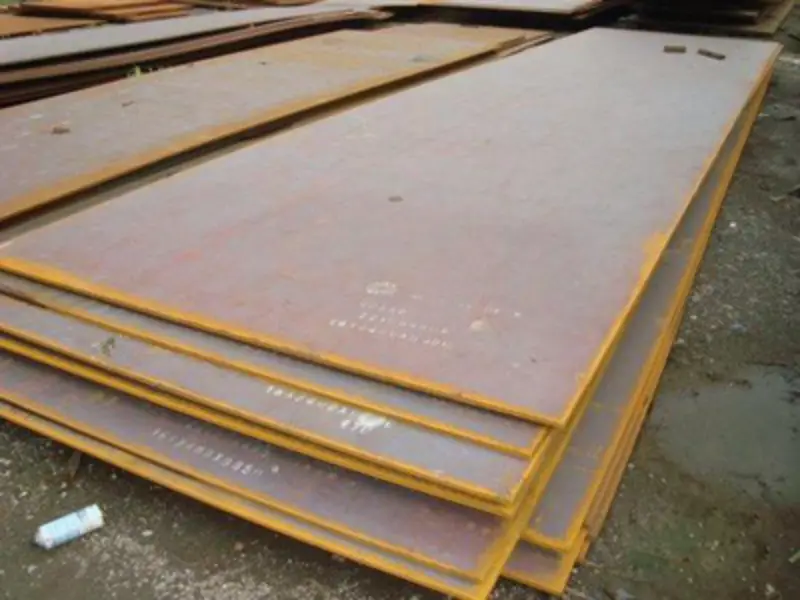
DIN 17102 WStE255 Automobile Structure Steel Plate
DIN 17102 WStE255 Automobile Structure Steel Plate - Fine Grain Weldable Steel
Detailed technical data for WStE255 steel under DIN 17102: chemical composition, mechanical properties, thermal and electrical physical properties, international equivalents, and application guidance for automotive structural parts.
Hot rolling, cold forming, welding, bending, deep drawing
- Phone : +8618037372205
- Email : [email protected]
- WhatsApp: Contact via Whtsapp
- WeChat: +8618037372205
DIN 17102 WStE255 Automobile Structure Steel Plate Introduction
WStE255 is a weldable fine grain structural steel plate specified in the German standard DIN 17102 for automobile construction and general structural engineering. It is delivered in the normalized condition (or equivalent heat treatment) and is characterized by a minimum yield strength of 255 MPa for thicknesses up to 16 mm. The fine grain structure, achieved by aluminium and microalloying elements, ensures a good combination of strength and toughness, as well as excellent weldability, making it suitable for cold forming and hot rolling processes.
The steel is widely used in load-bearing components of chassis, frames, and reinforcements where high fatigue resistance and safety are required. Typical processing includes cutting, bending, welding, and deep drawing. In comparison to conventional structural steels, WStE255 offers improved notch toughness and better performance at low temperatures.
DIN 17102 WStE255 Automobile Structure Steel Plate Chemical Composition
The chemical composition of WStE255 is designed to guarantee weldability and fine grain structure through controlled aluminium and microalloy additions. Values are maximum limits for ladle analysis according to DIN 17102, except where a range is indicated. The steel is aluminium-killed and may contain niobium, vanadium, or titanium as grain refiners.
| Element | Standard Value | Remarks |
|---|---|---|
| C | ≤ 0.20 | |
| Si | ≤ 0.50 | |
| Mn | 0.50 – 1.50 | |
| P | ≤ 0.035 | |
| S | ≤ 0.030 | |
| Al (total) | ≥ 0.020 | Grain refining |
| N | ≤ 0.020 | |
| Nb | ≤ 0.05 | Optional microalloy |
| V | ≤ 0.10 | Optional microalloy |
| Ti | ≤ 0.05 | Optional microalloy |
DIN 17102 WStE255 Automobile Structure Steel Plate Thermal and Electrical Physical Properties
The following values are typical for carbon-manganese structural steels and serve as engineering reference. They are not part of the delivery standard but are essential for design calculations. Properties may vary slightly depending on exact chemical composition and heat treatment condition.
| Property | Typical Value | Unit | Test condition |
|---|---|---|---|
| Density (ρ) | 7.85 | g/cm³ | at 20 °C |
| Modulus of elasticity (E) | 210 | GPa | at 20 °C |
| Shear modulus (G) | 81 | GPa | at 20 °C |
| Poisson's ratio (ν) | 0.3 | – | at 20 °C |
| Thermal expansion coefficient (α) | 11.7 × 10⁻⁶ | K⁻¹ | between 20 °C and 100 °C |
| Thermal conductivity (λ) | approx. 50 | W/(m·K) | at 20 °C |
| Specific heat capacity | 460 | J/(kg·K) | at 20 °C |
| Electrical resistivity (ρ_e) | 0.15 – 0.20 | Ω·mm²/m | at 20 °C |
DIN 17102 WStE255 Automobile Structure Steel Plate Mechanical Properties
The mechanical properties apply to the normalized delivery condition. Depending on plate thickness, the yield strength decreases slightly for thicker sections. The tensile test is performed in the longitudinal direction at room temperature. Bend test is carried out with a mandrel diameter related to the plate thickness (a = specimen thickness).
| Property | Required Value | Unit | Test condition |
|---|---|---|---|
| Yield strength (ReH) | ≥ 255 | MPa | thickness ≤ 16 mm |
| Yield strength (ReH) | ≥ 245 | MPa | thickness 16 mm < t ≤ 40 mm |
| Yield strength (ReH) | ≥ 235 | MPa | thickness 40 mm < t ≤ 63 mm |
| Tensile strength (Rm) | 360 – 510 | MPa | all thicknesses |
| Elongation after fracture (A) | ≥ 24 | % | thickness ≤ 16 mm, gauge length 5.65√So |
| Elongation after fracture (A) | ≥ 24 | % | thickness 16–40 mm |
| Elongation after fracture (A) | ≥ 23 | % | thickness 40–63 mm |
| Bend test (mandrel diameter) | d = 3a (180°) | – | thickness ≤ 16 mm, width ≥ 30 mm |
DIN 17102 WStE255 Automobile Structure Steel Plate Completely Equivalent Material Standards and Replaceable Grades
| Country/Region | Standard | Grade | Remarks |
|---|---|---|---|
| Europe | EN 10025-3 | S275N / S275NL | Normalized fine grain steel, direct successor; slightly higher min. yield (275 MPa) |
| Germany | DIN 17102 (withdrawn) | WStE255 | Original specification, replaced by EN 10025-3 |
| International | ISO 630-3 | E275C / E275D | Comparable normalized structural steel |
DIN 17102 WStE255 Automobile Structure Steel Plate Application Introduction
WStE255 is specifically designed for welded structures in vehicle manufacturing where good cold formability and fatigue strength are required. Its fine grain structure ensures dependable toughness at ambient and moderately low temperatures, while the moderate carbon content keeps the steel easily weldable without preheating under normal conditions. Typical production steps include blanking, bending, stamping, and multi-pass welding.
Product Applications: Chassis frames and subframes, Cross members and longitudinal beams, Suspension control arms, Axle supports and reinforcements, Pressed structural panels, Brackets and mounting plates
Processed into products: Chassis longitudinal rails, Engine cradle cross members, Rear axle beam, Suspension arm brackets, Shock absorber towers, Trailer drawbars
Application industries: Automotive construction (passenger cars, commercial vehicles), Agricultural machinery and trailers, Earthmoving and construction equipment, Railway vehicle components, General structural engineering
DIN 17102 WStE255 Automobile Structure Steel Plate Similar / Substitute Materials with Close Properties
| Country/Region | Standard | Grade | Remarks |
|---|---|---|---|
| USA | ASTM A572/A572M | Grade 50 [345] | Higher yield strength (345 MPa), but comparable carbon-manganese base; commonly used in automotive structures |
| Japan | JIS G3106 | SM490A / SM490B | Weldable structural steel with minimum tensile strength 490 MPa, slightly different chemistry |
| China | GB/T 1591 | Q345B / Q345C | Higher yield strength (345 MPa), low alloy structural steel, widely used equivalent |
| UK | BS 4360 (withdrawn) | 43C / 50B | Older standard, strength levels comparable to 255 MPa category |
Notes:
Thickness ranges above 63 mm are not covered by the standard mechanical property table; consult the manufacturer for special grades or additional tests. For low-temperature applications below -10 °C, the WStE255 base designation may need to be supplemented with an improved notch toughness class (e.g., WStE255T for higher toughness). When welding, suitable low-hydrogen procedures and wires matched to the base material strength are recommended.
- Share



