
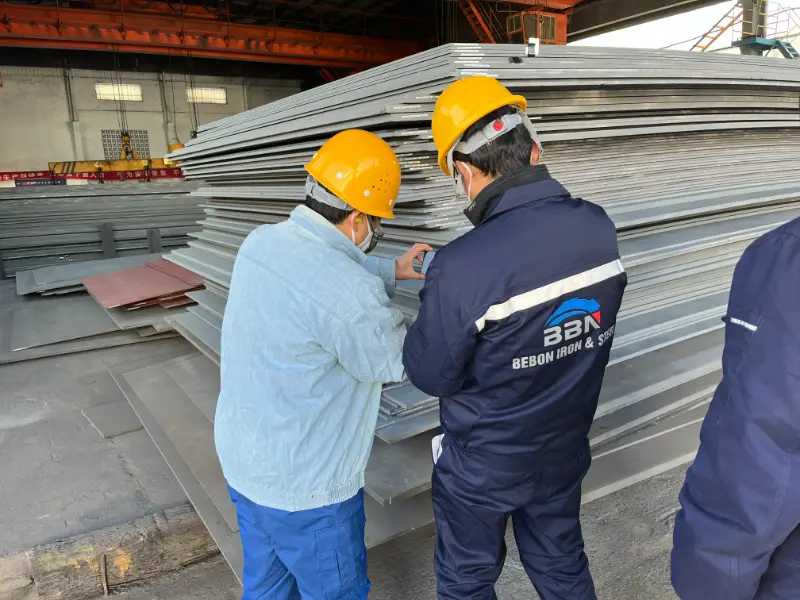
DIN 17102 StE255 Fine
DIN 17102 StE255 Fine-Grain Structural Steel for Automotive Applications
DIN 17102 StE255 is a normalized fine-grain structural steel with minimum yield strength 255 MPa, excellent weldability and cold formability, widely used in automotive chassis, frames and structural components.
Hot rolling, normalizing, controlled rolling, cold forming, welding, cutting, drilling
- Phone : +8618037372205
- Email : [email protected]
- WhatsApp: Contact via Whtsapp
- WeChat: +8618037372205
DIN 17102 StE255 Fine Introduction
StE255 is a fine-grain structural steel specified in the German standard DIN 17102. It is produced as normalized or controlled rolled flat products and is characterised by its minimum yield strength of 255 MPa, good toughness at low temperatures, and reliable weldability. Key features include:
- Fine grain structure per Grade E (killed and fine-grained)
- Excellent cold formability for bending, drawing and roll forming
- Guaranteed Charpy impact energy at -20°C
- Available in plates, sheets and wide flats up to moderate thicknesses
Commonly used in automotive structural parts, agricultural machinery and general engineering where a balance of strength, formability and weldability is required.
DIN 17102 StE255 Fine Chemical Composition
The chemical composition of StE255 according to DIN 17102 is designed to achieve fine-grain structure and mechanical properties through controlled additions of aluminium and optionally microalloying elements. Maximum limits are given for C, P and S to ensure weldability and toughness.
- Aluminium is required for grain refinement, typically with a minimum total Al of 0.020%.
- Niobium, vanadium and titanium may be added singly or in combination for further grain refinement and precipitation strengthening.
| Element | Standard Value (max %) | Remarks |
|---|---|---|
| Carbon (C) | 0.20 | Max |
| Silicon (Si) | 0.55 | Max. May be 0.15-0.50 for semi-killed steel |
| Manganese (Mn) | 0.50 - 1.50 | Range |
| Phosphorus (P) | 0.035 | Max |
| Sulfur (S) | 0.030 | Max |
| Nitrogen (N) | 0.009 | Max for normalizing rolled products; higher for Al-killed fine-grain |
| Aluminium (Al total) | ≥ 0.020 | Min for fine-grain practice |
| Niobium (Nb) | 0.05 | Max typical; optional microalloying |
| Vanadium (V) | 0.10 | Max typical; optional |
| Titanium (Ti) | 0.10 | Max typical; optional |
DIN 17102 StE255 Fine Physical and Thermal Properties
The following physical properties are typical for StE255 at room temperature and are not part of the DIN 17102 standard. They are provided for engineering calculations.
- Density varies slightly with composition but remains near 7.85 g/cm³.
- Thermal and electrical properties are useful for welding and thermal processing.
| Property | Typical Value | Unit | Test Condition / Remarks |
|---|---|---|---|
| Density (ρ) | 7.85 | g/cm³ | At 20°C |
| Modulus of elasticity (E) | 210 | GPa | At 20°C, tension |
| Shear modulus (G) | 81 | GPa | Calculated from E and ν |
| Poisson ratio (ν) | 0.3 | — | At 20°C |
| Thermal expansion coefficient (α) | 11.7 – 12.5 | 10⁻⁶/K | 20–100°C; 12.0 typical |
| Thermal conductivity (λ) | 48 – 52 | W/(m·K) | At 20°C |
| Specific heat capacity (cp) | 460 – 480 | J/(kg·K) | At 20°C |
| Electrical resistivity (ρe) | 0.14 – 0.20 | µΩ·m | At 20°C, depending on alloy |
DIN 17102 StE255 Fine Mechanical Properties
The mechanical properties specified are minimum values in the transverse direction for flat products unless otherwise noted. Charpy impact test is mandatory at -20°C for fine-grain grades.
- Yield strength decreases with increasing thickness; for plate thicknesses > 16 mm, lower ReH values apply (e.g., 245 MPa for 16–40 mm).
- Elongation is measured on proportional test pieces with gauge length L0 = 5.65√S0.
| Property | Standard Requirement | Unit | Test Condition |
|---|---|---|---|
| Upper yield strength (ReH) | 255 | MPa | Thickness ≤ 16 mm, transverse |
| Upper yield strength (ReH) | 245 | MPa | Thickness 16–40 mm, transverse |
| Tensile strength (Rm) | 360 – 480 | MPa | All thicknesses, transverse |
| Elongation after fracture (A5) | ≥ 24 | % | Gauge length L0 = 5.65√S0, transverse, thickness ≤ 16 mm |
| Elongation after fracture (A5) | ≥ 23 | % | Thickness 16–40 mm |
| Bend test (mandrel diameter) | 2a (for a ≤ 12 mm) | – | 180° bend, a = specimen thickness; no cracks |
| Bend test (mandrel diameter) | 3a (for a 12–25 mm) | – | 180° bend |
| Charpy impact energy (KV2) | ≥ 27 | J | Longitudinal, -20°C, average of 3 specimens |
| Charpy impact energy (KV2) | ≥ 20 | J | Individual minimum value, -20°C |
DIN 17102 StE255 Fine Full Equivalent Material Standards and Substitutable Grades
| Country/Region | Standard | Grade | Remarks |
|---|---|---|---|
| Germany | DIN 17102 (withdrawn) | StE255 | Original specification; fine-grain structural steel |
| Europe | EN 10149-2:2013 | S260NC | Closest replacement; cold-roll formed high-yield steel, minimum yield 260 MPa. Chemistry and impact properties align with StE255 for thickness ≤ 16 mm. |
| International | ISO 6930-1:2001 | S260MC | High yield strength steel for cold forming; technical delivery conditions similar to EN 10149-2. |
| Japan | JIS G 3135:2006 | SPFC 340 | Cold-reduced high strength steel sheet; minimum yield 255 MPa and tensile 340 MPa provide a functional substitute, but check strength range and formability. |
DIN 17102 StE255 Fine Application Introduction
StE255 (and its modern equivalent S260NC) is designed for structural components that are produced by cold forming and require reliable toughness at sub-zero temperatures. Typical application areas include:
- Automotive chassis and underbody parts where dynamic loads require good fatigue strength.
- Agricultural and construction machinery subjected to moderate impact.
- Welded frames, brackets, and base structures in general engineering.
Product Applications: Passenger car subframes and engine cradles, Truck chassis longitudinal beams, Cross members for trailers and semi-trailers, Agricultural vehicle ROPS (roll-over protective structures), Warehouse racking uprights and beams, Wind turbine tower internal platforms and brackets
Processed into products: Longitudinal frame rails, Cross-members, Reinforcement brackets, Spring hanger brackets, Control arm supports, Chassis mounting plates, Formed channels and U-profiles, Weldments for axle housings
Application industries: Automotive (chassis, body-in-white structural parts), Agricultural machinery (loader arms, frames), Construction equipment (light structural frames), Railway (non-critical structural members), General mechanical engineering (welded fabrications)
DIN 17102 StE255 Fine Similar / Compatible Material Recommendations
| Country/Region | Standard | Grade | Remarks |
|---|---|---|---|
| Europe | EN 10025-3:2019 | S275N | Normalized fine-grain structural steel with slightly higher yield (275 MPa) and tensile strength. Good low-temperature toughness. Suitable when higher strength is acceptable. |
| Europe | EN 10025-3:2019 | S260N | This grade is not standard but may be agreed. Check availability; if available, it would be the direct normalized equivalent of StE255. |
| Germany | DIN EN 10149-2 | S315MC | Higher strength alternative (yield 315 MPa) for cold forming; may require more press capacity but allows weight reduction. |
| USA | ASTM A1011/A1011M | Grade 40 (275 MPa) | Hot-rolled structural steel with minimum yield 275 MPa. Lower carbon content; not a direct match but comparable in many structural applications. |
Notes:
Important note: When substituting older DIN 17102 grades, confirm that the current European standard (EN 10149-2 or EN 10025-3) is accepted for the application.
- For cold forming, EN 10149-2 S260NC is the logical replacement, but the minimum yield strength is slightly higher (260 vs. 255 MPa). Adjust forming tools if necessary.
- Normalized grades (EN 10025-3) provide better homogeneity in thicker sections, but may have slightly higher strength and different impact test temperatures.
- Surface condition: StE255 was typically supplied as rolled or descaled; EN grades may have improved surface quality options.
- Consult the material supplier for actual property certificates and confirm welding compatibility before switching.
- Share



