
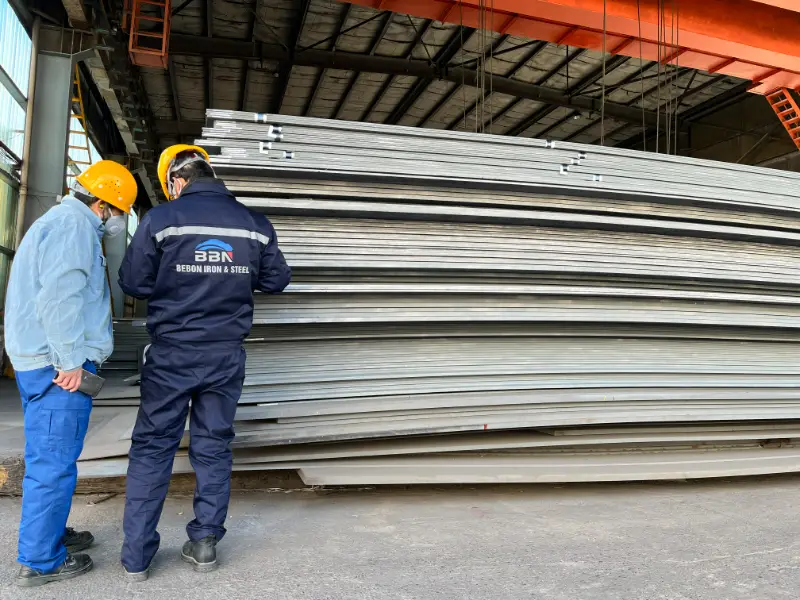
QStE550TM Steel
QStE550TM Steel: High-Strength Hot-Rolled Automobile Structure per SEW092
Detailed material data and properties of QStE550TM automotive structural steel according to SEW092 standard, including chemistry, mechanical and physical performance.
Cold forming, bending, stamping, drawing, welding
- Phone : +8618037372205
- Email : [email protected]
- WhatsApp: Contact via Whtsapp
- WeChat: +8618037372205
QStE550TM Steel Introduction
QStE550TM is a hot-rolled, high-strength low-alloy (HSLA) steel for cold forming, primarily used in automobile structural components. It is specified in the German steel standard SEW092 and features a minimum yield strength of 550 MPa. The material combines excellent formability with high strength, achieved through microalloying with elements such as niobium, titanium, and vanadium, resulting in a fine-grained ferritic-pearlitic microstructure. Typical delivery condition is as-rolled or normalized-rolled, suitable for subsequent cold forming, bending, and limited drawing operations. The steel offers good weldability and fatigue resistance, making it ideal for weight-reduced chassis and body-in-white applications.
QStE550TM Steel Chemical Composition
Ladle analysis according to SEW 092. Microalloying elements Nb, Ti, and V are added for grain refinement and precipitation hardening, ensuring the required minimum yield strength. The low carbon equivalent improves weldability and cold formability.
| Element | Specified Value (%) | Remarks |
|---|---|---|
| C | ≤ 0.12 | Max. |
| Si | ≤ 0.50 | Max. |
| Mn | ≤ 2.00 | Max. |
| P | ≤ 0.030 | Max. |
| S | ≤ 0.025 | Max. |
| Altot | ≥ 0.015 | Min. |
| Nb | ≤ 0.09 | Max. |
| Ti | ≤ 0.15 | Max. |
| V | ≤ 0.20 | Max. |
| N | ≤ 0.020 | Usually controlled for titanium nitride formation |
QStE550TM Steel Thermal and Electrical Physical Properties
Typical values for low-carbon microalloyed steel at room temperature, unless otherwise noted. These properties are not part of the delivery requirements but serve as engineering reference for design and simulation.
| Property | Typical Value | Unit | Remarks |
|---|---|---|---|
| Density (ρ) | 7.85 | g/cm³ | At 20 °C |
| Modulus of elasticity (E) | 210 | GPa | At 20 °C |
| Shear modulus (G) | 80 | GPa | Calculated from E and ν |
| Poisson's ratio (ν) | 0.3 | — | Elastic range |
| Thermal expansion coefficient (α) | 11.5 × 10⁻⁶ | K⁻¹ | Average between 20–100 °C |
| Thermal expansion coefficient (α) | 12.5 × 10⁻⁶ | K⁻¹ | Average between 20–300 °C |
| Thermal conductivity (λ) | 50 | W/(m·K) | At 20 °C |
| Specific heat capacity (cp) | 460 | J/(kg·K) | At 20 °C |
| Electrical resistivity (ρe) | 0.20 | Ω·mm²/m | At 20 °C |
QStE550TM Steel Mechanical Properties
Transverse test specimens as per SEW 092, valid for uncoated conditions. The material exhibits a pronounced yield point with subsequent work hardening. Minimum elongation values guarantee sufficient ductility for cold forming operations. Bending tests confirm good foldability without cracking.
| Property | Required Value | Unit | Test Condition / Remarks |
|---|---|---|---|
| Yield strength (ReH) | ≥ 550 | MPa | Applicable to all thicknesses |
| Tensile strength (Rm) | 600 – 760 | MPa | Thickness ≤ 6 mm |
| Tensile strength (Rm) | 600 – 760 | MPa | Thickness > 6 mm |
| Elongation after fracture (A80) | ≥ 12 | % | Gauge length 80 mm, thickness < 3 mm |
| Elongation after fracture (A5) | ≥ 14 | % | Gauge length 5.65√So, thickness ≥ 3 mm |
| Bend test | No cracking | — | Mandrel diameter = 1.5 × thickness (thickness ≤ 6 mm), 180° |
| Bend test | No cracking | — | Mandrel diameter = 2.0 × thickness (thickness > 6 mm), 180° |
QStE550TM Steel Recommended Fully Equivalent Material Standards and Replaceable Grades
| Country/Region | Standard | Grade | Remarks |
|---|---|---|---|
| Germany / Europe | EN 10149-2 | S550MC | Thermomechanically rolled, identical strength and formability class |
| International | ISO 6930-2 | HR550F | Hot-rolled high yield steel for cold forming, equivalent chemical and mechanical requirements |
| Japan | JFS A 2001 | JSH550R | Japanese iron and steel standard for high-tensile hot-rolled sheet, very similar composition and properties |
QStE550TM Steel Application Introduction
QStE550TM is engineered for demanding automotive structural applications where high strength and good cold formability are required to reduce weight without compromising safety. It is typically processed by blanking, bending, drawing, and assembly welding. The steel can be painted or coated after appropriate surface treatment. Consistent mechanical properties across the strip width and length ensure reliable mass production.
Product Applications: Car body structural members, Chassis frames and subframes, Pickup truck beds, Trailer platforms, Wheel rims and disc wheels, Fuel tank supports and battery trays, Cold-formed welded tubes for structural use
Processed into products: Longitudinal and cross members, Suspension control arms and spring brackets, Bumpers and crash reinforcements, Seat back frames and rails, Engine cradles, Door impact beams, Axle housings and differential covers
Application industries: Automotive manufacturing, Commercial vehicle and trailer industry, Agricultural and construction machinery, Rail transport, Tubular structural elements
QStE550TM Steel Similar / Near-Equivalent Material Recommendations
| Country/Region | Standard | Grade | Remarks |
|---|---|---|---|
| Germany | SEW 092 | QStE500TM | Lower yield strength (500 MPa), same formability class, often interchangeable with design adjustment |
| Germany | SEW 092 | QStE600TM | Higher yield strength (600 MPa), reduced elongation, suitable for higher loads |
| Europe | EN 10149-2 | S500MC | European counterpart with 500 MPa yield, widely used; may be considered if 550 MPa is not mandatory |
| Europe | EN 10149-2 | S600MC | 600 MPa yield, alternative for lightweight design requiring stronger material |
Notes:
- The steel can be supplied pickled and oiled, slit to width, or as mill-edge coils. Surface quality classes (A, B) may be agreed upon.
- For thicknesses greater than 8 mm, mechanical properties should be agreed at the time of order.
- Welding can be performed by all common methods (MAG, spot, laser). Low carbon equivalent (typically ≤ 0.30) minimises hardening in the heat-affected zone.
- Cold-formability can be further enhanced by selecting a grade with higher elongation (e.g., special killed or IF variants) if required by the forming process.
- SEW 092 has been largely superseded by EN 10149-2, but QStE550TM is still used for customer-specific approvals and legacy designs.
- Share



