
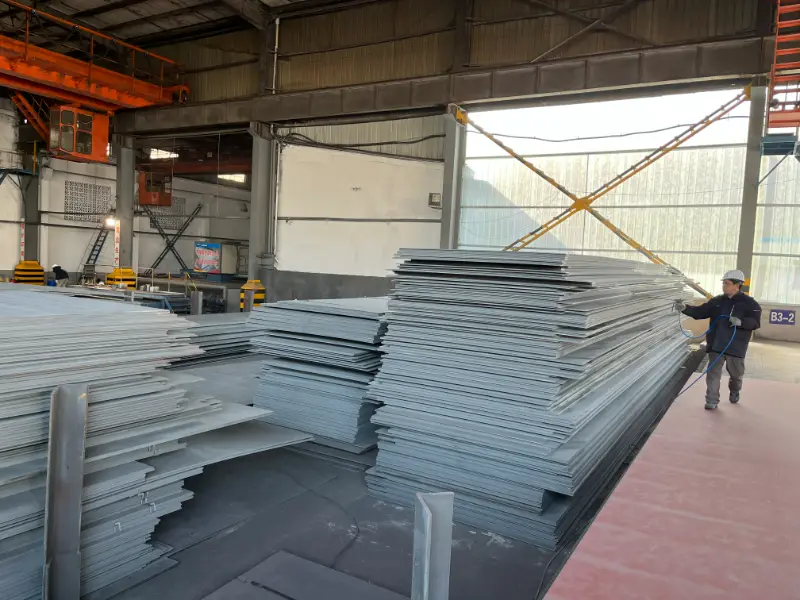
S355J0WP Weather Resistant Steel Plate
EN10025-5 S355J0WP Weather Resistant Steel Plate: Properties, Equivalents & Applications
Explore EN 10025-5 S355J0WP weather resistant steel plate with detailed chemical composition, mechanical properties, thermal and electrical data, complete international equivalents, and application guide.
Hot rolling, cold forming, welding, cutting, punching, riveting
- Phone : +8618037372205
- Email : [email protected]
- WhatsApp: Contact via Whtsapp
- WeChat: +8618037372205
S355J0WP Weather Resistant Steel Plate Introduction
S355J0WP is a hot-rolled weather-resistant structural steel grade defined in EN 10025-5. It features enhanced atmospheric corrosion resistance due to a deliberate phosphorus content (0.06–0.15%) and the presence of copper, chromium, and nickel. The alloy forms a stable, protective patina under cyclic wet-dry conditions, often eliminating the need for painting. With a minimum yield strength of 355 MPa and guaranteed impact energy of 27 J at 0°C (J0), this grade is suitable for welded, bolted, and riveted structures in outdoor environments. Common delivery forms include plates, sheets, and strips, primarily used in bridges, facades, containers, and industrial buildings.
S355J0WP Weather Resistant Steel Plate Chemical Composition
The chemical composition of S355J0WP according to EN 10025-5:2019 is shown below. The phosphorus range (0.06–0.15%) is intentionally higher than in standard structural steels, which together with copper, chromium, and nickel promotes the formation of a dense, adherent oxide layer that protects against further corrosion. Nitrogen is limited to ensure sufficient toughness. Total aluminium may be specified if grain refinement is required.
| Element | Standard Value (max unless range) | Remarks |
|---|---|---|
| Carbon (C) | ≤ 0.12 | Heat analysis |
| Silicon (Si) | ≤ 0.75 | |
| Manganese (Mn) | ≤ 1.0 | |
| Phosphorus (P) | 0.06 – 0.15 | Key element for weathering resistance |
| Sulfur (S) | ≤ 0.035 | |
| Chromium (Cr) | 0.30 – 1.25 | |
| Copper (Cu) | 0.25 – 0.55 | Enhances patina formation |
| Nickel (Ni) | ≤ 0.65 | |
| Nitrogen (N) | ≤ 0.009 | For thin gauge, may be adjusted |
S355J0WP Weather Resistant Steel Plate Thermal and Electrical Physical Properties
The following physical properties are typical for weather-resistant structural steel similar to S355J0WP. They are not part of the EN 10025-5 delivery conditions but are provided for design calculations. Values may vary slightly depending on the exact composition and manufacturing route. These data are compiled from reliable published sources for low-alloy steels with weathering characteristics.
| Property | Typical Reference Value | Unit | Test Condition / Remarks |
|---|---|---|---|
| Density (ρ) | 7.85 | g/cm³ | Room temperature |
| Modulus of elasticity (E) | 210 | GPa | Room temperature, tensile |
| Shear modulus (G) | 81 | GPa | Calculated from E and ν |
| Poisson's ratio (ν) | 0.3 | - | Within elastic range |
| Coefficient of thermal expansion (α) | 11.1 | 10⁻⁶/K | 20 – 100°C |
| Coefficient of thermal expansion (α) | 12.5 | 10⁻⁶/K | 20 – 200°C |
| Coefficient of thermal expansion (α) | 13.3 | 10⁻⁶/K | 20 – 400°C |
| Thermal conductivity (λ) | 42 | W/(m·K) | At 20°C |
| Specific heat capacity (cp) | 460 | J/(kg·K) | At 20°C |
| Electrical resistivity (ρₑ) | 0.21 | μΩ·m | At room temperature |
S355J0WP Weather Resistant Steel Plate Mechanical Properties
Mechanical properties of S355J0WP are specified in EN 10025-5:2019 for flat products. Yield strength decreases with increasing thickness. The tensile strength range applies to all thicknesses up to 100 mm. Minimum elongation values refer to a gauge length of L₀ = 5.65√S₀ (A5). Charpy-V impact tests are performed at 0°C; the guaranteed minimum absorbed energy is 27 J for longitudinal specimens (t ≥ 6 mm). Properties are valid for the as-rolled or normalized condition.
| Property | Standard Required Value | Unit | Test Condition |
|---|---|---|---|
| Yield strength (ReH) | 355 | MPa | Thickness ≤ 16 mm |
| Yield strength (ReH) | 345 | MPa | 16 mm < thickness ≤ 40 mm |
| Yield strength (ReH) | 335 | MPa | 40 mm < thickness ≤ 63 mm |
| Yield strength (ReH) | 325 | MPa | 63 mm < thickness ≤ 80 mm |
| Yield strength (ReH) | 315 | MPa | 80 mm < thickness ≤ 100 mm |
| Tensile strength (Rm) | 470 – 630 | MPa | Thickness ≤ 100 mm |
| Elongation (A) (L₀ = 5.65√S₀) | ≥ 20 | % | Thickness ≤ 40 mm, longitudinal |
| Elongation (A) | ≥ 19 | % | 40 mm < thickness ≤ 63 mm, longitudinal |
| Elongation (A) | ≥ 18 | % | 63 mm < thickness ≤ 100 mm, longitudinal |
| Impact energy (KV₂) at 0°C | ≥ 27 | J | Longitudinal, t ≥ 6 mm |
S355J0WP Weather Resistant Steel Plate Exact Equivalent Material Standards and Substitutable Grades
| Country / Region | Standard | Grade | Remarks |
|---|---|---|---|
| European Union | EN 10025-5:2019 | S355J0WP | Original grade |
| International (ISO) | ISO 4952:2003 | Fe355W1 | Mechanical and chemical equivalence |
| Germany | DIN EN 10025-5 | S355J0WP (1.8959) | Direct adoption of EN standard, material number 1.8959 |
| United Kingdom | BS EN 10025-5 | S355J0WP | Direct adoption |
| France | NF EN 10025-5 | S355J0WP | Direct adoption |
| Italy | UNI EN 10025-5 | S355J0WP | Direct adoption |
| Spain | UNE EN 10025-5 | S355J0WP | Direct adoption |
S355J0WP Weather Resistant Steel Plate Application Introduction
S355J0WP is widely employed in structural applications exposed to the weather, where the self-protecting patina reduces maintenance costs. It can be used unpainted in many environments, though careful detailing is required to avoid crevices and prolonged wetness. The steel is readily weldable using standard methods for weathering steel, and cold forming is possible for moderate radii.
Product Applications: Weather-resistant steel plates for bridge girders, Facade cladding panels and architectural siding, Container corrugated sheets and frames, Ventilation ducts and chimney components, Light poles and high-mast structures, Earth-moving and agricultural equipment bodies
Processed into products: Girders, ribs, and diaphragms in composite bridges, Load-bearing facade mullions and transoms, Container corner fittings and rail supports, Hinges, brackets, and stiffeners for industrial doors, Tower leg angles and flange plates, Chute liners and hopper plates
Application industries: Bridge construction (road, rail, pedestrian), Portrait architecture and building envelopes, Freight containers and intermodal equipment, Railway vehicles and rolling stock, Transmission towers and telecommunication masts, Industrial chimneys and exhaust ducts, Agricultural machinery and silos, Offshore and coastal structures (with additional corrosion allowance)
S355J0WP Weather Resistant Steel Plate Near / Similar Alternative Material Recommendations
| Country / Region | Standard | Grade | Remarks |
|---|---|---|---|
| USA | ASTM A588/A588M | Grade A (Grade B) | Minimum yield 345 MPa (50 ksi); weathering properties similar; phosphorus content not specifically elevated; check impact requirements. |
| Japan | JIS G3114 | SMA490AW | Minimum yield 355 MPa, tensile 490-610 MPa, impact 27 J at 0°C; typical weathering steel. |
| China | GB/T 4171 | Q355GNH (09CuPCrNi-A) | Minimum yield 355 MPa, enhanced atmospheric corrosion resistance; similar phosphorus range. |
| Europe | EN 10025-5 | S355J2WP | Impact at -20°C instead of 0°C; otherwise comparable weathering properties. |
| Europe | EN 10025-5 | S355J0W | Weathering steel with lower phosphorus (P max 0.035) and different corrosion index; suitable for less aggressive atmospheres. |
Notes:
Welding considerations: Matching weathering steel electrodes (e.g., EN ISO 2560-B E 46 Z W, AWS E7018-W1) should be used to ensure the weld zone develops a uniform patina.
- Cold forming: Recommended minimum bend radii follow EN 10025-5. Cracking is unlikely for moderate bends if the material is free from edge defects.
- Corrosion: The protective patina forms after about 2–5 years of alternating wet/dry cycles. Performance is poor in constantly wet or heavily polluted (SO₂, Cl⁻) environments without added protection.
- Certification: EN 10204 type 3.1 or 3.2 inspection documents are normally supplied. Impact tests are mandatory for quality J0.
- Share



