
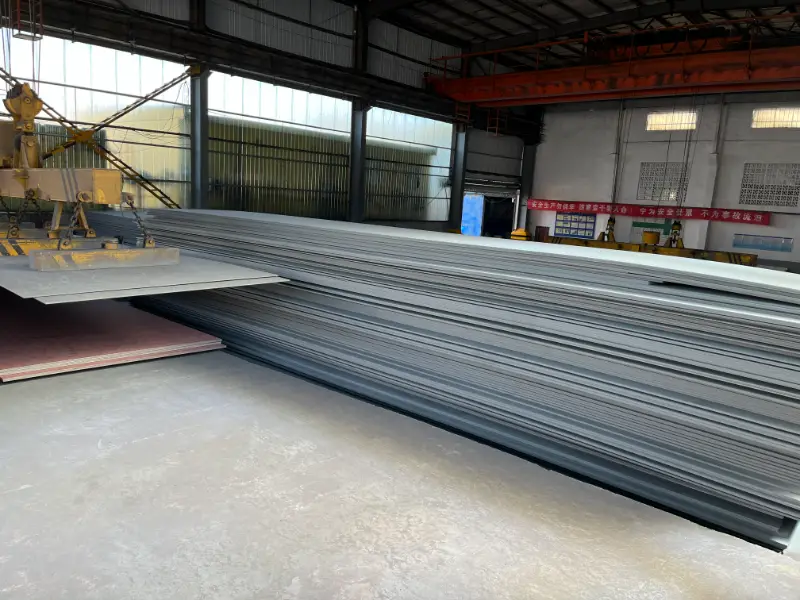
EN10025-5 S235J2W Weather Resistant Steel Plate
S235J2W Weathering Steel – EN 10025-5 Structural Plate Data & Equivalents
Complete material profile for EN 10025-5 S235J2W atmospheric corrosion resistant structural steel: chemical composition, mechanical and physical properties, international equivalents and processing guide.
Hot rolling, welding, bolting, cold forming, machining, thermal cutting
- Phone : +8618037372205
- Email : [email protected]
- WhatsApp: Contact via Whtsapp
- WeChat: +8618037372205
EN10025-5 S235J2W Weather Resistant Steel Plate Introduction
S235J2W is a hot-rolled structural steel with improved atmospheric corrosion resistance (weathering steel) specified in the European standard EN 10025-5:2004. It is alloyed with small amounts of copper, chromium and nickel to form a protective patina that resists corrosion in outdoor exposure without painting. Material number: 1.8958.
Key features:
- Minimum yield strength of 235 MPa (≤16 mm thickness)
- Guaranteed impact toughness at -20 °C (J2 quality level)
- Excellent weldability and cold formability
- Self-protecting rust layer reduces maintenance
- Suitable for welded, bolted and riveted structures
Typical applications include uncoated steel structures, bridges, containers, rail vehicles and architectural cladding.
EN10025-5 S235J2W Weather Resistant Steel Plate Chemical Composition
The chemical composition of S235J2W is designed for atmospheric corrosion resistance by deliberate additions of Cu, Cr, and Ni. The maximum phosphorus and sulfur contents are controlled to ensure good weldability and notch toughness. Values are in accordance with EN 10025-5:2004, Table 1 for grade S235J2W (1.8958).
| Element | Heat analysis (max %) | Remarks |
|---|---|---|
| Carbon (C) | ≤ 0.13 | |
| Silicon (Si) | ≤ 0.40 | |
| Manganese (Mn) | 0.20 – 0.60 | |
| Phosphorus (P) | ≤ 0.040 | Typically lower for J2 quality |
| Sulfur (S) | ≤ 0.035 | |
| Chromium (Cr) | 0.40 – 0.80 | Essential for patina formation |
| Copper (Cu) | 0.25 – 0.55 | Essential for patina formation |
| Nickel (Ni) | ≤ 0.65 | Improves toughness and corrosion resistance |
| Nitrogen (N) | ≤ 0.012 | Usually not intentionally added |
| Aluminium (Al) | ≥ 0.020 (if used for grain refinement) | Optional, or other grain refining elements |
EN10025-5 S235J2W Weather Resistant Steel Plate Thermal and Electrical Properties
The physical property values listed below are typical for low‑alloy weathering steels at room temperature and atmospheric pressure. They are based on published data for comparable low‑carbon structural steels and may vary slightly with composition and microstructure. Values serve for design calculations but are not mandatory inspection items in EN 10025-5.
| Property | Typical value | Unit | Test condition / Remarks |
|---|---|---|---|
| Density (ρ) | 7.85 | g/cm³ | 20 °C |
| Modulus of elasticity (E) | 210 | GPa | 20 °C, longitudinal |
| Shear modulus (G) | ≈ 81 | GPa | Calculated from E and ν |
| Poisson's ratio (ν) | 0.3 | – | Elastic region |
| Thermal expansion coefficient (α) | 12.5 × 10⁻⁶ | K⁻¹ | 20 – 100 °C |
| Thermal expansion coefficient (α) | 13.2 × 10⁻⁶ | K⁻¹ | 20 – 200 °C |
| Thermal conductivity (λ) | 50 | W/(m·K) | 20 °C |
| Thermal conductivity (λ) | 47 | W/(m·K) | 100 °C |
| Specific heat capacity (cp) | 460 | J/(kg·K) | 20 °C |
| Specific heat capacity (cp) | 500 | J/(kg·K) | 100 °C |
| Electrical resistivity (ρe) | ~ 0.25 × 10⁻⁶ | Ω·m | At 20 °C; typical for low‑alloy steel |
EN10025-5 S235J2W Weather Resistant Steel Plate Mechanical Properties
Mechanical properties are guaranteed for products in the as-delivered condition according to EN 10025-5. Minimum values depend on product thickness. The longitudinal (L) or transverse (T) direction is specified where different. Impact test is carried out on Charpy-V specimens at -20 °C (J2 quality). Bending test is applicable to flat products.
| Property | Value | Unit | Test condition / Thickness range |
|---|---|---|---|
| Yield strength ReH | ≥ 235 | MPa | t ≤ 16 mm |
| Yield strength ReH | ≥ 225 | MPa | 16 mm < t ≤ 40 mm |
| Yield strength ReH | ≥ 215 | MPa | 40 mm < t ≤ 63 mm |
| Yield strength ReH | ≥ 215 | MPa | 63 mm < t ≤ 80 mm |
| Yield strength ReH | ≥ 215 | MPa | 80 mm < t ≤ 100 mm |
| Tensile strength Rm | 360 – 510 | MPa | t ≤ 100 mm |
| Tensile strength Rm | 350 – 500 | MPa | 100 mm < t ≤ 150 mm (agreed at inquiry) |
| Elongation A (L=5.65√S₀) | ≥ 24 | % | t ≤ 40 mm (transverse) |
| Elongation A | ≥ 23 | % | 40 mm < t ≤ 63 mm |
| Elongation A | ≥ 22 | % | 63 mm < t ≤ 100 mm |
| Impact energy KV (-20 °C) | ≥ 27 (min.) | J | Longitudinal, Charpy V-notch |
| Bend test (mandrel diameter) | No cracks – 1t | t ≤ 16 mm (transverse test piece) | |
| Bend test | No cracks – 1.5t | 16 mm < t ≤ 25 mm | |
| Bend test | No cracks – 2t | 25 mm < t ≤ 40 mm |
EN10025-5 S235J2W Weather Resistant Steel Plate Fully Equivalent Standards and Replaceable Grade Designations
| Country/Region | Standard | Grade | Remarks |
|---|---|---|---|
| Europe | EN 10025-5:2004 | S235J2W (1.8958) | Current European standard |
| Europe (withdrawn) | EN 10155:1993 | S235J2W (1.8958) | Predecessor standard; fully equivalent technical delivery conditions |
| France (AFNOR) | NF A 35-502 (withdrawn) | E 24 W 4 | Historical French designation for similar weathering steel |
| Germany (DIN) | DIN 17119 (withdrawn) | WTSt 37-3 | Old German material, comparable chemistry but may differ in toughness requirement |
| International (ISO) | ISO 4952:2006 | Fe 235W B | ISO grade with similar minimum yield strength and corrosion resistance; B suffix implies impact requirements |
EN10025-5 S235J2W Weather Resistant Steel Plate Application Introduction
S235J2W weathering steel is designed for exposed structures where a stable, protective rust layer (patina) eliminates the need for painting and reduces lifecycle costs. Key application rules:
- The material must be freely exposed to the atmosphere to form a uniform patina; avoid long‑term water pooling or permanent wetness.
- Design details should prevent crevices and deposits that trap moisture.
- In aggressive industrial or marine-heavy environments, paint or additional protection may be required on sheltered surfaces.
- Welding consumables must be matched to provide equivalent weld metal corrosion resistance (e.g., low-alloy filler with copper and nickel).
- The grade is fully weldable by all common processes (SMAW, GMAW, SAW) without preheating for thicknesses normally encountered.
- Galvanic corrosion must be considered when connecting dissimilar metals.
Product Applications: Uncoated steel bridges and overpasses, Weathering steel building envelopes and sunshades, Exterior stairs, fire escapes, and walkways, Container panels and intermodal container frames, Electricity pylons and transmission pole supports, Railway car body shells and hopper wagons, Structural frames for industrial halls and storage sheds
Processed into products: Welded I-beams and box girders, Flange and web plates in plate girders, Bent and folded architectural cladding panels, Cold-formed or press-braked stiffeners, Bolted connection plates and end plates, Laser-, plasma- or flame-cut blanks for further fabrication, Welded tubular poles and masts
Application industries: Civil engineering and infrastructure, Bridge construction (composite steel-concrete bridges, pedestrian bridges), Building and architecture (exposed facades, roof cladding, sculptures), Freight wagons, truck chassis, and rolling stock manufacturing, Transmission towers and telecommunications masts, Container and silo production, Agricultural and earth-moving equipment
EN10025-5 S235J2W Weather Resistant Steel Plate Similar and Alternative Weathering Steel Grades
| Country/Region | Standard | Grade | Remarks |
|---|---|---|---|
| Europe | EN 10025-5 | S355J2W | Higher minimum yield strength (355 MPa); otherwise same corrosion resistance concept and thickness range |
| Europe | EN 10025-5 | S235J0W | Same strength level but lower notch toughness (27 J at 0 °C instead of -20 °C) |
| Europe | EN 10025-5 | S235J2WP | Similar strength and toughness; higher phosphorus content for enhanced corrosion protection but may affect welding |
| USA | ASTM A242 / A242M | Type 1 | Minimum yield 345 MPa (50 ksi) so it is stronger; atmospheric corrosion resistance approximately 4× carbon steel |
| USA | ASTM A588 / A588M | Grade A | Minimum yield 345 MPa; used for painted or unpainted applications; often called Corten A equivalent |
| Japan | JIS G 3125 | SPA-H | High weather resistance; minimum tensile strength 490 MPa, yield ≈ 355 MPa; widely used for containers and rolling stock |
| China | GB/T 4171 | Q235NH | Yield 235 MPa tensile 360‑510 MPa; close match in strength but impact test temperature may differ |
Notes:
Patina development: The protective oxide layer normally forms after 1–3 years of natural exposure depending on climate and wet‑dry cycles.
Certification: Products are supplied with inspection certificate 3.1 per EN 10204 unless otherwise agreed.
Thickness range: EN 10025-5 covers nominal thicknesses up to 150 mm for S235J2W; properties for thicker plates must be agreed at the time of inquiry.
Weldability: Carbon equivalent (CEV) typically ≤ 0.44, ensuring good weldability without preheat for plate thicknesses up to approx. 30 mm in moderate restraint. For greater thickness or high restraint, a preheat of 50‑100 °C may be applied.
Corrosion rate: In rural or moderate urban environments, corrosion loss is expected to be less than 0.03 mm/year after the patina is established.
- Share



