
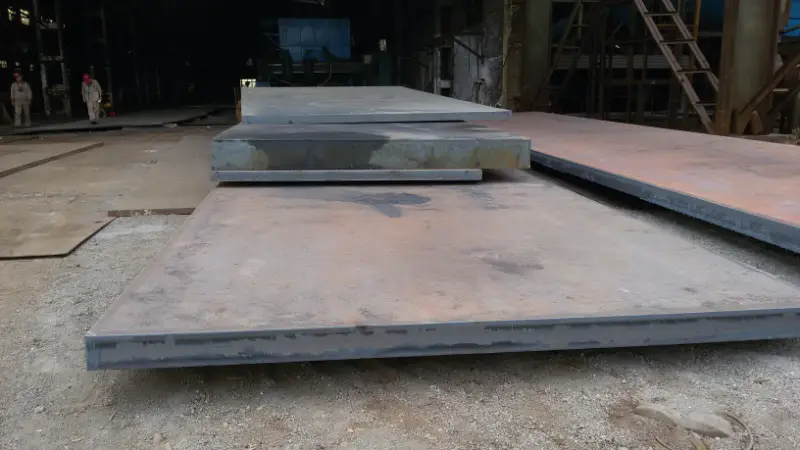
S355J0W Weathering Steel
S355J0W Weathering Steel: Superior Atmospheric Corrosion Resistance per EN 10025-5
Comprehensive data for EN 10025-5 S355J0W weather resistant steel plate including chemical composition, mechanical properties, physical properties, international equivalents, and application examples. Ideal for bridges, containers, and structural projects.
Hot rolling, cold forming, welding, machining, punching, oxy-fuel cutting
- Phone : +8618037372205
- Email : [email protected]
- WhatsApp: Contact via Whtsapp
- WeChat: +8618037372205
S355J0W Weathering Steel Introduction
S355J0W is a hot-rolled structural weathering steel defined in EN 10025-5:2019, designed for enhanced atmospheric corrosion resistance through the addition of alloying elements such as copper, chromium, and nickel. This steel develops a protective rust-like patina when exposed to the weather, eliminating the need for paint in many environments and significantly reducing maintenance costs. With a minimum yield strength of 355 MPa (for thickness up to 16 mm) and guaranteed Charpy impact toughness at 0°C (J0 quality), it combines structural integrity with excellent weldability and formability. Typical applications include
- Bridges and viaducts
- Architectural facades
- Railway rolling stock
- Shipping containers
- Transmission towers
Its balanced chemistry ensures consistent mechanical properties in the as-rolled or normalized condition.
S355J0W Weathering Steel Chemical Composition
The table below lists the ladle analysis limits for S355J0W as specified in EN 10025-5:2019. The weathering alloying elements Cu, Cr, Ni ensure the formation of a dense, adherent oxide layer. Residual elements are controlled to maintain weldability and notch toughness at 0°C. If nitrogen-binding elements (e.g., Al, V, Nb, Ti) are added, their contents must be reported on the inspection certificate.
| Element | Value (%) | Remarks |
|---|---|---|
| Carbon (C) | ≤0.19 | Max. |
| Silicon (Si) | ≤0.55 | Max. |
| Manganese (Mn) | 0.45 – 1.60 | Range |
| Phosphorus (P) | ≤0.035 | Max. |
| Sulfur (S) | ≤0.035 | Max. |
| Chromium (Cr) | 0.35 – 0.85 | Weathering element |
| Copper (Cu) | 0.20 – 0.60 | Weathering element |
| Nickel (Ni) | ≤0.70 | Weathering element |
| Molybdenum (Mo) | ≤0.35 | Optional, if added |
| Vanadium (V) | ≤0.14 | Optional, if added |
| Niobium (Nb) | ≤0.065 | Optional, if added |
| Titanium (Ti) | ≤0.14 | Optional, if added |
| Aluminium (Al total) | ≥0.020 | If sufficient for nitrogen binding |
| Nitrogen (N) | ≤0.015 | If not bound by Al or other elements |
S355J0W Weathering Steel Thermal and Electrical Physical Properties
The physical property data below are approximate room‑temperature values for low‑alloy weathering steels similar to S355J0W. They are collected from published literature and steel manuals and are suitable for engineering calculations. Actual values may vary slightly depending on exact composition and heat treatment. Properties at elevated temperature follow typical trends for carbon‑manganese steels.
| Property | Typical Value | Unit | Condition / Temperature |
|---|---|---|---|
| Density (ρ) | 7.85 | g/cm³ | 20 °C |
| Elastic Modulus (E) | 210 | GPa | 20 °C, static |
| Shear Modulus (G) | ~81 | GPa | 20 °C, calculated |
| Poisson's Ratio (ν) | ~0.3 | — | Elastic range |
| Thermal Expansion Coefficient (α) | 11.1 | 10⁻⁶/K | 20 – 100 °C |
| Thermal Expansion Coefficient (α) | 12.5 | 10⁻⁶/K | 20 – 200 °C |
| Thermal Expansion Coefficient (α) | 13.5 | 10⁻⁶/K | 20 – 400 °C |
| Thermal Conductivity (λ) | 42 – 48 | W/(m·K) | 20 °C |
| Specific Heat Capacity (cp) | 460 – 480 | J/(kg·K) | 20 °C |
| Electrical Resistivity (ρe) | 0.20 – 0.30 | µΩ·m | 20 °C |
S355J0W Weathering Steel Mechanical Properties
The following mechanical properties apply to flat products of S355J0W in the as-rolled condition. Tensile testing is performed on transverse specimens according to EN ISO 6892-1, and Charpy V‑notch impact tests are carried out in accordance with EN ISO 148-1. Values depend on product thickness; the table provides the minimum requirements from EN 10025-5:2019, Table 7.
| Property | Required Value | Unit | Test Conditions / Thickness Range |
|---|---|---|---|
| Yield Strength (ReH), min. | 355 | MPa | t ≤ 16 mm |
| Yield Strength (ReH), min. | 345 | MPa | 16 mm < t ≤ 40 mm |
| Yield Strength (ReH), min. | 335 | MPa | 40 mm < t ≤ 63 mm |
| Yield Strength (ReH), min. | 325 | MPa | 63 mm < t ≤ 80 mm |
| Yield Strength (ReH), min. | 315 | MPa | 80 mm < t ≤ 100 mm |
| Yield Strength (ReH), min. | 295 | MPa | 100 mm < t ≤ 150 mm |
| Tensile Strength (Rm) | 470 – 630 | MPa | t ≤ 100 mm |
| Tensile Strength (Rm) | 450 – 600 | MPa | 100 mm < t ≤ 150 mm |
| Elongation (A), min., L0=5.65√S0 | 22 | % | t ≤ 40 mm, transverse |
| Elongation (A), min., L0=5.65√S0 | 21 | % | 40 mm < t ≤ 63 mm, transverse |
| Elongation (A), min., L0=5.65√S0 | 20 | % | 63 mm < t ≤ 100 mm, transverse |
| Elongation (A), min., L0=5.65√S0 | 18 | % | 100 mm < t ≤ 150 mm, transverse |
| Impact Energy (KV2), min. | 27 | J | 0 °C, longitudinal, average of 3 tests |
S355J0W Weathering Steel Fully Equivalent Material Standards and Replaceable Grades
| Country/Region | Standard | Grade | Remarks |
|---|---|---|---|
| Europe | EN 10025-5 | S355J0W | Base standard, 0 °C impact, atmospheric corrosion resistant |
| Germany | DIN EN 10025-5 | S355J0W | Identical adoption of EN standard |
| France | NF EN 10025-5 | S355J0W | Identical adoption |
| UK | BS EN 10025-5 | S355J0W | Identical adoption |
| Italy | UNI EN 10025-5 | S355J0W | Identical adoption |
| Spain | UNE EN 10025-5 | S355J0W | Identical adoption |
| Japan | JIS G 3114 | SMA490CW | Comparable weathering steel, 0 °C impact (Cu-Cr-Ni added), yield min ~365 MPa for thin gauges |
| China | GB/T 4171 | Q355NH | Near equivalent, yield ≥355 MPa, 0 °C toughness class D/E depending on impact requirement |
| USA | ASTM A588/A588M | Grade A (or Grade B) | Similar weathering steel, min YS 345 MPa (50 ksi), not identical but widely interchangeable in structural design |
| Russia | GOST R 55374 | 16Д (16D) or 17G1S-U | Comparable weathering steel, some grades with Cu-Cr-Ni addition |
S355J0W Weathering Steel Application Introduction
S355J0W is designed for welded, bolted, and riveted structures that are exposed to the weather and require longer service life with minimal maintenance. The characteristic patina not only protects but also gives an attractive ochre‑brown appearance. It is widely used when weight reduction by leaving off protective coatings is desired or when painting is difficult. However, it should not be used in permanently wet or marine‑chloride environments without additional protection.
Product Applications: Uncoated steel bridges and footbridges, Facade cladding panels and roofing, Welded beams and columns for exposed frameworks, Shipping containers (Corten steel containers), Railway coal/gondola cars and hopper wagons, Electricity pylons and antenna masts, Wind‑screening panels and noise barriers, Monolithic sculptures and public artwork
Processed into products: Structural beams (IPE, HEA, HEB profiles) and hollow sections, Plate girders and box sections for bridges, Bent or cold‑formed profiles for architectural elements, Laser‑cut or flame‑cut parts for heavy machinery frames, Welded fabrications such as support brackets and base plates, Formed sheet metal parts for vehicle bodies
Application industries: Civil engineering and infrastructure, Bridge construction, Architecture and building envelopes, Railway rolling stock manufacturing, Container and freight wagon production, Power transmission and telecommunications towers, Shipbuilding (limited, for non‑immersed structures), Art and landscape architecture
S355J0W Weathering Steel Similar or Closely Related Weathering Steel Grades
| Country/Region | Standard | Grade | Remarks |
|---|---|---|---|
| Europe | EN 10025-5 | S355J2W | Higher toughness: min. 27 J at -20 °C, otherwise chemistry and strength similar |
| Europe | EN 10025-5 | S355K2W | Even higher toughness: min. 40 J at -20 °C, suitable for demanding cold-climate applications |
| Europe | EN 10025-5 | S355J0WP | Higher phosphorus variant for improved weathering, wall thickness limitations due to P content |
| Europe | EN 10025-5 | S355J2WP | Combines -20 °C toughness with high‑P weathering composition |
| USA | ASTM A588/A588M | Grade B | Mn range slightly different, but similar strength and weathering concept |
| USA | ASTM A242 | Type 1 / Type 2 | Legacy weathering steel, YS ≥ 345 MPa or 290 MPa depending on thickness, high Cu content |
| Japan | JIS G 3114 | SMA490AW | As‑rolled weathering steel, 0 °C class not guaranteed; check impact requirement |
| Japan | JIS G 3114 | SMA490BW | Normalized weathering, impact test at 0 °C may be special agreement |
| China | GB/T 4171 | Q415NH | Higher strength grade (min YS 415 MPa), same weathering philosophy, can replace S355J0W where higher strength is acceptable |
Notes:
- Welding: Use low‑hydrogen welding consumables matched to the alloy content; preheating may be necessary for thick plates or high restraint conditions.
- Paint and coating: If aesthetic requirements or specific exposure conditions demand painting, the protective patina must be properly prepared by brush blasting and a suitable primer must be applied.
- Design consideration: Drainage holes and avoidance of crevices are essential to ensure proper wet/dry cycling for the patina to form correctly.
- Availability: Thickness range up to 150 mm for plates and up to 100 mm for sections, depending on mill. Certificates EN 10204 type 3.1 typically supplied.
- Supplementary requirements: Options like ultrasonic testing, through‑thickness properties (Z‑quality), or ship classification society approval can be agreed at the time of order.
- Share



