
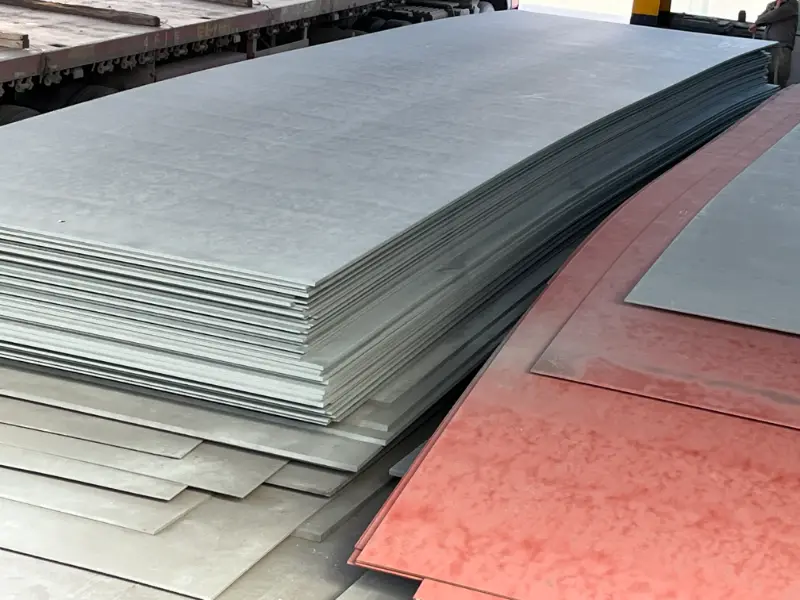
Q/BQB 310-2009 B420L
Q/BQB 310-2009 B420L Hot Rolled Automotive Structural Steel Plate Properties and Equivalents
Detailed data sheet of B420L steel under Q/BQB 310-2009, including chemical composition, mechanical properties, physical performance, international equivalents, and application guide.
Hot rolling, cold forming, stamping, welding, bending, cutting
- Phone : +8618037372205
- Email : [email protected]
- WhatsApp: Contact via Whtsapp
- WeChat: +8618037372205
Q/BQB 310-2009 B420L Introduction
B420L is a hot-rolled high-strength low-alloy (HSLA) steel grade specified in Q/BQB 310-2009, Baosteel's enterprise standard for automobile structural steel plates and strips. It features a minimum tensile strength of 420 MPa combined with good formability and weldability. The steel is primarily designed for automotive structural components that require weight reduction without sacrificing strength. With a refined grain structure achieved through microalloying elements (Nb, Ti), B420L offers enhanced toughness and fatigue resistance. Its low carbon equivalent ensures excellent weldability, making it suitable for various joining processes. Typical applications include chassis parts, longitudinal beams, cross members, and other load-bearing elements.
Q/BQB 310-2009 B420L Chemical Composition
The chemical composition of B420L is controlled to achieve a fine ferrite-pearlite or bainitic microstructure with microalloy precipitates. Tight limits on carbon and sulfur/phosphorus ensure good weldability and toughness. Niobium and/or titanium are added for grain refinement and precipitation strengthening.
| Element | Specified Value | Remarks |
|---|---|---|
| C | ≤0.12 | Max 0.10 for improved formability per typical practice |
| Si | ≤0.50 | |
| Mn | ≤1.20 | 1.40 max in some thickness ranges; enhances strength |
| P | ≤0.030 | |
| S | ≤0.025 | Lower S (≤0.015) often preferred for better toughness |
| Alt (total Al) | ≥0.015 | Kill agent; grain refinement |
| Nb | ≤0.09 | Optional microalloy for grain refinement and precipitation hardening |
| Ti | ≤0.15 | Optional microalloy, alone or combined with Nb |
Q/BQB 310-2009 B420L Thermal and Electrical Physical Properties
Physical properties are typical for low-carbon microalloyed steels. They are not part of the Q/BQB 310 acceptance criteria but are provided for engineering design. Values at room temperature unless otherwise noted.
| Property | Typical Value | Unit | Test Condition |
|---|---|---|---|
| Density (ρ) | 7.85 | g/cm³ | 20 °C |
| Elastic modulus (E) | 210 | GPa | 20 °C, static |
| Shear modulus (G) | ≈81 | GPa | 20 °C, calculated from E and ν |
| Poisson's ratio (ν) | 0.30 | — | 20 °C, elastic range |
| Thermal expansion (α) | 11.7 × 10⁻⁶ | K⁻¹ | 20–100 °C |
| Thermal expansion (α) | 12.5 × 10⁻⁶ | K⁻¹ | 20–200 °C |
| Thermal conductivity (λ) | ≈50 | W/(m·K) | 100 °C |
| Specific heat capacity (c) | ≈460 | J/(kg·K) | 20 °C |
| Electrical resistivity (ρ_e) | ≈0.13 × 10⁻⁶ | Ω·m | 20 °C |
Q/BQB 310-2009 B420L Mechanical Properties
Mechanical properties are evaluated on transverse test pieces according to Q/BQB 310. The steel exhibits a minimum yield strength of 255 MPa and guaranteed tensile strength range of 420-540 MPa. Elongation depends on gauge length and thickness. Bending performance is excellent, with tight bend radii achievable.
| Property | Required Value | Unit | Test Condition |
|---|---|---|---|
| Yield strength (ReH) | ≥255 | MPa | Transverse, t≤6.0 mm, lower yield or 0.2% proof stress |
| Tensile strength (Rm) | 420–540 | MPa | Transverse, t≤6.0 mm |
| Elongation (A) | ≥26 | % | Gauge length L₀=80 mm, width 20 mm, t<3.0 mm |
| Elongation (A) | ≥28 | % | Gauge length L₀=80 mm, width 20 mm, t≥3.0 mm |
| Elongation (A) | ≥24 | % | Gauge length L₀=50 mm, width 25 mm, t≤6.0 mm (alternative) |
| Bend test (180°) | d=0a | Bend diameter equal to specimen thickness, t≤6.0 mm |
Q/BQB 310-2009 B420L Full Equivalent Standards and Replaceable Grades
| Country/Region | Standard | Grade | Remarks |
|---|---|---|---|
| Europe | EN 10149-2 | S420MC | Thermomechanically rolled, comparable strength and formability, high-S tolerance slightly different |
| Japan | JFS A 2001 | JSH440R | Hot rolled steel sheet for automobile structures, equivalent tensile class |
| Japan | JIS G 3113 | SAPH440 | Closest match in SAPH series, though SAPH440 allows slightly higher P and S |
| International | ISO 4997 | HSLA340 | Designation based on yield strength; similar composition but lower tensile minimum |
Q/BQB 310-2009 B420L Application Introduction
B420L is specifically tailored for the automotive industry, where a balance of strength, ductility, and weldability is needed. It is used in safety-critical and load-bearing structures. The steel performs well in cold forming operations like bending and drawing, and is compatible with various welding techniques.
Product Applications: Chassis frames and subframes, Longitudinal and cross beams, Suspension control arms and links, Wheel rims and spokes, Bumper reinforcement beams, Seat frames and sliding rails, Transmission support brackets
Processed into products: Stamped body-in-white reinforcements, Laser-welded tailored blanks for door pillars, Hydroformed engine cradles, Cold-formed brackets and reinforcements, Roll-formed side impact beams
Application industries: Automotive manufacturing, Commercial vehicle and trailer construction, Railway cars (non-pressure parts), Agricultural machinery, Construction equipment (light structural parts)
Q/BQB 310-2009 B420L Similar / Analogous Substitute Materials
| Country/Region | Standard | Grade | Remarks |
|---|---|---|---|
| China | GB/T 20887 (or GB/Q/BQB) | HR420LA (or similar) | Cold-rolled HSLA grade with comparable strength, requiring different processing |
| Germany | DIN EN 10149-2 | S420MC | Same as EN grade, widely accepted substitute |
| USA | SAE J1392 | 050XK (approximate) | HSLA grade 050XK with 50 ksi minimum yield, roughly comparable |
| South Korea | KS D 3512 | SAPH440 | Korean standard equivalent to JIS SAPH440 |
| India | IS 11513 | Fe 410 (tentative) | Based on tensile strength; requires checks on elongation |
Notes:
Additional considerations:
- B420L can be supplied as pickled and oiled (PO) to improve surface quality and prevent rust.
- Controlled sulfur and phosphorus levels are crucial for cold-forming edge quality.
- The steel exhibits good fatigue resistance, making it suitable for dynamic loads.
- For welding, low carbon equivalent (typically ≤0.22) minimizes cold cracking risk; preheating is usually unnecessary for thicknesses up to 6 mm.
- Normalizing is not required; the as-rolled microstructure provides the designed properties.
- Alternative grades with higher strength (e.g., B460L, B500L) are available in the same Baosteel standard for increased load capacity.
- Share



