
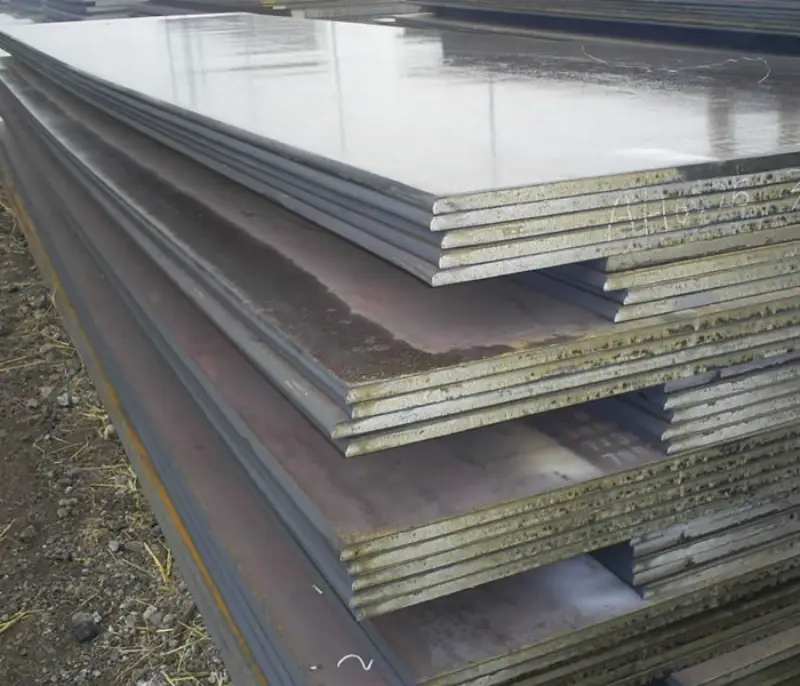
B320L Automotive Structural Steel
B320L Automotive Structural Steel - High Strength, Excellent Formability for Lightweight Designs
B320L is a hot-rolled high-strength low-alloy steel for automotive structural applications. With a minimum yield strength of 320 MPa, it offers good cold formability and weldability, enabling weight reduction while maintaining safety performance. Compliant with Baosteel Q/BQB 310-2009.
Cold forming, stamping, bending, welding, cutting, piercing
- Phone : +8618037372205
- Email : [email protected]
- WhatsApp: Contact via Whtsapp
- WeChat: +8618037372205
B320L Automotive Structural Steel Introduction
B320L is a hot-rolled, high-strength low-alloy (HSLA) steel grade specifically developed for automotive structural components. Manufactured by Baosteel in accordance with the enterprise standard Q/BQB 310-2009, this steel combines a minimum yield strength of 320 MPa with excellent cold formability, good weldability, and high fatigue durability. Its controlled chemical composition and fine-grained microstructure are achieved through advanced thermomechanical rolling processes. Typical applications include chassis frames, cross members, longitudinal beams, wheel rims, and other load-bearing parts. The grade is designed to meet the automotive industry's demand for lightweight construction without compromising crashworthiness and long-term durability. B320L is supplied as hot-rolled strip or sheet, available in various thicknesses for subsequent press forming, bending, and welding operations.
B320L Automotive Structural Steel Chemical Composition
The chemical composition of B320L is strictly controlled to ensure a balance between strength and formability. Low carbon content guarantees excellent weldability, while microalloying elements such as niobium or titanium may be added to refine grain size and improve strength. Aluminum is used as a deoxidizer and grain refiner. All values are from Q/BQB 310-2009 standard requirements.
| Element | Standard Value (Max unless range) | Notes |
|---|---|---|
| C | ≤0.12 | Carbon enables strength; kept low for weldability |
| Si | ≤0.50 | Silicon for deoxidation |
| Mn | ≤1.20 | Manganese improves strength and toughness |
| P | ≤0.030 | Phosphorus limited for toughness and formability |
| S | ≤0.025 | Sulfur restricted for ductility and weldability |
| Alt | ≥0.015 | Total aluminum for grain refinement |
B320L Automotive Structural Steel Thermal and Electrical Physical Properties
The following physical properties are typical for low-carbon HSLA steels similar to B320L. These values are not specified in the product standard Q/BQB 310-2009 but are based on published data for comparable structural steels at room temperature unless otherwise noted. They are useful for design calculations involving thermal loads or electrical applications.
| Property | Typical Value | Unit | Test Condition / Remarks |
|---|---|---|---|
| Density (ρ) | 7.85 | g/cm³ | Room temperature |
| Modulus of Elasticity (E) | 207 | GPa | Room temperature |
| Shear Modulus (G) | 79.6 | GPa | Calculated from E and ν (typical) |
| Poisson's Ratio (ν) | 0.3 | – | Room temperature |
| Thermal Expansion Coefficient (α) | 12.2 | 10⁻⁶/K | 20–100 °C |
| Thermal Expansion Coefficient (α) | 12.8 | 10⁻⁶/K | 20–200 °C |
| Thermal Expansion Coefficient (α) | 13.5 | 10⁻⁶/K | 20–400 °C |
| Thermal Conductivity (λ) | 51 | W/(m·K) | At 20 °C |
| Specific Heat Capacity (cp) | 460 | J/(kg·K) | At 20 °C |
| Electrical Resistivity (ρe) | 0.25 | Ω·mm²/m | At 20 °C |
B320L Automotive Structural Steel Mechanical Properties
The mechanical properties of B320L are evaluated on transverse test pieces according to the standard. The steel is characterized by its minimum yield strength of 320 MPa and good elongation, ensuring suitable formability for cold bending and drawing operations. Values depend on product thickness; the table lists requirements as per Q/BQB 310-2009. Bending test performance is critical for structural applications.
| Property | Standard Requirement | Unit | Test Condition / Remarks |
|---|---|---|---|
| Lower Yield Strength (ReL) or Proof Strength (Rp0.2) | ≥320 | MPa | All thicknesses; transverse |
| Tensile Strength (Rm) | 370 – 480 | MPa | All thicknesses; transverse |
| Elongation after fracture (A80) | ≥26 | % | Nominal thickness < 3 mm; gauge length 80 mm |
| Elongation after fracture (A5.65) | ≥28 | % | Nominal thickness ≥ 3 mm; proportional gauge length 5.65√S₀ |
| Bend Test (180° bend) | No cracks | – | Thickness < 3 mm: bending mandrel diameter = 0.0 × specimen thickness (t); Thickness ≥ 3 mm: mandrel diameter = 0.5 × t |
B320L Automotive Structural Steel Internationally Equivalent Standards and Substitutable Grades
| Country / Region | Standard | Grade | Remarks |
|---|---|---|---|
| Europe | EN 10149-2:2013 | S315MC | Closest match; minimum yield 315 MPa instead of 320 MPa, tensile 390–510 MPa. Direct substitution is common after thickness/formability verification. |
| International | ISO 6930-2:2004 | FeE315V | Yield strength 315 MPa; similar composition and formability class. |
| China | GB/T 20887.1-2007 | HR320F | Yield strength 320 MPa; slightly different elongation requirements. Suitable for similar cold-forming structural applications. |
B320L Automotive Structural Steel Application Introduction
B320L is specifically designed for cold-formed automotive structural components that require a combination of high strength and good ductility. Its excellent weldability allows for assembly into complex structures. The steel is ideal for weight-reduction strategies without compromising safety. Typical industries and products include:
Product Applications: Passenger car chassis subframes, Longitudinal and transverse beams for trucks, Wheel rims and discs, Suspension control arms and spring brackets, Engine cradles and mounting supports, Reinforcement plates for body-in-white, Lightweight trailer frames
Processed into products: Stamped and bent reinforcement brackets, Welded tube profiles (e.g., hydroformed) for structural cages, Laser-cut blanks for progressive die stamping, Cold-formed C- and U-channel structural members, Perforated mounting plates with tight dimensional tolerances
Application industries: Automotive (passenger cars, commercial vehicles), Agriculture and construction machinery, Railway rolling stock (secondary structures), General engineering (frames, supports)
B320L Automotive Structural Steel Similar or Alternative Materials for Comparison
| Country / Region | Standard | Grade | Description |
|---|---|---|---|
| Europe | EN 10149-2:2013 | S355MC | Higher minimum yield strength (355 MPa) and tensile strength, but lower formability. Suitable where higher load capacity is required. |
| Japan | JIS G 3134:2018 | SPFH 490 | High-strength hot-rolled steel for automobile structural uses; tensile strength 490 MPa min. Yield strength lower (~325 MPa) depending on gauge. Alternative with different strength balance. |
| USA | ASTM A1011/A1011M-18 | Grade 50 Class 2 | High-strength low-alloy with minimum yield 340 MPa. Similar formability and weldability, often used in comparable structural components. |
| China | GB/T 3273-2015 | 510L | Automotive frame steel with minimum tensile 510 MPa and yield ~355 MPa. More commonly used for truck frames, but can be considered where slightly higher strength but less formability is acceptable. |
Notes:
- B320L is produced exclusively by Baosteel; alternative sources should verify equivalent mechanical and chemical properties.
- For thicknesses outside the standard scope (e.g. >12 mm), please consult the manufacturer for adjusted requirements.
- The bend test mandrel diameter may be modified by agreement for severe forming operations.
- Surface quality: Class A (improved surface) or Class B (normal surface) may be specified depending on subsequent processing such as painting or e-coating.
- Welding recommendations: Low hydrogen processes (GMAW, SAW) are preferred; preheating is generally not required for thicknesses below 20 mm.
- Share



