
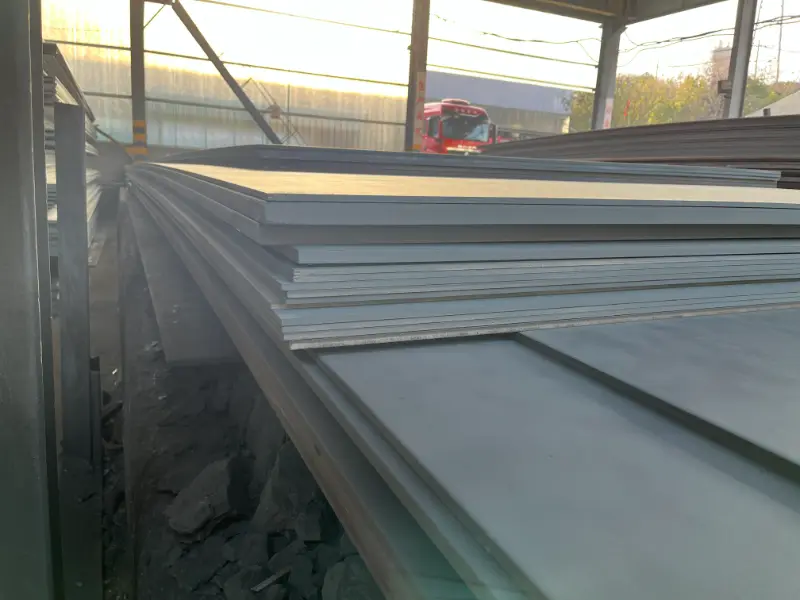
B420CL Automotive Structure Steel Plate as per Q/BQB 310-2009
B420CL Automotive Structure Steel Plate as per Q/BQB 310-2009 - Precise Grade Analysis
Comprehensive material datasheet for B420CL hot-rolled steel plate for automotive structural applications according to Baosteel Q/BQB 310-2009, covering chemistry, mechanical and physical properties, international equivalents, and typical uses.
Hot rolling, controlled rolling, cooling; downstream: cold stamping, bending, roll forming, welding, painting
- Phone : +8618037372205
- Email : [email protected]
- WhatsApp: Contact via Whtsapp
- WeChat: +8618037372205
B420CL Automotive Structure Steel Plate as per Q/BQB 310-2009 Introduction
B420CL is a hot-rolled high-strength low-alloy (HSLA) steel plate specifically developed for cold forming of automotive structural parts, defined in Baosteel enterprise standard Q/BQB 310-2009. The designation signifies B (Baosteel), 420 (minimum tensile strength 420 MPa), and CL (Cold forming). It exhibits a fine-grained ferritic-pearlitic microstructure achieved through controlled rolling and microalloying with elements such as niobium and titanium, offering an excellent balance of strength, ductility, and weldability. Typical applications include chassis members, cross members, longitudinal beams, and reinforcement parts in passenger cars and commercial vehicles. The material is supplied in the as-hot-rolled condition, suitable for subsequent cold stamping, bending, and drawing operations without intermediate annealing. Its consistent mechanical properties and good surface quality make it a preferred choice for lightweight automotive design.
B420CL Automotive Structure Steel Plate as per Q/BQB 310-2009 Chemical Composition
The chemical composition complies with Baosteel Q/BQB 310-2009 for grade B420CL. Microalloying elements Nb, Ti, V may be added singly or in combination to achieve the required mechanical properties through grain refinement and precipitation strengthening. The total microalloy content is limited to ensure cold formability and weldability.
| Element | Standard Value (%) | Remarks |
|---|---|---|
| C | ≤ 0.12 | Ladle analysis |
| Si | ≤ 0.50 | |
| Mn | ≤ 1.50 | |
| P | ≤ 0.030 | |
| S | ≤ 0.025 | |
| Alt (total Al) | ≥ 0.015 | |
| Nb | ≤ 0.09 | When added singly |
| Ti | ≤ 0.15 | When added singly |
| V | ≤ 0.20 | When added singly |
| Nb+V+Ti | ≤ 0.22 | Combined addition |
B420CL Automotive Structure Steel Plate as per Q/BQB 310-2009 Thermal and Electrical Physical Properties
These physical properties are typical for low-carbon HSLA steel with ferritic-pearlitic microstructure and are not part of Q/BQB 310-2009 requirements. Values are provided for engineering calculations, finite element analysis, and process simulation. They correspond to room temperature (20 °C) unless stated otherwise.
| Property | Typical Value | Unit | Test Condition / Remarks |
|---|---|---|---|
| Density (ρ) | 7.85 | g/cm³ | At 20 °C |
| Young's modulus (E) | 200 - 210 | GPa | Room temperature, static testing |
| Shear modulus (G) | ~ 80 | GPa | Calculated from E and ν = 0.3 |
| Poisson's ratio (ν) | 0.3 | — | Elastic range |
| Coefficient of thermal expansion (α) | 12.0 × 10⁻⁶ | /K | 20 – 100 °C (mean value) |
| Thermal conductivity (λ) | ~ 50 | W/(m·K) | At 20 °C |
| Specific heat capacity (cp) | ~ 460 | J/(kg·K) | At 20 °C |
| Electrical resistivity (ρₑ) | 0.25 – 0.30 | µΩ·m | At 20 °C, suitable for resistance welding evaluation |
B420CL Automotive Structure Steel Plate as per Q/BQB 310-2009 Mechanical Properties
Mechanical properties are specified in Q/BQB 310-2009. Tests are performed on transverse specimens unless otherwise agreed. The yield strength is the lower yield point (ReL) or 0.2% proof stress (Rp0.2) if a yield phenomenon is absent. Elongation values depend on specimen gauge length and thickness. Bending test is a simple check of formability; no fracture or cracks are permitted.
| Property | Standard Requirement | Unit | Test Condition |
|---|---|---|---|
| Yield strength (ReL / Rp0.2) | ≥ 305 | MPa | Transverse specimen |
| Tensile strength (Rm) | 420 - 540 | MPa | Transverse specimen |
| Elongation (A80) | ≥ 22 | % | Gauge length 80 mm, thickness < 3.0 mm |
| Elongation (A5) | ≥ 24 | % | Gauge length 5.65√S0, thickness ≥ 3.0 mm |
| Bend test | d = 0.5a | — | 180° bending, mandrel diameter 0.5 × specimen thickness (a) |
| Notch impact energy (KV) | Not specified | J | Typical values for reference: ≥ 40 J at -20 °C (for informational purpose only) |
B420CL Automotive Structure Steel Plate as per Q/BQB 310-2009 Completely Equivalent Standards and Substitutable Grades
| Country/Region | Standard | Grade | Remarks |
|---|---|---|---|
| China | Q/BQB 310-2009 | B420CL | Original specification; no identical counterpart in international standards found |
B420CL Automotive Structure Steel Plate as per Q/BQB 310-2009 Application Introduction
B420CL is designed for cold-formed structural parts in vehicles, combining good ductility with sufficient strength to reduce weight. Typical processing includes blanking, forming, and assembly by welding. It is not intended for heat treatment (quenching and tempering) due to the risk of altering the fine-grained microstructure. Surface condition can be as-rolled or pickled; subsequent coating (e.g., e-coat, powder coating) requires clean surfaces.
Product Applications: Chassis frames and subframes, Cross members and side rails, Suspension control arms, Engine cradles, Seat frames and reinforcement panels, Brackets and mounting plates, Wheel disks and rims (where deep drawing is needed)
Processed into products: Automotive: longitudinal beams, cross member reinforcements, spring hanger brackets, bumper beams, shock absorber mounts, Trailers: chassis rails, coupling brackets, axle beams, General engineering: stamped and welded assemblies, support brackets, flanges
Application industries: Automotive (passenger cars, light commercial vehicles, trucks), Trailer and coach building, Agricultural machinery frames, Construction machinery (non-safety critical structural parts)
B420CL Automotive Structure Steel Plate as per Q/BQB 310-2009 Similar/Comparable Materials
| Country/Region | Standard | Grade | Remarks |
|---|---|---|---|
| EU | EN 10149-2 | S315MC | Similar cold-forming HSLA steel with comparable yield strength; however, S315MC specifies a minimum yield strength of 315 MPa and a slightly different tensile range (390–510 MPa). Chemical limits differ (C ≤ 0.12, Mn ≤ 1.30, Si ≤ 0.50, S ≤ 0.020, P ≤ 0.025). Not a direct substitution without re-validation. |
| EU | EN 10149-2 | S420MC | Higher strength grade (YS ≥ 420 MPa, TS 480–620 MPa) that can be a strength upgrade but requires forming assessment; chemical composition adapted (C ≤ 0.12, Mn ≤ 1.60). |
| Japan | JIS G 3113 | SAPH440 | Hot-rolled automotive structural steel with minimum tensile strength 440 MPa, yield ≥ 305 MPa. Chemistry: C ≤ 0.21, Mn ≤ 1.50, Si ≤ 0.30. Slightly higher tensile strength but similar yield behavior; often used for similar applications. Must be verified for specific forming requirements. |
| USA | SAE J1392 | 045XLK (or similar HSLA 340–420 grades) | SAE grades provide tensile strengths aligned with B420CL, but chemical/physical equivalence must be checked case by case. |
Notes:
Weldability: B420CL can be welded by all common methods (MIG/MAG, resistance spot welding, laser welding) without preheating; the low carbon equivalent (typically ≤0.25) ensures good cold-cracking resistance.
Formability: The minimum bend radius recommended is 1t to 1.5t in transverse direction. For severe drawing, application trials are advised.
Surface condition: Available as pickled and oiled or mill finish. Oiled surfaces must be degreased before painting.
Dimensional tolerances: Conform to Q/BQB 301 or relevant thickness/width standards. Thickness tolerance is typically ±0.15 mm for ≤2.0 mm and ±0.20 mm for >2.0 mm.
Health & Safety: During welding and cutting, appropriate ventilation is required to avoid fume hazards.
- Share



