
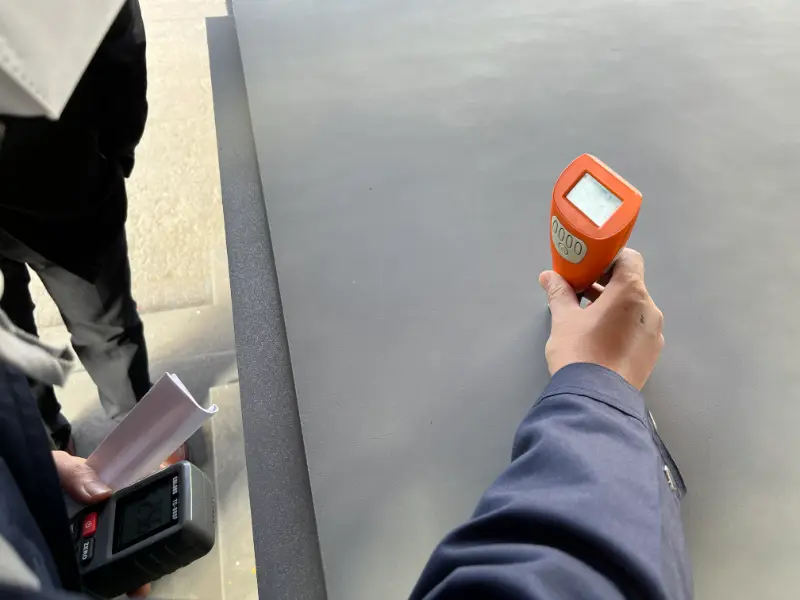
Q960D High-Strength Structural Steel Plate
Q960D High-Strength Structural Steel Plate: GB/T 16270 Standard & Applications
Explore the complete material datasheet for Q960D carbon and low-alloy high-strength steel plate under GB/T 16270. Includes chemical composition, mechanical properties, thermal and electrical properties, international equivalents, and application guide.
Hot rolled, quenched and tempered, cold forming, welding, machining
- Phone : +8618037372205
- Email : [email protected]
- WhatsApp: Contact via Whtsapp
- WeChat: +8618037372205
Q960D High-Strength Structural Steel Plate Introduction
Q960D is a quenched and tempered high-strength structural steel plate defined under Chinese standard GB/T 16270. It offers a minimum yield strength of 960 MPa and excellent low-temperature impact toughness at -20°C, making it suitable for demanding load-bearing structures. Key characteristics:
- Ultra-high strength with good weldability
- Fine-grain microstructure achieved through controlled quenching and tempering
- Exceptional toughness in sub-zero environments
- Good cold-forming capability for thicknesses up to 50 mm
- Widely used in mobile crane booms, mining equipment, and heavy-duty structural components
Q960D High-Strength Structural Steel Plate Chemical Composition
The following chemical composition applies to ladle analysis of Q960D as specified in GB/T 16270. Maximum limits are imposed on impurities and alloying elements to ensure consistent hardenability and mechanical properties. Carbon equivalent (CEV) is typically controlled to guarantee weldability.
- Microalloying elements like Nb, V, Ti contribute to grain refinement and precipitation strengthening.
- Boron (B) may be added in small amounts to improve hardenability.
| Element | Max Value (%) | Remarks |
|---|---|---|
| C | 0.20 | Carbon, max |
| Si | 0.80 | Silicon, max |
| Mn | 2.00 | Manganese, max |
| P | 0.020 | Phosphorus, max |
| S | 0.010 | Sulfur, max |
| Cr | 1.50 | Chromium, max |
| Ni | 2.00 | Nickel, max |
| Mo | 0.70 | Molybdenum, max |
| Cu | 0.50 | Copper, max |
| B | 0.005 | Boron, max |
| V | 0.12 | Vanadium, max |
| Ti | 0.05 | Titanium, max |
| Nb | 0.06 | Niobium, max |
| Als | 0.015 min | Total aluminum, if added as grain refiner |
Q960D High-Strength Structural Steel Plate Thermal and Electrical Physical Properties
Physical properties are generic for low-alloy quenched and tempered steels with similar composition and microstructure. Actual values may vary slightly depending on specific heat treatment and product form. These values are suitable for engineering calculations and design.
- Density is measured at room temperature.
- Thermal expansion coefficient is an average value over the indicated temperature range.
| Property | Value | Unit | Condition/Remarks |
|---|---|---|---|
| Density ρ | 7.85 | g/cm³ | Room temperature |
| Modulus of Elasticity E | 205 | GPa | Room temperature |
| Shear Modulus G | 80 | GPa | Room temperature |
| Poisson's Ratio ν | 0.30 | – | Room temperature |
| Thermal Expansion Coefficient α | 11.5 | 10⁻⁶/°C | 20 – 100 °C |
| Thermal Expansion Coefficient α | 12.5 | 10⁻⁶/°C | 20 – 300 °C |
| Thermal Conductivity λ | 38 | W/(m·K) | Room temperature |
| Specific Heat Capacity cp | 460 | J/(kg·K) | Room temperature |
| Electrical Resistivity ρe | 0.25 | μΩ·m | Room temperature |
Q960D High-Strength Structural Steel Plate Mechanical Properties
Mechanical properties are determined on transverse test pieces taken from quenched and tempered plates. Values depend on product thickness. Minimum yield strength and tensile strength are guaranteed; elongation and impact toughness meet the specified requirements.
- Impact test temperature for D-grade is -20°C.
- Bend test is performed through 180° over a specified former diameter.
| Property | Value | Unit | Condition/Thickness |
|---|---|---|---|
| Yield Strength ReH | ≥ 960 | MPa | t ≤ 50 mm |
| Yield Strength ReH | ≥ 900 | MPa | 50 < t ≤ 100 mm |
| Tensile Strength Rm | 980 – 1150 | MPa | t ≤ 50 mm |
| Tensile Strength Rm | 920 – 1100 | MPa | 50 < t ≤ 100 mm |
| Elongation A | ≥ 10 | % | t ≤ 50 mm, gauge 5.65√So |
| Elongation A | ≥ 9 | % | 50 < t ≤ 100 mm |
| Charpy Impact KV (-20°C) | ≥ 47 | J | Longitudinal, V-notch, t ≤ 100 mm |
| Bend Test (180°) d = former | 3t | – | t ≤ 16 mm |
| Bend Test (180°) d = former | 4t | – | 16 < t ≤ 50 mm |
Q960D High-Strength Structural Steel Plate Fully Equivalent Material Standards and Substitutable Grades
| Country/Region | Standard | Grade | Remarks |
|---|---|---|---|
| Europe | EN 10025-6 | S960Q | Quenched and tempered, min. yield 960 MPa, -20°C impact; closest match |
| International | ISO 4950-3 | E960DD | High yield strength flat products, Q+T, -20°C grade |
Q960D High-Strength Structural Steel Plate Application Introduction
Q960D steel plates are engineered for use in severe load-bearing applications where high strength-to-weight ratio and good toughness are essential. Typical uses include:
- Mobile crane telescopic booms and lattice structures
- Heavy-duty mining dump truck frames and bodies
- Bridge structural elements and large-span girders
- Offshore platform beams and jack-up legs
- Highly stressed parts of construction machinery and earthmoving equipment
The material is suitable for cold forming (bending, rolling) and can be welded with appropriate low-hydrogen procedures to avoid cold cracking.
Product Applications: Telescopic crane booms, Lattice mast sections, Dump truck bodies and frames, Excavator arms and booms, Bridge steel girders, Jack-up rig legs, Hydraulic cylinder rods, Heavy-lift structural components
Processed into products: Welded box sections, Bent flanges, Bolted connections, Machined pins and brackets, Plasma- or laser-cut blanks for further fabrication
Application industries: Mobile Crane Manufacturing, Mining & Earthmoving Equipment, Bridge Construction, Offshore & Marine Engineering, Heavy Transport Vehicles, Structural Engineering
Q960D High-Strength Structural Steel Plate Similar or Nearby Substitute Materials
| Country/Region | Standard | Grade | Remarks |
|---|---|---|---|
| China | GB/T 16270 | Q890D | Min. yield 890 MPa, same Q+T delivery and -20°C impact; slightly lower strength |
| China | GB/T 16270 | Q960E | Same strength, but impact tested at -40°C; better low-temperature toughness |
| Europe | EN 10025-6 | S960QL | Same S960Q base, but with specified low-temperature impact at -40°C; often interchangeable with Q960E |
| USA | ASTM A514/A514M | Grade B / Grade H | Min. yield 690 MPa, not fully equivalent in strength; only suitable where lower strength is acceptable |
Notes:
Weldability: Preheating and interpass temperature control are recommended depending on plate thickness and hydrogen potential of the consumables. A typical preheat temperature of 100–150°C is applied for thicknesses above 10 mm. Post-weld heat treatment (PWHT): Not generally required, but stress relieving at 550°C may be performed if necessary; care must be taken to avoid temper embrittlement. Thickness limits: The standard covers products up to 150 mm, but the guaranteed mechanical properties may degrade for extreme thicknesses; it is advisable to confirm with the mill for thicknesses above 100 mm. Surface condition: As-rolled and descaled; blast-cleaned and primed surfaces are available upon request.
- Share



