
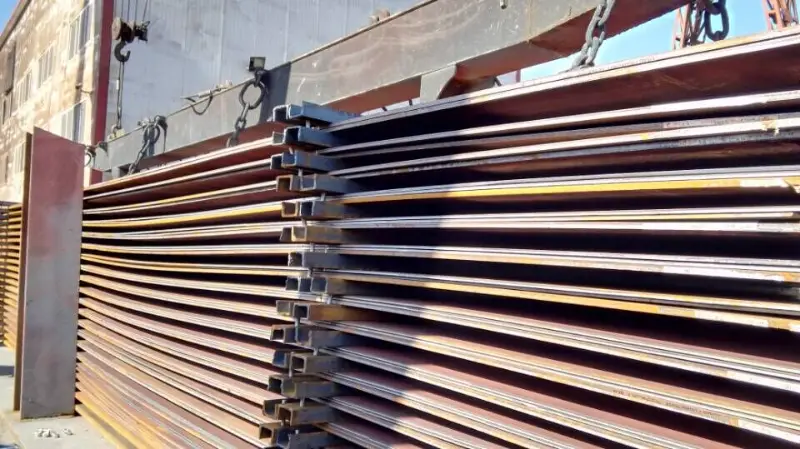
GB/T 16270 Q960E High-Strength Quenched and Tempered Steel Plate
Q960E High-Strength Quenched and Tempered Steel Plate per GB/T 16270
Q960E is a high-strength structural steel with minimum yield strength of 960 MPa, excellent low-temperature toughness, suitable for heavy-duty welded structures.
Welding, bending, cutting, machining, hot/cold forming (limited), suitable for quenched and tempered delivery condition
- Phone : +8618037372205
- Email : [email protected]
- WhatsApp: Contact via Whtsapp
- WeChat: +8618037372205
GB/T 16270 Q960E High-Strength Quenched and Tempered Steel Plate Introduction
Q960E is a carbon and low-alloy high-strength quenched and tempered steel plate defined in China standard GB/T 16270. It offers a minimum yield strength of 960 MPa and tensile strength ranging from 980 to 1150 MPa, combined with good ductility and outstanding low-temperature impact toughness (-40°C, KV2 ≥ 47J). The steel is microalloyed with elements such as niobium, vanadium, titanium and boron to achieve fine grain structure and high hardenability. It is primarily used in heavy machinery, mobile cranes, mining equipment, offshore structures and bridges where weight reduction and high strength are critical. The 'E' suffix indicates its low-temperature toughness class. Delivery condition is quenched and tempered (Q+T).
GB/T 16270 Q960E High-Strength Quenched and Tempered Steel Plate Chemical Composition
The chemical composition of Q960E is designed to achieve high strength and hardenability while maintaining weldability and low-temperature toughness. Carbon content is limited to ≤0.20% to avoid cold cracking. Manganese, chromium, nickel, and molybdenum are added for quench hardenability. Microalloying elements (Nb, V, Ti, B) provide grain refinement and precipitation strengthening. Phosphorus and Sulfur are strictly controlled to ensure cleanliness and impact properties.
| Element | Specified Value (≤%) | Remarks |
|---|---|---|
| Carbon (C) | ≤ 0.20 | Key strength element, limited for weldability |
| Silicon (Si) | ≤ 0.80 | Deoxidizer, contributes to strength |
| Manganese (Mn) | ≤ 2.00 | Hardenability and strength |
| Phosphorus (P) | ≤ 0.020 | Max for embrittlement control |
| Sulfur (S) | ≤ 0.010 | Max for toughness |
| Chromium (Cr) | ≤ 1.50 | Optional hardenability element |
| Nickel (Ni) | ≤ 2.00 | Optional, improves toughness |
| Molybdenum (Mo) | ≤ 0.70 | Optional, enhances hardenability |
| Copper (Cu) | ≤ 0.50 | Residual element, limited |
| Boron (B) | ≤ 0.0050 | For hardenability, typically >0.0005% if used |
| Niobium (Nb) | ≤ 0.06 | Grain refinement (optional) |
| Vanadium (V) | ≤ 0.12 | Precipitation strengthening (optional) |
| Titanium (Ti) | ≤ 0.05 | Grain refinement, deoxidation (optional) |
| Nitrogen (N) | ≤ 0.015 | Max to avoid embrittlement |
| Aluminum (Al) | ≥ 0.015 | Min for deoxidation, optional |
GB/T 16270 Q960E High-Strength Quenched and Tempered Steel Plate Thermal and Electrical Physical Properties
Physical properties are typical for low-alloy quenched and tempered steel with similar composition. Values may vary slightly with the actual heat treatment and alloy content. Density is approximately 7.85 g/cm³, elastic modulus around 210 GPa. The thermal expansion coefficient is about 12×10⁻⁶ /K at room temperature range. Thermal conductivity is moderate, typical for alloyed steels. Specific heat capacity is near 450 J/(kg·K). Electrical resistivity is around 0.20 ×10⁻⁶ Ω·m.
| Property | Typical Value | Unit | Test Condition / Remarks |
|---|---|---|---|
| Density (ρ) | 7.85 | g/cm³ | Room temperature |
| Elastic modulus (E) | 210 | GPa | Tensile modulus, RT |
| Shear modulus (G) | 81 | GPa | Calculated from E and ν |
| Poisson's ratio (ν) | 0.3 | - | Dimensionless |
| Thermal expansion coefficient (α) | 12.0 – 12.5 | ×10⁻⁶ /K | 20–100°C (6.7–6.9 ×10⁻⁶ in/in/°F) |
| Thermal conductivity (λ) | 38 – 42 | W/(m·K) | At 20°C |
| Specific heat capacity (cp) | 440 – 470 | J/(kg·K) | At 20°C |
| Electrical resistivity (ρ_e) | 0.18 – 0.22 | ×10⁻⁶ Ω·m | At 20°C |
GB/T 16270 Q960E High-Strength Quenched and Tempered Steel Plate Mechanical Properties
The mechanical properties are for quenched and tempered condition. The values depend on plate thickness, typically specified for thickness ≤ 50 mm. Yield strength minimum 960 MPa, tensile strength in the range 980–1150 MPa, elongation after fracture ≥10%. The material shows good ductility despite the high strength. The Charpy impact test is performed at -40°C with minimum absorbed energy of 47J for the E-grade.
| Property | Specified Value | Unit | Test Condition / Remarks |
|---|---|---|---|
| Yield strength (ReH) | ≥ 960 | MPa | Thickness ≤ 50 mm, transverse direction |
| Yield strength (ReH) | ≥ 920 | MPa | Thickness 50–100 mm (typical extension) |
| Tensile strength (Rm) | 980 – 1150 | MPa | All thicknesses |
| Elongation after fracture (A) | ≥ 10 | % | Gauge length 5.65√So, transverse, thickness ≤ 50 mm |
| Elongation after fracture (A) | ≥ 9 | % | Thickness 50–100 mm (typical extension) |
| Charpy V-notch impact (KV2) | ≥ 47 | J | At -40°C, longitudinal samples, full-size (10×10 mm) |
| Bending test (mandrel diameter) | d = 3a (180°) | - | a = specimen thickness, no cracks |
GB/T 16270 Q960E High-Strength Quenched and Tempered Steel Plate Fully Equivalent Material Standards and Alternative Grades
| Country/Region | Standard | Grade | Remarks |
|---|---|---|---|
| Europe | EN 10025-6 | S960QL | Closest equivalent, quenched and tempered, low-temperature impact at -40°C |
| Europe | EN 10025-6 | S960Q | Q version has impact at -20°C, can be substituted if -40°C not required |
| International | ISO 4950-3 | S960QL | High yield strength structural steels, quenched and tempered |
| USA | ASTM A514/A514M | Grade S | Approximate, min yield 690 MPa, not directly 960 MPa; higher strength requires ASTM A709 or A1011 with modifications |
| Japan | JIS G 3128 | SHY 900 | Comparable 900 MPa class, may need agreement for 960 MPa |
| China | GB/T 16270 | Q960D | Lower toughness: impact at -20°C, otherwise same strength level |
GB/T 16270 Q960E High-Strength Quenched and Tempered Steel Plate Application Introduction
Q960E steel plates are used in demanding structural applications where high strength-to-weight ratio, excellent low-temperature toughness, and good weldability are required. The material is typically delivered in quenched and tempered condition with a minimum yield strength of 960 MPa. It can be welded with low-hydrogen processes and appropriate preheat/interpass temperatures to avoid cold cracking. Post-weld heat treatment is generally not required for thicknesses up to 50 mm but may be considered for thicker sections. The steel finds use in mobile cranes, mining machinery, offshore structures, bridges, and high-stress components subjected to severe loading and low-temperature environments.
Product Applications: Mobile crane booms and outriggers, Mining truck chassis and dump bodies, Excavator arms and buckets, Offshore platform structural nodes, Long-span bridge girders, High-pressure vessels and penstocks, Wind turbine tower sections
Processed into products: Welded box sections and I-beams, High-strength fasteners and pins, Heavy-duty gears and shafts, Structural connectors and brackets, Wear-resistant liners (if surface hardness improved), Lifting and rigging equipment parts
Application industries: Heavy Engineering, Construction and Infrastructure, Mining and Earthmoving, Offshore and Marine, Transport and Lifting Equipment, Renewable Energy (wind turbine towers)
GB/T 16270 Q960E High-Strength Quenched and Tempered Steel Plate Recommended Similar/Alternative Materials
| Country/Region | Standard | Grade | Remarks |
|---|---|---|---|
| China | GB/T 16270 | Q890E | Slightly lower minimum yield strength (890 MPa), same low-temperature toughness, can be used if design allows strength reduction |
| Europe | EN 10025-6 | S890QL | Similar concept, 890 MPa yield, -40°C impact, suitable when 960 MPa is over-spec |
| Europe | EN 10025-6 | S960QL | Direct equivalent, already listed above, but also a similar alternative if full equivalence not required |
| USA | ASTM A514 | Grade E | 690 MPa yield, lower strength but often used in similar heavy structural applications; upgrade to A709 Grade HPS 100W for 690 MPa, not 960 |
| Japan | JIS G 3128 | SHY 685 | Lower strength class but widely used in bridge construction, may be considered if strength requirements are relaxed |
Notes:
Welding: Use low-hydrogen consumables matching the strength class. Preheating temperature typically 100–150°C, interpass temperature ≤ 200°C. The carbon equivalent (CEV) should be controlled to ensure weldability, typically below 0.65%.
Forming: Cold forming is limited to small radii due to high strength; hot forming may alter properties and requires re-heat treatment.
Inspection: Ultrasonic testing per GB/T 2970 is often specified. Surface quality and flatness according to GB/T 709.
Certification: Material certificates according to EN 10204 type 3.1 or GB equivalent.
- Share



