
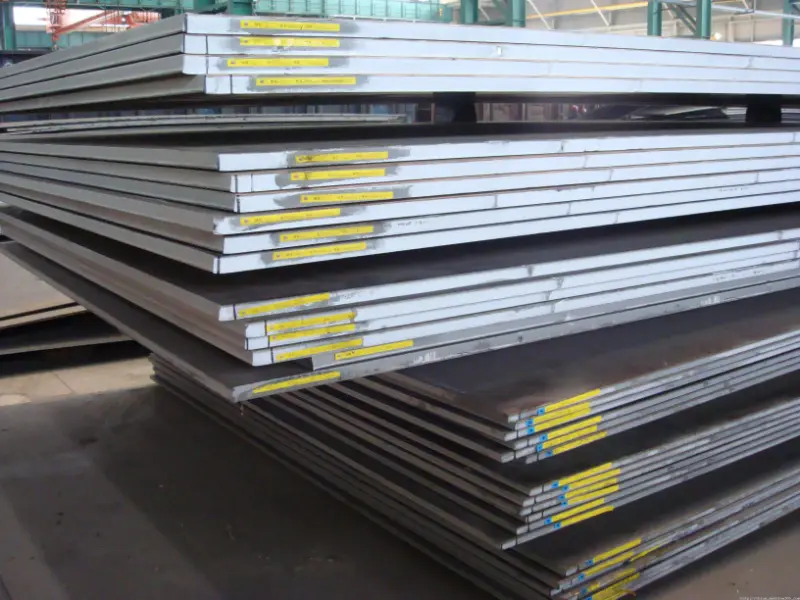
Q960C High Strength Quenched & Tempered Steel Plate
Q960C High Strength Quenched & Tempered Steel Plate | GB/T 16270 Grade Analysis
Comprehensive material data sheet for Q960C carbon and low-alloy high-strength steel plate under Chinese standard GB/T 16270. Chemical composition, mechanical properties, international equivalents, and application guidance.
Quenching and tempering (Q&T); suitable for cutting, cold and hot forming, welding (with preheat and post-weld heat treatment as recommended), and machining.
- Phone : +8618037372205
- Email : [email protected]
- WhatsApp: Contact via Whtsapp
- WeChat: +8618037372205
Q960C High Strength Quenched & Tempered Steel Plate Introduction
Q960C is a high-strength quenched and tempered structural steel plate specified in Chinese standard GB/T 16270-2009. The designation indicates a minimum yield strength of 960 MPa and quality level C, requiring 0°C impact toughness. It belongs to the low-alloy high-strength structural steel category, offering an excellent combination of high strength, good weldability, and moderate low-temperature toughness. Main alloying elements include manganese, chromium, nickel, and molybdenum, with careful control of carbon and micro-alloying elements to achieve fine grain strengthening and precipitation hardening after quenching and tempering. This grade is widely used in heavy-duty machinery, bridges, offshore structures, and mining equipment where weight reduction and high load-bearing capacity are critical.
Q960C High Strength Quenched & Tempered Steel Plate Chemical Composition
The chemical composition of Q960C is designed to achieve high strength after quenching and tempering while maintaining adequate weldability and toughness. Carbon content is kept relatively low (≤0.20%) to ensure good weldability. Manganese, chromium, nickel, and molybdenum provide hardenability and strength. Micro-alloying elements such as niobium, vanadium, and titanium contribute to grain refinement and precipitation hardening. Phosphorus and sulfur are strictly controlled to enhance ductility and impact properties. The following values are based on GB/T 16270-2009.
| Element | Specified Value (max unless range) | Remarks |
|---|---|---|
| C | ≤0.20% | Lower carbon improves weldability and toughness |
| Si | ≤0.80% | Deoxidizer and strength contributor |
| Mn | ≤2.00% | Enhances hardenability and strength |
| P | ≤0.020% | Controlled for toughness |
| S | ≤0.010% | Low sulfur for ductility and through-thickness properties |
| Cr | ≤1.50% | Increases hardenability and corrosion resistance |
| Ni | ≤2.00% | Improves toughness and hardenability |
| Mo | ≤0.70% | Increases hardenability and resistance to tempering |
| Cu | ≤0.50% | Residual element; may provide some corrosion resistance |
| B | ≤0.0050% | Powerful hardenability booster in minute amounts |
| V | ≤0.12% | Micro-alloying for grain refinement |
| Nb | ≤0.06% | Grain refiner and precipitation strengthener |
| Ti | ≤0.05% | Grain refiner; also binds nitrogen |
| N | ≤0.015% | Residual; can form nitrides with Ti or Al |
| Al (total) | ≥0.015% | Deoxidizer and grain refiner (if added) |
Q960C High Strength Quenched & Tempered Steel Plate Thermal and Electrical Physical Properties
The GB/T 16270 standard does not mandate specific thermal or electrical properties. The values listed below are typical for a low-alloy quenched and tempered steel of this strength class and are provided for general engineering reference. Actual values may vary slightly depending on exact composition and heat treatment condition. They should not be used for critical design without supplier verification.
| Property | Typical Value | Unit | Test Condition |
|---|---|---|---|
| Density (ρ) | ~7850 | kg/m³ | Room temperature |
| Modulus of elasticity (E) | ~205 – 210 | GPa | Room temperature |
| Shear modulus (G) | ~79 – 81 | GPa | Room temperature |
| Poisson's ratio (ν) | ~0.3 | – | Room temperature |
| Thermal expansion coefficient (α) | ~11.5 – 12.5 × 10⁻⁶ | 1/K | 20 – 200°C |
| Thermal conductivity (λ) | ~35 – 45 | W/(m·K) | Room temperature |
| Specific heat capacity | ~460 – 500 | J/(kg·K) | Room temperature |
| Electrical resistivity (ρ_e) | ~0.20 – 0.25 × 10⁻⁶ | Ω·m | Room temperature |
Q960C High Strength Quenched & Tempered Steel Plate Mechanical Properties
Mechanical properties of Q960C are guaranteed in the quenched and tempered condition. The yield strength, tensile strength, and elongation vary with plate thickness due to the influence of cooling rate and hardenability. Impact energy is measured on longitudinal Charpy V-notch specimens at 0°C with a minimum average of 47 J. Bend test requirements are also thickness-dependent. The values below represent the minimum requirements from the standard.
| Property | Required Value | Unit | Test Condition / Thickness |
|---|---|---|---|
| Yield Strength (ReH) | ≥960 | MPa | Plate thickness ≤ 50 mm |
| Yield Strength (ReH) | ≥900 | MPa | 50 mm < thickness ≤ 100 mm |
| Yield Strength (ReH) | ≥850 | MPa | 100 mm < thickness ≤ 150 mm |
| Tensile Strength (Rm) | 980 – 1150 | MPa | Plate thickness ≤ 100 mm |
| Tensile Strength (Rm) | 930 – 1100 | MPa | 100 mm < thickness ≤ 150 mm |
| Elongation after fracture (A) | ≥10 | % | Proportional test piece, L0 = 5.65√S0; all thicknesses |
| Impact energy (KV2) | ≥47 (average) | J | Longitudinal, 0°C; single value ≥70% of average |
| Bend test (180°) – bend diameter d | d = 3a (no cracks) | – | Plate thickness ≤ 50 mm |
| Bend test (180°) – bend diameter d | d = 4a (no cracks) | – | 50 mm < thickness ≤ 100 mm |
| Bend test (180°) – bend diameter d | d = 5a (no cracks) | – | 100 mm < thickness ≤ 150 mm |
Q960C High Strength Quenched & Tempered Steel Plate Fully Equivalent Material Standards and Replaceable Grades
| Country/Region | Standard | Grade | Remarks |
|---|---|---|---|
| Europe | EN 10025-6 | S960Q | Quenched and tempered; minimum yield 960 MPa; comparable chemical composition; also available as S960QL with lower temperature impact. |
| Europe | EN 10025-6 | S960QL | Similar to S960Q but with guaranteed impact toughness at -50°C; may serve as substitute where enhanced low-temperature toughness is needed. |
| International | ISO 4950-2 | S960Q | High yield strength quenched and tempered steel; essentially identical to EN grade. |
Q960C High Strength Quenched & Tempered Steel Plate Application Introduction
Q960C steel plate is designed for structural applications demanding high static and dynamic loads combined with weight savings. Its balanced composition allows welding using low hydrogen processes with appropriate preheating and interpass temperature control. Post-weld heat treatment is generally not required but may be applied for stress relief under controlled conditions. Forming after tempering is limited but can be performed with large radii. The material is typically delivered in the quenched and tempered condition ready for fabrication.
Product Applications: Crane telescopic booms and chassis frames, Dump truck bodies and shovel buckets, Offshore platform support structures and nodes, Bridge girders and orthotropic deck plates, High-strength welded beams and columns, Large-diameter line pipe (in some specifications)
Processed into products: Welded structural frames for heavy machinery, Boom and luffing jibs for crawler cranes, Cutting edges and wear plates (hardfaced), Pedestal mountings for offshore cranes, Transition pieces and lifting lugs, Stiffeners and brackets for dynamically loaded structures
Application industries: Construction machinery (mobile cranes, concrete pump booms), Mining and earthmoving equipment (excavator booms, dump truck bodies), Bridge engineering (heavy load bridges, pedestrian bridge components requiring extreme strength), Offshore and marine structures (jack-up rig legs, crane pedestals), Pressure vessel and storage tank components, Military vehicles and armor plates
Q960C High Strength Quenched & Tempered Steel Plate Similar or Closely Matching Alternative Grades
| Country/Region | Standard | Grade | Remarks |
|---|---|---|---|
| China | GB/T 16270 | Q960D | Same strength level but improved toughness (impact test at -20°C). Suitable when lower service temperature is required. |
| China | GB/T 16270 | Q960E | Impact test at -40°C; excellent low-temperature toughness. |
| China | GB/T 16270 | Q890C | Yield strength ≥890 MPa; otherwise similar composition. Economical alternative if strength requirements can be slightly reduced. |
| Europe | EN 10025-6 | S890Q | Yield strength ≥890 MPa; close substitute where S960Q is over-specified. |
| Europe | EN 10025-6 | S1100Q | Higher strength (≥1100 MPa) option within the same family for weight-critical designs. |
Notes:
Welding recommendations: Use low-hydrogen welding consumables (AWS E11018-M or equivalent) and maintain a minimum preheat temperature of 150–200°C depending on plate thickness. Through-thickness properties: Enhanced Z-quality (Z15, Z25, Z35) can be ordered to reduce lamellar tearing risk. Ultrasonic testing: Can be performed in accordance with EN 10160 or GB/T 2970 upon request. Surface condition: Plates are typically supplied as-rolled and descaled; alternative surface conditions may be agreed.
- Share



