
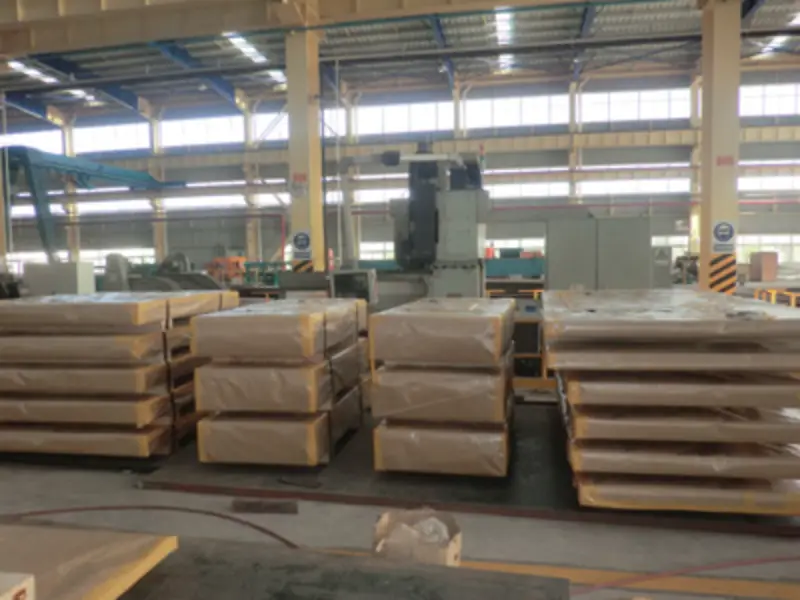
GB/T 16270 Q890F High Strength Quenched and Tempered Steel Plate
Q890F High Strength Quenched and Tempered Steel Plate to GB/T 16270
Comprehensive material data for Q890F carbon and low-alloy high-strength steel plate according to Chinese standard GB/T 16270, covering chemical composition, mechanical properties, and physical properties.
Quenching and tempering, cutting, welding, bending (limited, requires preheating and controlled parameters)
- Phone : +8618037372205
- Email : [email protected]
- WhatsApp: Contact via Whtsapp
- WeChat: +8618037372205
GB/T 16270 Q890F High Strength Quenched and Tempered Steel Plate Introduction
Q890F is a carbon and low-alloy high-strength structural steel plate specified in GB/T 16270. Delivered in the quenched and tempered (Q+T) condition, this grade ensures a minimum yield strength of 890 MPa and a tensile strength ranging from 940 to 1100 MPa. The steel's fine-grained microstructure, achieved through controlled alloying and heat treatment, provides outstanding toughness at temperatures as low as -60 °C, meeting the requirements of quality level F.
- Key features: high static and dynamic strength, excellent low-temperature impact toughness, and good weldability.
- Available plate thickness: typically 6–100 mm.
Q890F is designed for heavy-load-bearing structures where weight reduction and structural reliability are critical. Common applications include construction machinery, offshore platforms, bridges, and pressure vessels when supplemented by specific standards. The alloying concept relies on modest carbon content for weldability, combined with additions of Cr, Ni, Mo, and microalloying elements such as Nb, V, Ti, which ensure deep hardenability and grain refinement during thermal processing.
GB/T 16270 Q890F High Strength Quenched and Tempered Steel Plate Chemical Composition
The chemical composition limits for Q890F are specified in GB/T 16270. The steel is microalloyed with Nb, V, Ti, and B for grain refinement and hardenability. Sulfur and phosphorus are kept low to enhance toughness and cleanliness. The manufacturer may add other elements as needed, but the following maximum values apply.
| Element | Specified Value (max unless range noted) | Remarks |
|---|---|---|
| Carbon (C) | 0.20 | Maximum |
| Silicon (Si) | 0.80 | Maximum |
| Manganese (Mn) | 1.80 | Maximum |
| Phosphorus (P) | 0.020 | Maximum |
| Sulfur (S) | 0.010 | Maximum |
| Chromium (Cr) | 1.50 | Maximum |
| Nickel (Ni) | 2.00 | Maximum |
| Molybdenum (Mo) | 0.70 | Maximum |
| Vanadium (V) | 0.12 | Maximum |
| Niobium (Nb) | 0.06 | Maximum |
| Titanium (Ti) | 0.05 | Maximum |
| Boron (B) | 0.005 | Maximum |
| Copper (Cu) | 0.50 | Maximum (residual or added) |
GB/T 16270 Q890F High Strength Quenched and Tempered Steel Plate Thermal and Electrical Physical Properties
The following physical property values are typical for quenched and tempered low-alloy high-strength steels similar to Q890F. They are not mandatory requirements of GB/T 16270 but are widely used in engineering design. Properties may vary slightly depending on exact composition and heat treatment condition.
| Property | Typical Value | Unit | Test Conditions |
|---|---|---|---|
| Density (ρ) | 7.85 | g/cm³ | At 20 °C |
| Elastic Modulus (E) | 206 | GPa | At 20 °C |
| Shear Modulus (G) | 79.3 | GPa | Calculated (G = E / [2(1+ν)]) |
| Poisson's Ratio (ν) | 0.30 | – | At 20 °C |
| Thermal Expansion Coefficient (α) | 12.2 × 10⁻⁶ | /K | 20 °C to 100 °C |
| Thermal Conductivity (λ) | 40 | W/(m·K) | At 20 °C |
| Specific Heat Capacity (c) | 460 | J/(kg·K) | At 20 °C |
| Electrical Resistivity (ρ_e) | 0.20 × 10⁻⁶ | Ω·m | At 20 °C |
GB/T 16270 Q890F High Strength Quenched and Tempered Steel Plate Mechanical Properties
Mechanical properties are determined on specimens taken in the transverse direction from the quenched and tempered plate. The requirements for Q890F include tensile properties and Charpy V-notch impact energy at -60 °C. Bending test is performed with a specified mandrel diameter to verify formability. Values depend on plate thickness; where applicable, both thickness ranges are shown.
| Property | Specified Value | Unit | Test Conditions |
|---|---|---|---|
| Yield Strength (ReH) | ≥ 890 | MPa | Plate thickness ≤ 100 mm |
| Tensile Strength (Rm) | 940 – 1100 | MPa | Plate thickness ≤ 100 mm |
| Elongation after fracture (A) | ≥ 12 | % | Plate thickness ≤ 50 mm; gauge length 5.65√S₀ |
| Elongation after fracture (A) | ≥ 11 | % | Plate thickness > 50 mm to 100 mm; gauge length 5.65√S₀ |
| Bend test (180°) | d = 3a | – | Plate thickness ≤ 50 mm; a = plate thickness |
| Bend test (180°) | d = 4a | – | Plate thickness > 50 mm to 100 mm; a = plate thickness |
| Charpy Impact Energy (KV₂) | ≥ 27 | J | At -60 °C; longitudinal (or transverse as per order) V-notch specimen |
GB/T 16270 Q890F High Strength Quenched and Tempered Steel Plate Exactly Equivalent Material Standards and Substitute Grades
| Country/Region | Standard | Grade | Remarks |
|---|---|---|---|
| Europe | EN 10025-6 | S890QL1 | Quenched and tempered; minimum yield 890 MPa; impact energy 27 J at -60 °C — identical strength-toughness class |
| International | ISO 630-6 | S890QL1 | Equivalent to EN 10025-6; -60 °C impact requirement |
GB/T 16270 Q890F High Strength Quenched and Tempered Steel Plate Application Introduction
Q890F is engineered for highly loaded welded structures that demand high strength, good ductility, and resistance to brittle fracture at low temperatures. Typical industries benefit from the combination of high static and dynamic load capacity, reduced structural weight, and suitability for welding if proper procedures are followed. Processing (cutting, welding, bending) should be performed with careful control of heat input, preheating, and interpass temperature to preserve the tempered martensite/bainite microstructure.
Product Applications: Telescopic crane booms and mobile crane lattice sections, Offshore platform legs, spudcans, and deck supports, Long-span bridge girders and orthotropic deck plates, Heavy-duty vehicle chassis and subframes, Excavator booms and arms, Wind turbine tower flanges and transition pieces (where high strength is necessary)
Processed into products: Welded built-up I- and box-section beams, Load-bearing brackets and gusset plates, Lifting lugs and padeyes, Flanges and stiffened panels, Structural tubulars and cones, Machinery base plates and mounting frames
Application industries: Construction machinery (cranes, excavators, bulldozers), Offshore and marine engineering (platform structures, jack-up legs), Bridge building (heavy girders, arch ribs), Heavy transport (trailers, truck frames), Mining and earthmoving equipment (dump truck bodies, crusher components), Pressure vessels (subject to specific code requirements, e.g., EN 13445)
GB/T 16270 Q890F High Strength Quenched and Tempered Steel Plate Similar/Comparable Substitute Materials
| Country/Region | Standard | Grade | Remarks |
|---|---|---|---|
| China | GB/T 16270 | Q890E | Same strength but higher impact test temperature (-40 °C); may be used where lower toughness demand is acceptable |
| Europe | EN 10025-6 | S890Q | Impact test at 0 °C; not suitable for critical low-temperature service without verification |
| Europe | EN 10025-6 | S890QL | Impact test at -50 °C; slightly lower toughness than Q890F |
| Japan | JIS G 3128 | SHY900N | Yield strength ≥ 885 MPa, tensile strength 880–1050 MPa; impact properties depend on manufacturer, generally close but not identical to Q890F |
| USA | Various proprietary | Type 890 (e.g., WEL-TEN 890) | Proprietary Japanese brand with similar strength; chemical composition and toughness may differ; requires qualification |
Notes:
The data presented are based on GB/T 16270-2009 and common engineering references. For specific orders, the material test certificate should be consulted to confirm actual chemical and mechanical properties. Welding of Q890F requires low-hydrogen practices, adequate preheat (typically 100–150 °C depending on thickness and heat input), and limited heat input to avoid degradation of the heat-affected zone. Post-weld heat treatment is generally not recommended without prior qualification. This steel is not intended for hot forming operations; forming should be performed at ambient temperature with sufficient radius to avoid cracking. Special attention must be paid to hydrogen-induced cracking when using this high-strength steel in humid or corrosive environments. If hot-dip galvanizing is required, the risk of liquid metal embrittlement should be evaluated.
- Share



