
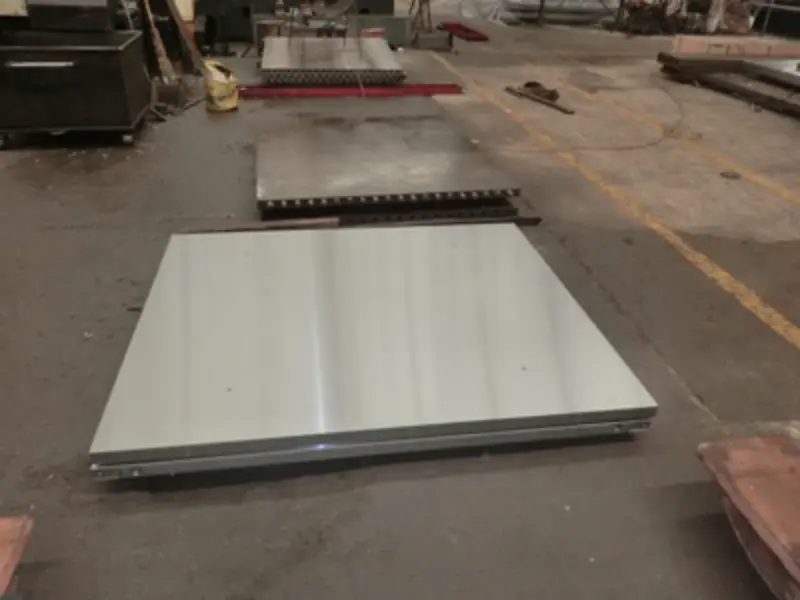
Q890E Quenched & Tempered High-Strength Steel Plate
Q890E Quenched & Tempered High-Strength Steel Plate | GB/T 16270 Expert Data
Detailed material datasheet for Q890E carbon and low-alloy high-strength structural steel plate under GB/T 16270, including chemical composition, mechanical properties, thermal and electrical data, and international equivalents like EN 10025-6 S890Q.
Hot Rolling, Quenching, Tempering, Cutting (Laser/Plasma/Waterjet), Cold Forming, Welding, Machining
- Phone : +8618037372205
- Email : [email protected]
- WhatsApp: Contact via Whtsapp
- WeChat: +8618037372205
Q890E Quenched & Tempered High-Strength Steel Plate Introduction
Q890E is a premium quenched and tempered high-strength carbon and low-alloy structural steel plate complying with the Chinese national standard GB/T 16270. It is designed for heavy-duty applications that demand a minimum yield strength of 890 MPa combined with excellent low-temperature toughness down to -40°C (quality grade E). The steel is produced through a controlled rolling and heat treatment process (quenching + tempering) that refines the microstructure, resulting in a favorable balance of high strength, good ductility, and weldability. Its chemical composition is carefully controlled with microalloying elements such as Nb, V, Ti, and B to enhance hardenability and mechanical properties. Thanks to its high strength-to-weight ratio, Q890E allows for lighter structural designs without compromising safety, making it ideal for mobile cranes, mining machinery, pressure vessels, and heavy structural components. International equivalents like S890Q / S890QL (EN 10025-6) and E890QL (ISO 4950) confirm its global acceptance.
Q890E Quenched & Tempered High-Strength Steel Plate Chemical Composition
The chemical composition of Q890E is strictly controlled to achieve the desired combination of high strength, toughness, and weldability. The following maximum limits apply unless a range is specified. The steel typically includes microalloying additions of Nb, V, Ti, and B for grain refinement and hardenability. A maximum carbon equivalent value (CEV) is also specified to ensure good weldability.
| Element | Maximum Value (wt. %) | Remarks |
|---|---|---|
| Carbon (C) | 0.20 | Max |
| Silicon (Si) | 0.80 | Max |
| Manganese (Mn) | 2.00 | Max |
| Phosphorus (P) | 0.020 | Max |
| Sulfur (S) | 0.010 | Max |
| Chromium (Cr) | 1.50 | Max |
| Nickel (Ni) | 2.00 | Max |
| Molybdenum (Mo) | 0.70 | Max |
| Copper (Cu) | 0.50 | Max |
| Niobium (Nb) | 0.06 | Max |
| Vanadium (V) | 0.12 | Max |
| Titanium (Ti) | 0.05 | Max |
| Boron (B) | 0.005 | Max |
| Carbon Equivalent (CEV) | 0.65 (typical) | CEV = C + Mn/6 + (Cr+Mo+V)/5 + (Ni+Cu)/15; agreed at the time of order |
Q890E Quenched & Tempered High-Strength Steel Plate Thermal and Electrical Physical Properties
The following physical properties are typical for high-strength quenched and tempered steel of this grade. They are provided for design purposes and may vary slightly depending on the actual chemical composition and heat treatment condition.
| Property | Typical Value | Unit | Condition |
|---|---|---|---|
| Density (ρ) | 7.85 | g/cm³ | At room temperature |
| Modulus of elasticity (E) | 210 | GPa | At room temperature |
| Shear modulus (G) | ≈80 | GPa | At room temperature |
| Poisson's ratio (ν) | 0.3 | Elastic range | |
| Thermal expansion coefficient (α) | 12.0 | 10⁻⁶/K | Between 20°C and 100°C |
| Thermal conductivity (λ) | 35 – 40 | W/(m·K) | At room temperature |
| Specific heat capacity | 460 | J/(kg·K) | At room temperature |
| Electrical resistivity (ρₑ) | 0.25 – 0.30 | 10⁻⁶ Ω·m | At room temperature |
Q890E Quenched & Tempered High-Strength Steel Plate Mechanical Properties
Mechanical properties are determined on transverse test pieces taken from quenched and tempered plates. The values depend on the nominal thickness. The impact test is performed on longitudinal Charpy V-notch specimens at -40°C for grade E. Bending test is carried out with a specified mandrel diameter.
| Property | Minimum / Required Value | Unit | Test Condition |
|---|---|---|---|
| Yield Strength (ReH) | ≥ 890 | MPa | Plate thickness ≤ 50 mm |
| Yield Strength (ReH) | ≥ 830 | MPa | Plate thickness > 50 to ≤ 100 mm |
| Yield Strength (ReH) | ≥ 780 | MPa | Plate thickness > 100 to ≤ 150 mm |
| Tensile Strength (Rm) | 940 – 1100 | MPa | Plate thickness ≤ 50 mm |
| Tensile Strength (Rm) | 880 – 1100 | MPa | Plate thickness > 50 to ≤ 100 mm |
| Tensile Strength (Rm) | 830 – 1100 | MPa | Plate thickness > 100 to ≤ 150 mm |
| Elongation after fracture (A) | ≥ 12 | % | Gauge length 5.65√So; t ≤ 50 mm |
| Elongation after fracture (A) | ≥ 12 | % | Gauge length 5.65√So; 50 < t ≤ 100 mm |
| Elongation after fracture (A) | ≥ 11 | % | Gauge length 5.65√So; 100 < t ≤ 150 mm |
| Bending Test | No cracks | Bend angle 180°; mandrel diameter d = 3a (a = plate thickness) | |
| Impact Energy (KV₂) | ≥ 47 | J | Charpy V-notch, longitudinal, at -40°C |
Q890E Quenched & Tempered High-Strength Steel Plate Fully Equivalent Standards and Replaceable Grades
| Country / Region | Standard | Grade / Designation | Remarks |
|---|---|---|---|
| Europe | EN 10025-6 | S890Q, S890QL | S890Q: min. yield 890 MPa, impact test -20°C; S890QL: -40°C (L-class), equivalent to Q890E |
| International | ISO 4950-2 | E890QL | Quenched and tempered steel with min. yield 890 MPa and guaranteed toughness at -40°C |
| China | GB/T 16270 | Q890E | The subject grade |
Q890E Quenched & Tempered High-Strength Steel Plate Application Introduction
Q890E steel plate is engineered for extremely demanding structural applications that require minimum yield strength of 890 MPa along with reliable toughness at temperatures as low as -40°C. Its high strength-to-weight ratio allows for significant weight reduction compared to lower strength steels, which translates into lower material costs and improved energy efficiency in mobile equipment. The steel can be welded using low-hydrogen practices and preheating as per manufacturer recommendations, and it is suitable for both cold and hot forming (followed by re-tempering). Typical applications span across heavy-lifting, mining, offshore, and pressure vessel industries.
Product Applications: Telescopic crane booms and lattice boom sections, Chassis frames for heavy off-road vehicles, Mining truck bodies and excavator buckets, Hydraulic cylinder bodies and rod elements, High-pressure piping and penstock linings, Welded structural sections for bridges and stadiums
Processed into products: Boom segments and luffing jibs for cranes, Load-bearing pins and bushings (after forging and treatment), Wear plates and liners in crushing / grinding equipment, Turntables and slewing rings for excavators, Flanges and stiffeners in wind turbine towers, Reinforcement plates for offshore platform nodes
Application industries: Heavy-lifting and crane manufacturing (mobile cranes, crawler cranes, truck-mounted cranes), Mining and earthmoving equipment (excavators, dump trucks, bulldozers), Offshore engineering and shipbuilding (jack-up rigs, crane pedestals, structural nodes), Bridge construction (steel box girders, orthotropic decks), Pressure vessel and penstock manufacturing (high-pressure pipelines, hydraulic cylinders), Transport and logistics (heavy-duty trailers, tank containers)
Q890E Quenched & Tempered High-Strength Steel Plate Similar or Comparable Steel Grades
| Country / Region | Standard | Grade | Remarks |
|---|---|---|---|
| Europe | EN 10025-6 | S960Q / S960QL | Higher strength (min. yield 960 MPa), similar toughness levels, used as a stronger alternative in weight-critical designs. |
| USA | ASTM A514/A514M | Grade Q | Quenched and tempered; min. yield 690 MPa, but tensile strength up to 895 MPa; lower strength than Q890E but can be used where 890 MPa yield is not mandatory. |
| Japan | JIS G3128 | SHY685 | High yield strength steel for welded structures; min. yield 685 MPa, lower than Q890E, but comparable in some heavy machinery applications. |
| China | GB/T 16270 | Q960E | A higher grade within the same standard with minimum 960 MPa yield; suitable when Q890E does not meet the strength requirement. |
Notes:
- Welding Recommendations: Preheating temperature of 100–175°C depending on plate thickness and hydrogen level; low-hydrogen consumables (E11018-M or equivalent) are required. Post-weld heat treatment is usually not required but may be applied for stress relief at temperatures below the tempering temperature.
- Formability: The steel can be cold-bent with a minimum recommended radius of 4t (t = plate thickness) for thicknesses up to 50 mm. Hot forming should be followed by a re-tempering treatment to restore mechanical properties.
- Corrosion Protection: Q890E does not contain intentional atmospheric corrosion-resistant elements; painting or thermal spraying is recommended for outdoor exposure.
- Certification: The material is typically delivered with EN 10204 type 3.1 inspection certificate. Additional testing such as ultrasonic inspection (UT) to ASTM A578 / EN 10160 can be agreed upon order.
- Share



