
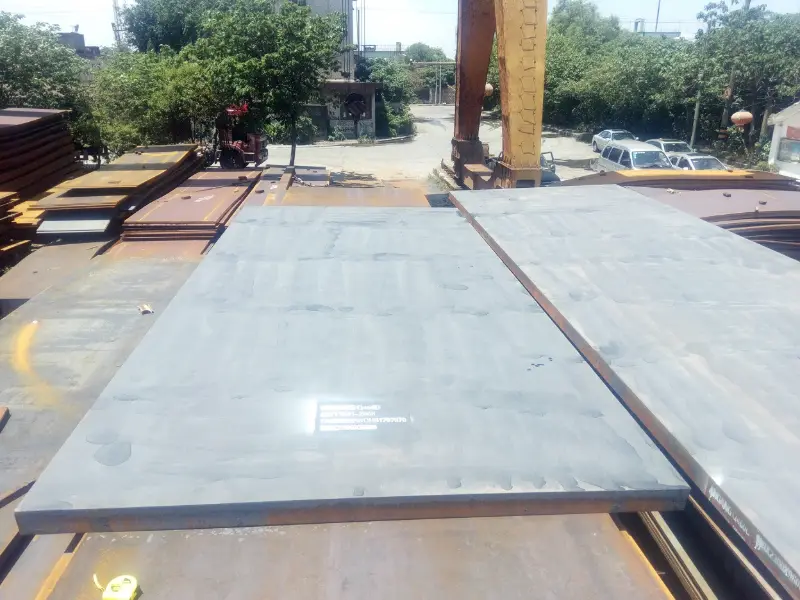
Q890D High-Strength Quenched and Tempered Steel Plate
Q890D High-Strength Quenched and Tempered Steel Plate - GB/T 16270 Standard
Comprehensive material data for Q890D steel plate under Chinese standard GB/T 16270, including chemical composition, mechanical properties, thermal and electrical properties, and equivalent grades.
Welding, bending, cold forming (limited), cutting, machining
- Phone : +8618037372205
- Email : [email protected]
- WhatsApp: Contact via Whtsapp
- WeChat: +8618037372205
Q890D High-Strength Quenched and Tempered Steel Plate Introduction
Q890D is a high-strength carbon and low-alloy structural steel plate specified in GB/T 16270 (High Strength Structural Steel Plates in the Quenched and Tempered Condition). It offers a minimum yield strength of 890 MPa and excellent toughness at -20°C. The steel is delivered in the quenched and tempered condition, achieving a fine microstructure that ensures high strength, good weldability, and good formability. Typical applications include heavy-duty machinery, mining equipment, bridge structures, and offshore engineering. Its low alloy design (mainly Mn, Cr, Ni, Mo) provides hardenability while maintaining adequate ductility.
Q890D High-Strength Quenched and Tempered Steel Plate Chemical Composition
The chemical composition of Q890D is according to GB/T 16270. It is a low-carbon, microalloyed steel with additions of Mn, Cr, Ni, Mo, and sometimes V, Nb, Ti for grain refinement and precipitation hardening. Maximum limits ensure good weldability and toughness. The carbon equivalent (CEV) is typically controlled to facilitate welding.
| Element | Standard Value (max, unless range) | Remarks |
|---|---|---|
| C | ≤0.20 | |
| Si | ≤0.80 | |
| Mn | ≤2.00 | |
| P | ≤0.020 | |
| S | ≤0.010 | |
| Cr | ≤1.50 | |
| Ni | ≤2.00 | |
| Mo | ≤0.70 | |
| Cu | ≤0.50 | |
| B | ≤0.005 | |
| V | ≤0.12 | |
| Nb | ≤0.06 | |
| Ti | ≤0.05 | |
| V+Nb+Ti | ≤0.22 | Sum of microalloying elements |
Q890D High-Strength Quenched and Tempered Steel Plate Thermal and Electrical Physical Properties
Typical physical properties for Q890D grade steel at room temperature unless otherwise noted. These values are representative for low-alloy high-strength steels and may vary slightly based on actual composition and heat treatment.
| Property | Typical Value | Unit | Test Condition |
|---|---|---|---|
| Density (ρ) | 7850 | kg/m³ | At 20°C |
| Elastic Modulus (E) | 210 | GPa | At 20°C |
| Shear Modulus (G) | 81 | GPa | At 20°C (calculated) |
| Poisson's Ratio (ν) | 0.30 | — | At 20°C |
| Thermal Expansion Coefficient (α) | 11.1 | 10⁻⁶/K | 20–100°C |
| Thermal Expansion Coefficient (α) | 12.3 | 10⁻⁶/K | 20–200°C |
| Thermal Conductivity (λ) | 46 | W/(m·K) | At 20°C |
| Thermal Conductivity (λ) | 42 | W/(m·K) | At 200°C |
| Specific Heat Capacity | 460 | J/(kg·K) | At 20°C |
| Electrical Resistivity (ρₑ) | 0.23 | μΩ·m | At 20°C |
Q890D High-Strength Quenched and Tempered Steel Plate Mechanical Properties
Mechanical properties for Q890D steel plates as per GB/T 16270. Values depend on plate thickness. Tensile testing is performed in accordance with GB/T 228. Impact tests at -20°C with Charpy V-notch specimens (KV2) are required for grade D. Bend test (180°) with specified mandrel diameter confirms formability.
| Property | Standard Value | Unit | Test Condition |
|---|---|---|---|
| Yield Strength (ReH) | ≥890 | MPa | Plate thickness ≤50 mm |
| Yield Strength (ReH) | ≥860 | MPa | Plate thickness >50–100 mm |
| Yield Strength (ReH) | ≥830 | MPa | Plate thickness >100–150 mm |
| Tensile Strength (Rm) | 940–1100 | MPa | Plate thickness ≤50 mm |
| Tensile Strength (Rm) | 930–1100 | MPa | Plate thickness >50–100 mm |
| Tensile Strength (Rm) | 900–1100 | MPa | Plate thickness >100–150 mm |
| Elongation (A) | ≥10 | % | Plate thickness ≤50 mm, gauge length 5.65√S0 |
| Elongation (A) | ≥10 | % | Plate thickness >50–100 mm |
| Elongation (A) | ≥10 | % | Plate thickness >100–150 mm |
| Bend Test (180°) | No crack, mandrel diameter d=4a | — | Plate thickness ≤50 mm |
| Bend Test (180°) | No crack, mandrel diameter d=5a | — | Plate thickness >50–100 mm |
| Impact Energy (KV2, -20°C) | ≥47 (longitudinal) | J | Standard Charpy V-notch specimen |
Q890D High-Strength Quenched and Tempered Steel Plate Fully Equivalent Material Standards and Substitutable Grades
| Country/Region | Standard | Grade | Remarks |
|---|---|---|---|
| Europe | EN 10025-6 | S890QL | Same quenched and tempered structure; -20°C impact option (L) matches D requirement |
| International (withdrawn but referenced) | ISO 4950-2:1995 | E890DD | Historical equivalent; DD suffix indicates delivery condition and temperature (-20°C) |
| USA | — | — | No direct ASTM equivalent; closest strength levels are A514 Grade S (yield 690 MPa) or proprietary grades |
| Japan | — | — | No direct JIS equivalent; SHY685/780 have lower strength; Nippon Steel WEL-TEN 950 series may be comparable |
Q890D High-Strength Quenched and Tempered Steel Plate Application Introduction
Q890D steel plate is extensively used in structures requiring high strength-to-weight ratio, good toughness at low temperatures, and reliable weldability. Its quenched and tempered condition guarantees homogeneous mechanical properties through the thickness. Industries and typical products include:
Product Applications: Crane booms and telescopic arms, Excavator buckets and blades, Mining truck frames and dump bodies, Bridge girders and arch ribs, Offshore platform support structures, High-pressure piping and manifold blocks
Processed into products: Welded structural parts (box sections, beams), Cut and machined support brackets, Bent and formed reinforcing plates, Precision-cut flame-cut parts (e.g., flanges, base plates), Heavy-duty fasteners and pins (after additional processing)
Application industries: Heavy machinery and construction equipment (cranes, excavators, bulldozers), Mining and earthmoving equipment (dump truck bodies, bucket components), Bridge and structural engineering (trusses, load-bearing beams), Offshore and marine engineering (jack-up rig legs, ship superstructures), Pressure vessels and penstocks, Railway wagons and transportation
Q890D High-Strength Quenched and Tempered Steel Plate Similar/Alternative Material Recommendations
| Country/Region | Standard | Grade | Remarks |
|---|---|---|---|
| China | GB/T 16270 | Q960D | Higher strength (yield ≥960 MPa) with same -20°C impact requirement; can replace Q890D where weight reduction is critical; welding precautions needed |
| Europe | EN 10025-6 | S960QL | European high-strength quenched and tempered steel; slightly higher yield strength; often interchangeable with design adjustments |
| USA | ASTM A514 | Grade S | Yield strength ≥690 MPa, tensile 760–895 MPa; lower strength but often used in similar heavy equipment; may require increased thickness |
| Japan | JIS G3128 | SHY685 | Yield ≥685 MPa, tensile 780–930 MPa; lower strength; needs thickness reevaluation when substituting for Q890D components |
Notes:
Welding: Preheating (typically 150–200°C depending on thickness) and low-hydrogen practices are recommended. Post-weld heat treatment (PWHT) may be needed for thick sections. Forming: Cold bending is limited; hot forming or controlled press-braking with large radii is preferred. Delivery conditions: Plates are delivered in quenched and tempered condition; surface quality and flatness comply with GB/T 16270. Inspection: Ultrasonic testing (UT) per GB/T 2970 can be specified for internal soundness.
- Share



