
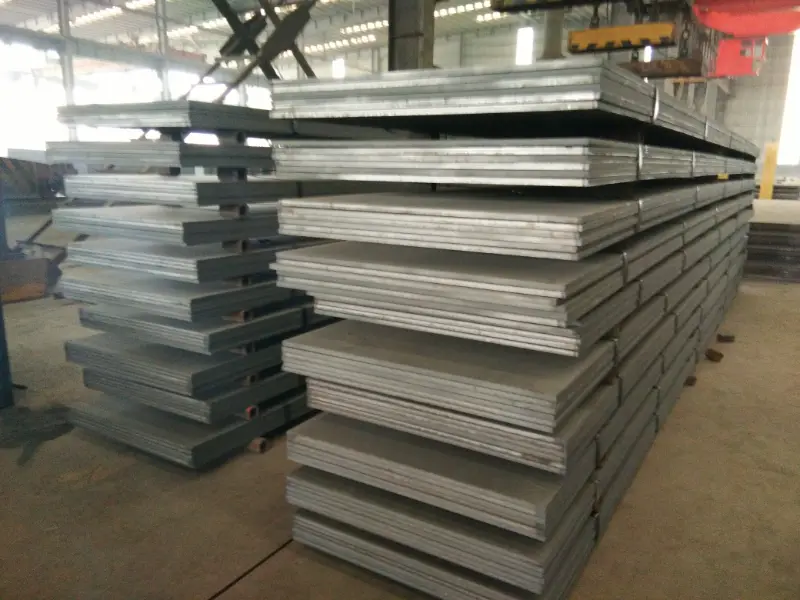
Q890C Steel Plate
GB/T 16270 Q890C Ultra-High Strength Quenched & Tempered Steel Plate – Reliable Performance for Heavy Machinery
Q890C is a premium low-alloy high-strength structural steel in accordance with China GB/T 16270, designed for demanding structural applications requiring minimum yield strength of 890 MPa and excellent low-temperature impact toughness.
Thermal cutting, cold forming, submerged arc welding (SAW), gas metal arc welding (GMAW), machining, shot blasting
- Phone : +8618037372205
- Email : [email protected]
- WhatsApp: Contact via Whtsapp
- WeChat: +8618037372205
Q890C Steel Plate Introduction
Q890C steel is a high-performance quenched and tempered structural steel plate defined by GB/T 16270. It belongs to the category of carbon and low-alloy high-strength steels with a minimum yield strength of 890 MPa. The material combines ultra-high strength, good ductility, and reliable notch toughness at 0°C, making it ideal for heavy-duty welded structures in machinery and civil engineering.
Key features include:
- Ultra-high yield and tensile strength, allowing significant weight reduction and improved payload capacity
- Excellent low-temperature impact energy (min. 47 J at 0°C) for safety-critical applications
- Controlled carbon equivalent (typically ≤ 0.60%) facilitating good weldability when proper preheat and procedures are followed
- Fine-grained bainitic/martensitic microstructure obtained through quenching and tempering, ensuring uniform mechanical properties through thickness
- Stringent purity control (low P, S) enhancing resistance to lamellar tearing and improving fatigue life
Q890C is delivered in the quenched and tempered condition, ready for fabrication. It is widely used in mobile crane booms, concrete pump trucks, mining equipment, offshore structures, and bridge components.
Q890C Steel Plate Chemical Composition per GB/T 16270
The chemical composition of Q890C steel is designed to achieve high strength through controlled microalloying while maintaining suitable carbon equivalent for field welding. Maximum limits are applied to impurity elements such as phosphorus and sulfur to ensure cleanliness and toughness. Ni, Cr, Mo, and microalloying additions (Nb, V, Ti, B) provide deep hardenability and fine grain strengthening. Actual product analysis may differ slightly within permitted tolerances.
| Element | Value (wt%) | Remark |
|---|---|---|
| C (Carbon) | ≤ 0.20 | Max |
| Si (Silicon) | ≤ 0.50 | Max |
| Mn (Manganese) | ≤ 1.60 | Max |
| P (Phosphorus) | ≤ 0.020 | Max |
| S (Sulfur) | ≤ 0.010 | Max |
| Cr (Chromium) | ≤ 1.20 | Max |
| Ni (Nickel) | ≤ 2.00 | Max |
| Mo (Molybdenum) | ≤ 0.70 | Max |
| Cu (Copper) | ≤ 0.50 | Max |
| Nb (Niobium) | ≤ 0.06 | Max |
| V (Vanadium) | ≤ 0.12 | Max |
| Ti (Titanium) | ≤ 0.05 | Max |
| B (Boron) | ≤ 0.005 | Max |
| Al (Aluminum) | ≥ 0.015 (total) | Min |
| N (Nitrogen) | ≤ 0.015 | Max |
Q890C Steel Plate Thermal and Electrical Physical Properties
These values are not specified in GB/T 16270 but represent typical data for quenched and tempered structural steel grades similar to Q890C. They are suitable for engineering design calculations. The properties may vary slightly depending on the actual chemical composition and heat treatment.
| Property | Typical value | Unit | Test condition / Remarks |
|---|---|---|---|
| Density (ρ) | 7.85 | g/cm³ | Room temperature |
| Young's modulus (E) | 205 - 210 | GPa | Room temperature |
| Shear modulus (G) | 80 - 81 | GPa | Calculated from E and ν |
| Poisson's ratio (ν) | 0.29 - 0.30 | - | Elastic region |
| Thermal expansion coefficient (α) | 12.5 | 10⁻⁶/K | 20 - 100°C |
| Thermal expansion coefficient (α) | 13.5 | 10⁻⁶/K | 20 - 300°C |
| Thermal conductivity (λ) | 38 - 42 | W/(m·K) | At 20°C |
| Thermal conductivity (λ) | 35 - 38 | W/(m·K) | At 200°C |
| Specific heat capacity (c_p) | 460 - 500 | J/(kg·K) | 20 - 200°C |
| Electrical resistivity (ρₑ) | 0.20 - 0.25 | μΩ·m | At 20°C |
Q890C Steel Plate Mechanical Properties
Mechanical properties are verified on transverse test pieces according to GB/T 2975, unless otherwise agreed. Depending on plate thickness, the minimum yield and tensile strengths as well as elongation may be adjusted. Good through-thickness properties are ensured by a low sulfur content and fine microstructure. Impact toughness at 0°C (>47 J) provides reliable brittle fracture resistance.
| Property | Value | Unit | Condition / Plate thickness |
|---|---|---|---|
| Yield strength (ReH) min. | 890 | MPa | t ≤ 50 mm, transverse |
| Yield strength (ReH) min. | 850 | MPa | 50 < t ≤ 100 mm, transverse |
| Tensile strength (Rm) | 940 - 1100 | MPa | t ≤ 100 mm, transverse |
| Elongation (A) min. | 10 | % | t ≤ 50 mm, L₀=5.65√S₀ |
| Elongation (A) min. | 9 | % | 50 < t ≤ 100 mm, L₀=5.65√S₀ |
| Bend test (d = bending diameter, a = thickness) | d = 3a | - | t ≤ 50 mm; 180° no cracks |
| Bend test | d = 4a | - | 50 < t ≤ 100 mm; 180° no cracks |
| Impact energy (KV₂) min. | 47 | J | 0°C, longitudinal |
| Impact energy (KV₂) min. | 27 | J | -20°C (Q890D grade reference) |
Q890C Steel Plate Equivalent Standards and Substitutable Grades
| Country/Region | Standard | Grade | Remarks |
|---|---|---|---|
| Europe | EN 10025-6 | S890Q (1.8941) | Same minimum yield strength, comparable chemical composition; Q corresponds to lower toughness, but S890Q is the direct counterpart for Q890C. |
| Europe | EN 10025-6 | S890QL (1.8983) | Enhanced low-temperature toughness (-40°C), fully substitutable for Q890C in demanding applications. |
| Europe | EN 10025-6 | S890QL1 (1.8936) | Extra low-temperature toughness (-60°C), suitable for arctic conditions. |
| International | ISO 4951-2 | S890Q | Identical strength requirements, globally recognized equivalent. |
Q890C Steel Plate Application Introduction
Q890C steel is specifically engineered for welded structures where extreme strength and reduced dead weight are essential. It is extensively used in heavy mobile equipment, lifting devices, and challenging infrastructure projects. The material performs well under repeated dynamic loading and retains sufficient toughness after welding. Typical fields include:
Product Applications: Mobile crane telescopic booms and outriggers, Concrete pump truck placing booms and frame components, Mining excavator buckets, arms and boom structural parts, High-capacity fork lift masts, Heavy-duty truck chassis and trailer beams, Offshore crane pedestals and A-frames, Bridge girder webs and mounting brackets
Processed into products: Welded box-section booms, Lattice mast chords and diagonals, Pivot pins and heavily loaded connection plates (if machined from plate), Web plates and flanges in heavy girders, Reinforcement ribs and stiffeners, Fatigue-critical joints in dynamically loaded structures, High-pressure hydraulic cylinder bodies (rolled and welded)
Application industries: Construction machinery (cranes, excavators, concrete pumps), Mining and quarrying equipment, Heavy transport and trailer frames, Port and offshore lifting equipment, Bridge engineering (orthotropic deck plates, box girders), Shipbuilding (high-stress structural members, ramps)
Q890C Steel Plate Similar Materials with Close Performance
| Country/Region | Standard | Grade | Remarks |
|---|---|---|---|
| Europe | EN 10025-6 | S960Q | Higher strength level (min. yield 960 MPa); can be used if design allows and weldability is reassessed. |
| China | GB/T 16270 | Q890D | Same strength, better low-temperature toughness (-20°C); direct superior substitute. |
| China | GB/T 16270 | Q690D | Lower strength (690 MPa); can be used for less stressed components, easier welding. |
| Japan | JIS G 3128 | SHY685N / SHY685NS | Similar 685 MPa yield with excellent toughness; used in construction machinery but lower strength. |
| USA | ASTM A514 / A517 | Grade B / H / Q | Max 690 MPa yield; often used in pressure vessels and bridges; not a direct replacement for 890 MPa structures. |
Notes:
Welding considerations: Due to the high strength and alloy content, low-hydrogen welding consumables and controlled preheat (typically 100–200°C) are recommended. Post-weld heat treatment is not normally required.
Availability: Plates are normally furnished with mill test certificates according to EN 10204 3.1. Ultrasonic testing per GB/T 2970 (Class II or III) is commonly specified.
Note: This data is based on GB/T 16270 (High Strength Structural Steel Plates in the Quenched and Tempered Condition) and representative published information. For critical applications, consult the latest edition of the standard and the approval certificate.
- Share



