
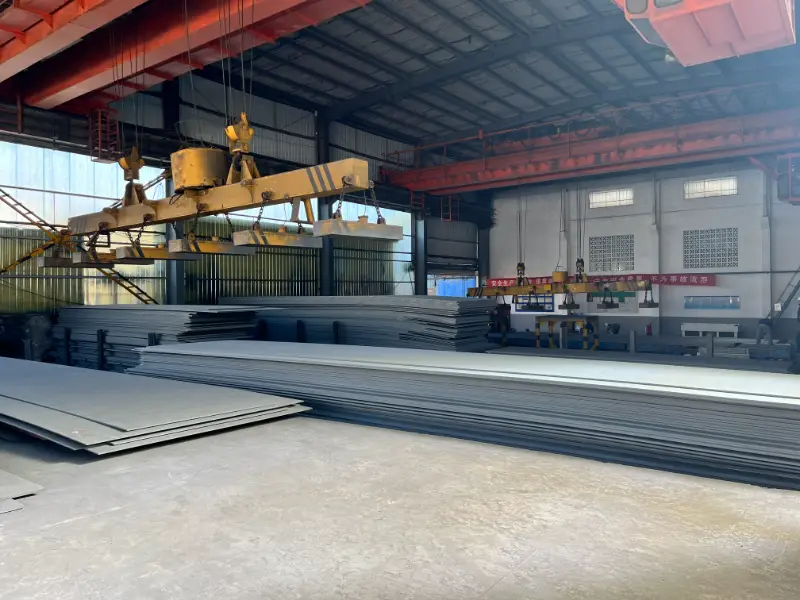
Q800F Ultra-High Strength Quenched & Tempered Steel Plate
Q800F Ultra-High Strength Quenched & Tempered Steel Plate | GB/T 16270
Detailed datasheet for Q800F carbon and low-alloy high-strength structural steel plate according to GB/T 16270. Includes chemical composition, mechanical properties at -60°C impact, thermal and electrical physical properties, international equivalents, and recommended applications.
Quenching and tempering (Q+T), hot rolling, controlled rolling, cold forming, machining, welding
- Phone : +8618037372205
- Email : [email protected]
- WhatsApp: Contact via Whtsapp
- WeChat: +8618037372205
Q800F Ultra-High Strength Quenched & Tempered Steel Plate Introduction
Q800F is a quenched and tempered high-strength structural steel plate under the Chinese standard GB/T 16270. It belongs to the carbon and low-alloy category and is designed for demanding welded structures. The grade delivers a minimum yield strength of 800 MPa with excellent low-temperature notch toughness (longitudinal impact energy ≥27 J at -60°C), ensuring reliable service in severe climatic and heavy-load conditions. Its fine-grained microstructure, achieved through controlled rolling and QT heat treatment, provides
- High strength-to-weight ratio for lightweight designs
- Good weldability with low carbon equivalent and Pcm values
- Superior resistance to brittle fracture at sub-zero temperatures
Typical applications include heavy-duty mobile cranes, mining equipment, offshore structures, and pressure vessels. The steel is delivered in the quenched and tempered condition and can be further processed by cold forming, machining, and welding.
Q800F Ultra-High Strength Quenched & Tempered Steel Plate Chemical Composition
Chemical composition as per GB/T 16270 for Q800F grade. The steel is microalloyed with elements such as Nb, V, Ti, and B to refine grain size and improve hardenability. Stricter limits on phosphorus and sulfur ensure high cleanliness and low-temperature toughness. The carbon equivalent (CEV) and weld crack sensitivity composition (Pcm) are controlled to guarantee adequate weldability.
| Element | Standard Value (max, %) | Remarks |
|---|---|---|
| Carbon (C) | 0.20 | Base element for strength; low level improves weldability |
| Silicon (Si) | 0.80 | Deoxidizer and solid-solution strengthener |
| Manganese (Mn) | 1.70 | Enhances hardenability and toughness |
| Phosphorus (P) | 0.020 | Controlled to prevent temper embrittlement |
| Sulfur (S) | 0.010 | Ultra-low sulfur for high lamellar tear resistance and toughness |
| Chromium (Cr) | 1.50 | Optional; increases hardenability and corrosion resistance |
| Nickel (Ni) | 2.00 | Optional; improves low-temperature toughness |
| Molybdenum (Mo) | 0.70 | Optional; suppresses temper embrittlement |
| Copper (Cu) | 0.50 | Optional; minor strength contribution; if higher, check hot shortness |
| Niobium (Nb) | 0.06 | Microalloy; grain refinement and precipitation strengthening |
| Vanadium (V) | 0.12 | Microalloy; precipitation strengthening |
| Titanium (Ti) | 0.05 | Microalloy; grain refinement and nitride formation |
| Boron (B) | 0.005 | Optional; strongly increases hardenability even in trace amounts |
| Aluminum (Al) | ≥0.015 (total) | Typically added for deoxidation and grain refinement |
| Nitrogen (N) | 0.015 | Bound as nitrides; free N limited to avoid aging |
| Carbon Equivalent (CEV) | Typically ≤0.60 | CEV = C + Mn/6 + (Cr+Mo+V)/5 + (Ni+Cu)/15; controlled for weldability |
| Cold Cracking Susceptibility Pcm | Typically ≤0.30 | Pcm = C + Si/30 + Mn/20 + Cu/20 + Ni/60 + Cr/20 + Mo/15 + V/10 + 5B |
Q800F Ultra-High Strength Quenched & Tempered Steel Plate Thermal and Electrical Physical Properties
Physical properties for a Q&T low-alloy high-strength steel of this strength class at room temperature, unless otherwise noted. These values are typical for design calculations and not guaranteed by the material standard. Thermal conductivity decreases and specific heat increases slightly with temperature. The electrical resistivity is based on generic values for low-alloy steels.
| Property | Typical Value | Unit | Test Condition / Remarks |
|---|---|---|---|
| Density (ρ) | 7.85 | g/cm³ | 20°C |
| Modulus of elasticity (E) | 206 | GPa | Room temperature |
| Shear modulus (G) | 80 | GPa | Calculated from E and ν |
| Poisson's ratio (ν) | 0.3 | - | In elastic range |
| Thermal expansion coefficient (α) | 11.1 | 10⁻⁶/K | 20°C to 100°C |
| Thermal expansion coefficient (α) | 12.1 | 10⁻⁶/K | 20°C to 200°C |
| Thermal expansion coefficient (α) | 12.9 | 10⁻⁶/K | 20°C to 300°C |
| Thermal conductivity (λ) | 36 | W/(m·K) | 20°C |
| Thermal conductivity (λ) | 34 | W/(m·K) | 300°C (approximate) |
| Specific heat capacity (cp) | 460 | J/(kg·K) | 20°C |
| Specific heat capacity (cp) | 520 | J/(kg·K) | 300°C (approximate) |
| Electrical resistivity (ρ_e) | 0.22 | 10⁻⁶ Ω·m | 20°C (typical for low-alloy steel) |
Q800F Ultra-High Strength Quenched & Tempered Steel Plate Mechanical Properties
Mechanical property requirements according to GB/T 16270 for Q800F plates in the quenched and tempered condition. Transverse test specimens. Impact test temperature is -60°C for grade F. The minimum energy is 27 J for longitudinal specimens. Properties vary with thickness; the table lists requirements for the most common thickness range. Note: Lower yield strength (ReL) may be specified where upper yield strength is not clearly defined.
| Property | Standard Requirement | Unit | Test Condition / Thickness |
|---|---|---|---|
| Yield Strength (ReH) | ≥800 | MPa | Thickness ≤50 mm |
| Yield Strength (ReH) | ≥750 | MPa | Thickness >50 mm to ≤100 mm |
| Tensile Strength (Rm) | 880 to 1100 | MPa | Thickness ≤50 mm |
| Tensile Strength (Rm) | 850 to 1100 | MPa | Thickness >50 mm to ≤100 mm |
| Elongation after fracture (A) | ≥10 | % | Gauge length Lo = 5.65√So; transverse; thickness ≤50 mm |
| Elongation after fracture (A) | ≥9 | % | Thickness >50 mm to ≤100 mm |
| Bend test (bending angle 180°) | d = 3a | - | Bend mandrel diameter, a = specimen thickness; thickness ≤50 mm |
| Bend test (bending angle 180°) | d = 4a | - | Thickness >50 mm to ≤100 mm |
| Impact energy (KV2) | ≥27 | J | -60°C; longitudinal test piece; thickness 10-100 mm |
| Impact energy (KV2) | ≥20 | J | -60°C; transverse test piece (if agreed) |
| Hardness | ≤340 HBW | - | For information only; not mandatory |
| Through-thickness reduction of area (Z) | ≥15 (Z15) | % | When specified; in accordance with GB/T 5313 |
Q800F Ultra-High Strength Quenched & Tempered Steel Plate Identical Material Standards and Substitutable Grades
| Country / Region | Standard | Grade | Remark |
|---|---|---|---|
| China | GB/T 16270 | Q800D | Same strength, lower toughness (-20°C), may substitute where -60°C impact not required |
| China | GB/T 16270 | Q800E | Same strength, -40°C impact, close but not identical to F grade |
| Europe | EN 10025-6 | S890Q | Minimum yield 890 MPa, -20°C (Q) or -40°C (QL) impact; closest EN strength grade, but yield level slightly higher |
| International | ISO 4950-2 | E890Q | Similar quenched & tempered plate, yield ≥890 MPa, not directly equivalent to 800 MPa class |
| Japan | JIS G 3135 | SPFC980Y | Cold-rolled high-strength sheet, 980 MPa tensile class, different product form and lower thickness range, not a full equivalent |
| USA | ASTM A514/A517 | Grade S | Yield ≥690 MPa, tensile 690-895 MPa, lower strength level than Q800F; may be considered for less demanding applications |
Q800F Ultra-High Strength Quenched & Tempered Steel Plate Application Introduction
Q800F steel is engineered for high-stress structural applications where a combination of extreme strength, light weight, and reliability at low ambient temperatures is mandatory. The steel is delivered in the quenched and tempered condition, enabling direct flame cutting, cold forming (with adequate bend radii), and welding without post-weld heat treatment. It is widely used in the following industries and products:
Product Applications: All-terrain mobile crane telescopic booms (e.g., Liebherr LTM 1750-9.1 section reinforcements), Hydraulic excavator booms, arms, and undercarriages, Mining truck body liners and frames (e.g., Caterpillar 797 haul truck), Offshore platform column nodes and heavy-lift crane pedestals, High-pressure gas storage cylinders (up to 69 MPa working pressure), Military bridging and temporary runway mats, Wind turbine tower flanges and transition pieces
Processed into products: Cut and welded structural beams and box-girder elements, Bent or rolled cylindrical shells for pressure vessels, Machined swing rings and bearing housings, Flame-cut chain links and lifting lugs, Bolted or welded splice plates and gusset plates, Formed stiffeners and ribs for lightweight panels, Threaded tie rods and anchor bolts
Application industries: Heavy lifting and transport (mobile cranes, crawler cranes, reach stackers), Mining and earth-moving (excavator booms, dump truck bodies, shovel buckets), Offshore and marine engineering (jack-up rigs, deck structures, crane pedestals), Pressure vessel and boiler manufacture (high-pressure cylinders, autoclaves), Bridge construction (long-span trusses, orthotropic decks), Defense and security (armor plates, blast-resistant containers), Railway vehicles (heavy-duty freight car frames)
Q800F Ultra-High Strength Quenched & Tempered Steel Plate Closely Related and Alternative Materials
| Country / Region | Standard | Grade | Remarks / Comparison |
|---|---|---|---|
| China | GB/T 16270 | Q690F | Yield ≥690 MPa, -60°C impact; lower strength but same toughness class; suitable where 800 MPa level is over-designed |
| China | GB/T 16270 | Q890F | Yield ≥890 MPa, -60°C impact; higher strength for weight-critical designs |
| Europe | EN 10025-6 | S960Q | Yield ≥960 MPa, -20°C (Q); higher strength, but lower impact temperature unless QL variant is chosen |
| Europe | EN 10025-6 | S890QL | Yield ≥890 MPa, -40°C impact; close strength and better low-temperature toughness than S890Q |
| USA | ASTM A514/A517 | Grade H | Yield ≥690 MPa, typical impact at -46°C; lower strength but good toughness |
| USA | ASTM A710 | Grade A | High-strength low-alloy plate, precipitation-hardened, yield ~550 MPa, not a strength match but good weldability and toughness |
| Japan | JIS G 3128 | SHY685N | Yield ≥685 MPa, -40°C; lower strength, close toughness level for offshore applications |
Notes:
Welding considerations: Low hydrogen welding processes are mandatory. Preheat and interpass temperature recommendations depend on thickness and combined hydrogen input; typically preheat to 100–175°C. Use matching or slightly undermatching filler metals (e.g., OK Autrod 13.12 or AWS ER120S-1). Cold forming: Minimum bending radius of 3t transverse to rolling direction is permitted without cracking; for longitudinal bends, larger radii may be required. Surface protection: The steel can be blasted and coated; shop-primer compatible with thermal cutting is recommended. Ordering: Specify grade Q800F, standard GB/T 16270, and any supplementary requirements such as ultrasonic testing (GB/T 2970), through-thickness properties, or notch toughness verification at lower temperatures.
- Share



