
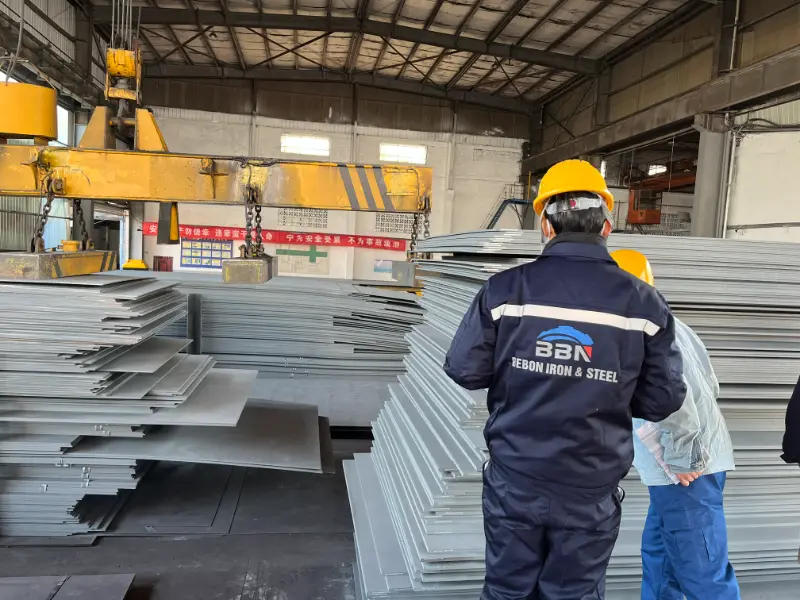
Q800E High-Strength Quenched & Tempered Steel Plate per GB/T 16270
Q800E High-Strength Quenched & Tempered Steel Plate per GB/T 16270 | 800 MPa Yield
Comprehensive data for Q800E carbon and low-alloy high-strength steel plate to GB/T 16270, including chemical composition, mechanical properties, thermal and electrical physical properties, international equivalents, and application guide.
Quenching and tempering, welding, cutting, cold forming (limited)
- Phone : +8618037372205
- Email : [email protected]
- WhatsApp: Contact via Whtsapp
- WeChat: +8618037372205
Q800E High-Strength Quenched & Tempered Steel Plate per GB/T 16270 Introduction
Q800E is a high-strength structural steel plate with a minimum yield strength of 800 MPa, classified under GB/T 16270 for quenched and tempered high-strength steels. It belongs to the carbon and low-alloy family, offering exceptional strength and good low-temperature toughness down to -40°C. The 'E' designation indicates guaranteed impact energy at -40°C. This steel is produced through a quenching and tempering heat treatment process, resulting in a fine-grained microstructure that provides a superior combination of strength, ductility, and weldability. Typical applications include heavy machinery, cranes, bridges, offshore structures, and pressure vessels where high load-bearing capacity and reliability are required.
Q800E High-Strength Quenched & Tempered Steel Plate per GB/T 16270 Chemical Composition
The chemical composition of Q800E according to GB/T 16270 is designed to achieve high strength through a lean alloy design with microalloying elements like Nb, V, Ti, and B. The low carbon content ensures good weldability, while controlled sulfur and phosphorus levels enhance cleanliness and toughness. Note: Unless otherwise agreed, the values are based on heat analysis. Product analysis may have slight deviations per the standard.
| Element | Standard Value (max unless range) | Remarks |
|---|---|---|
| C | ≤0.20 | |
| Si | ≤0.80 | |
| Mn | ≤1.50 | |
| P | ≤0.020 | |
| S | ≤0.010 | |
| Cr | ≤1.50 | |
| Ni | ≤2.00 | |
| Mo | ≤0.70 | |
| Nb | ≤0.06 | |
| V | ≤0.12 | |
| Ti | ≤0.05 | |
| B | ≤0.005 | |
| Cu | ≤0.50 | If specified |
| Al (total) | ≥0.015 | Minimum for grain refinement |
Q800E High-Strength Quenched & Tempered Steel Plate per GB/T 16270 Physical Properties
The following physical properties are typical reference values for quenched and tempered low-alloy steels of this strength class. They are not mandatory in GB/T 16270 but aid in design calculations. Variations may occur depending on the exact chemical composition and heat treatment.
| Property | Typical Value | Unit | Condition / Temperature |
|---|---|---|---|
| Density (ρ) | 7.85 | g/cm³ | 20°C |
| Modulus of Elasticity (E) | 210 | GPa | 20°C |
| Shear Modulus (G) | 81 | GPa | 20°C |
| Poisson's Ratio (ν) | 0.3 | - | 20°C |
| Thermal Expansion Coefficient (α) | 12.0 | 10⁻⁶/K | 20–100°C |
| Thermal Conductivity (λ) | 35 | W/(m·K) | 20°C |
| Specific Heat Capacity (c) | 480 | J/(kg·K) | 20°C |
| Electrical Resistivity (ρₑ) | 0.25 | μΩ·m | 20°C |
Q800E High-Strength Quenched & Tempered Steel Plate per GB/T 16270 Mechanical Properties
Mechanical properties are guaranteed for plates in the quenched and tempered condition. Standards require: Yield strength (ReH) ≥800 MPa for thickness ≤50 mm. For thicker sections, values may decrease; consult the standard. Tensile strength is in the range 940–1100 MPa. Elongation and impact toughness are specified for transverse specimens unless otherwise agreed. Impact energy KV2 at -40°C is ≥47 J. Bend test uses 180° bending with a mandrel diameter of 3×thickness.
| Property | Typical / Minimum Value | Unit | Test Condition / Remarks |
|---|---|---|---|
| Yield Strength (ReH) | ≥800 | MPa | Thickness ≤50 mm, transverse |
| Tensile Strength (Rm) | 940 – 1100 | MPa | Thickness ≤50 mm |
| Elongation (A) | ≥12 | % | Gauge length 5.65√S₀, thickness ≤50 mm |
| Impact Energy (KV₂) at -40°C | ≥47 | J | Transverse Charpy V-notch, average of 3 tests |
| Bend Test | No cracks | - | 180° bending, d=3a (a=thickness, ≤50 mm) |
Q800E High-Strength Quenched & Tempered Steel Plate per GB/T 16270 Fully Equivalent Material Standards and Replaceable Grades
| Country/Region | Standard | Grade | Remarks |
|---|---|---|---|
| Europe | EN 10025-6 | S890Q / S890QL | S890Q typical for 800 MPa min YS, S890QL with low temperature impact similar to E grade |
| International | ISO 4950-2 | E890DD or E890E | E890 with -40°C impact energy comparable to E grade |
| Japan | JIS G 3128 | SHY685NS | Approximate, YS 685 MPa; no direct 800 MPa in JIS, but closest high yield plate |
| USA | ASTM A514/A517 | Grade Q (max 690 MPa) | Yield strength lower, no direct equivalent, but used in similar applications |
Q800E High-Strength Quenched & Tempered Steel Plate per GB/T 16270 Application Introduction
Q800E plates are designed for heavy-duty structural applications requiring high strength-to-weight ratio and reliable toughness in cold climates. They can be welded using low-hydrogen processes with appropriate preheat and interpass control. Forming should consider the high strength and limited elongation; cold bending radii must be generous, and hot forming may be preferred.
Product Applications: Crane booms and jibs, Offshore platform legs and decks, Bridge girders and box sections, Slewing rings and gear blanks, Heavy-duty transport trailers, Wind turbine tower flanges and transition pieces
Processed into products: Welded structural beams, Load-bearing plates and gussets, Crane rail and slewing bearing supports, Pressure vessel shells and heads, Penstock bifurcations and wyes, Excavator arms and buckets, Heavy-lift padeyes and lifting lugs
Application industries: Heavy machinery and equipment, Bridge construction, Offshore and marine engineering, Pressure vessel and penstock manufacturing, Mining and material handling equipment, Building and infrastructure (high-rise, stadiums, etc.)
Q800E High-Strength Quenched & Tempered Steel Plate per GB/T 16270 Similar or Comparable Material Recommendations
| Country/Region | Standard | Grade | Remarks |
|---|---|---|---|
| China | GB/T 16270 | Q800D | Same strength level but impact at -20°C, otherwise identical composition |
| China | GB/T 16270 | Q800F | Same strength level, impact at -60°C, for more severe low-temperature service |
| Europe | EN 10025-6 | S890QL1 | Enhanced low-temperature toughness; comparable to Q800E/F |
| Germany | DIN EN 10025-6 | S890Q | Identical to EN grade |
| Japan | JIS G 3106 | SM570 | Lower yield (570 MPa), but similar weldable high-strength for structural use |
Notes:
- For thickness >50 mm, mechanical properties may be agreed upon at the time of ordering; the standard provides separate tables for 50–100 mm and 100–150 mm ranges.
- CEV (carbon equivalent) is typically ≤0.65% for good weldability; the actual value shall be reported on the inspection certificate.
- Plates are usually supplied with ultrasonic testing per GB/T 2970, class to be agreed.
- Dimension and shape tolerances follow GB/T 709.
- Share



