
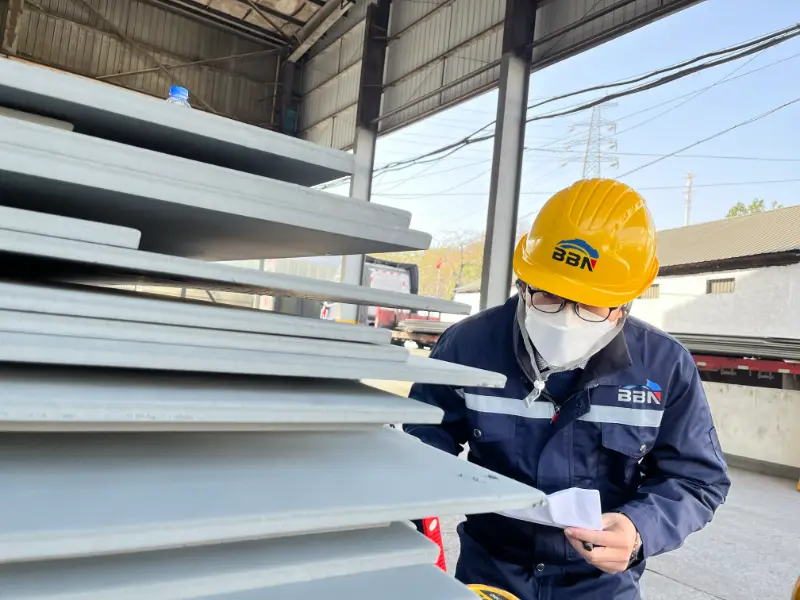
Q800D High-Strength Quenched & Tempered Steel Plate
Q800D High-Strength Quenched & Tempered Steel Plate - GB/T 16270
Q800D is a high-strength quenched and tempered structural steel plate with a minimum yield strength of 800 MPa, excellent toughness at -20°C, and good weldability. Ideal for heavy machinery, mining equipment, and bridges.
Hot rolling followed by quenching and tempering; subsequent cutting, bending, welding, and machining possible with proper practices.
- Phone : +8618037372205
- Email : [email protected]
- WhatsApp: Contact via Whtsapp
- WeChat: +8618037372205
Q800D High-Strength Quenched & Tempered Steel Plate Introduction
Q800D is a low-alloy high-strength structural steel plate defined in China's GB/T 16270 standard for quenched and tempered high-strength plates. It offers a minimum yield strength of 800 MPa in thicknesses up to 50 mm, combined with high tensile strength (880–1100 MPa) and good elongation. The 'D' quality designation guarantees impact energy of at least 34 J at -20°C, ensuring reliable toughness in cold environments. Key advantages:
- Excellent strength-to-weight ratio for weight-critical designs
- Good cold bending and welding performance with proper preheating
- Uniform mechanical properties through the thickness
Typical applications include crane booms, heavy mining truck frames, bridge structural components, and pressure vessels requiring high load-bearing capacity.
Q800D High-Strength Quenched & Tempered Steel Plate Chemical Composition
The chemical composition conforms to GB/T 16270 for Q800D. Limits on phosphorus and sulfur are tightened for quality level D to enhance toughness and weldability. Carbon equivalent (CEV) is controlled to ensure good weldability: typically max 0.60% depending on thickness.
| Element | Standard Value (wt. %) | Remarks |
|---|---|---|
| Carbon (C) | ≤ 0.20 | Max |
| Silicon (Si) | ≤ 0.80 | Max |
| Manganese (Mn) | ≤ 1.80 | Max |
| Phosphorus (P) | ≤ 0.020 | Max, quality D |
| Sulfur (S) | ≤ 0.010 | Max, quality D |
| Chromium (Cr) | ≤ 1.20 | Max |
| Nickel (Ni) | ≤ 2.00 | Max |
| Molybdenum (Mo) | ≤ 0.70 | Max |
| Copper (Cu) | ≤ 0.50 | Max |
| Niobium (Nb) | ≤ 0.06 | Max |
| Vanadium (V) | ≤ 0.12 | Max |
| Titanium (Ti) | ≤ 0.05 | Max |
| Boron (B) | ≤ 0.005 | Max |
Q800D High-Strength Quenched & Tempered Steel Plate Thermal and Electrical Physical Properties
The following physical properties are typical for low-alloy high-strength quenched and tempered steels of this class. They are not part of the material standard but are useful for design calculations. Variability exists with tempering temperature and exact alloy content.
| Property | Typical Value | Unit | Test Condition |
|---|---|---|---|
| Density (ρ) | 7.85 | g/cm³ | Room temperature |
| Modulus of Elasticity (E) | 200 – 210 | GPa | Room temperature |
| Shear Modulus (G) | 80 – 85 | GPa | Room temperature |
| Poisson's Ratio (ν) | 0.3 | — | Room temperature |
| Thermal Expansion Coefficient (α) | 12.0 | 10⁻⁶/K | 20 – 100°C |
| Thermal Conductivity (λ) | 40 – 45 | W/(m·K) | Room temperature |
| Specific Heat Capacity (c) | 460 | J/(kg·K) | Room temperature |
| Electrical Resistivity (ρe) | 0.20 – 0.25 | μΩ·m | Room temperature |
Q800D High-Strength Quenched & Tempered Steel Plate Mechanical Properties
Mechanical properties are guaranteed by the standard for the quenched and tempered condition. Values depend on plate thickness. The impact test is performed on longitudinal Charpy-V specimens. Bend test: normally no mandatory bend radius specified, but good ductility allows 180° bending with a mandrel diameter equal to 3 times the thickness (reference).
| Property | Required Value | Unit | Test Condition / Thickness |
|---|---|---|---|
| Yield Strength (ReH) | ≥ 800 | MPa | t ≤ 50 mm |
| Yield Strength (ReH) | ≥ 750 | MPa | 50 mm < t ≤ 100 mm |
| Yield Strength (ReH) | ≥ 700 | MPa | 100 mm < t ≤ 150 mm |
| Tensile Strength (Rm) | 880 – 1100 | MPa | t ≤ 50 mm |
| Tensile Strength (Rm) | 840 – 1100 | MPa | 50 mm < t ≤ 100 mm |
| Tensile Strength (Rm) | 800 – 950 | MPa | 100 mm < t ≤ 150 mm |
| Elongation (A) | ≥ 12 | % | t ≤ 50 mm, gauge 5.65√So |
| Elongation (A) | ≥ 11 | % | 50 mm < t ≤ 100 mm |
| Elongation (A) | ≥ 10 | % | 100 mm < t ≤ 150 mm |
| Impact Energy (KV2) | ≥ 34 | J | -20°C, longitudinal |
| Bend Test | D = 3a (180°) | — | Recommended, a = plate thickness |
Q800D High-Strength Quenched & Tempered Steel Plate Equivalent Standards and Substitute Grades
| Country / Region | Standard | Grade | Remarks |
|---|---|---|---|
| — | — | — | No direct identical equivalent exists. |
Q800D High-Strength Quenched & Tempered Steel Plate Application Introduction
Q800D is engineered for heavy-load structural components where high strength, weldability, and low-temperature toughness are essential. Typical usage environments:
- Mining and earthmoving machinery subjected to shock and abrasion
- Cranes and lifting equipment requiring high yield strength to reduce weight
- Bridges and offshore structures in cold climates
- High-pressure vessels and pensrocks
The quenched and tempered condition ensures homogeneous properties, making it suitable for precision cutting and welding with appropriate heat input control.
Product Applications: Excavator & bulldozer structural frames, Dump truck bodies and buckets, Crane booms and outriggers, Offshore platform legs and nodes, Bridge girders and truss members, Hydraulic cylinder bodies
Processed into products: Boom sections, stick assemblies, undercarriage frames, Wear plates, cutting edges, liners (as base material), Welded box-girder segments, Pin connections, bogie beams, support brackets, Thick-wall rolled and welded cylinders
Application industries: Mining & Quarrying, Construction Machinery, Cranes & Lifting, Offshore & Marine Engineering, Bridge Building, Pressure Vessel Manufacturing
Q800D High-Strength Quenched & Tempered Steel Plate Similar / Alternative Materials for Comparison
| Country / Region | Standard | Grade | Remarks |
|---|---|---|---|
| Europe | EN 10025-6 | S890Q | Minimum yield 890 MPa; slightly higher strength, similar toughness (S890QL at -40°C) |
| Europe | EN 10025-6 | S690Q | Minimum yield 690 MPa; lower strength but excellent toughness, often used as alternative |
| USA | ASTM A514 / A517 | Grade B, H, F, Q | Yield strength 690 MPa; lower strength but widely used for construction |
| Japan | JIS G 3128 | SHY685, SHY70 | Yield strength 685–700 MPa; usable with some downgauge |
| China | GB/T 16270 | Q690D | Yield 690 MPa; lower strength grade in the same standard, good substitute if 800 MPa not required |
Notes:
Welding considerations: Preheating (150–200°C) and controlled interpass temperature are recommended. Low-hydrogen electrodes (e.g., E7018 or E11018-M) should be used. Post-weld heat treatment is generally not required for thicknesses under 40 mm but may be applied for stress relief. Forming: Hot forming must be followed by a new quench and temper treatment to restore properties. Cold bending radii should be at least 3 times the thickness to avoid cracking. Ultrasonic testing to GB/T 2970 Class I or II is often performed to ensure internal soundness.
- Share



