
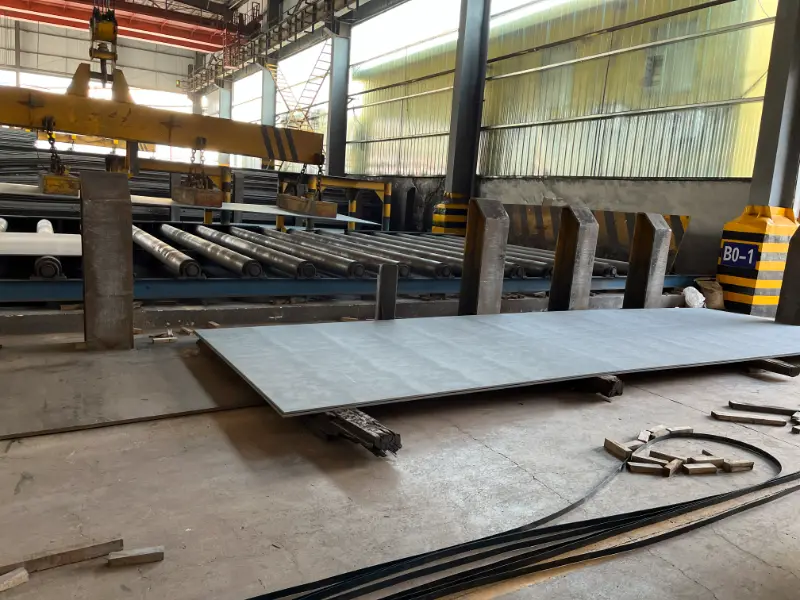
GB/T 16270 Q800C High-Strength Quenched & Tempered Steel Plate
GB/T 16270 Q800C High-Strength Quenched & Tempered Steel Plate - Composition, Properties & Equivalents
Detailed material data for GB/T 16270 Q800C carbon and low-alloy high-strength quenched and tempered steel plate: chemical composition, mechanical properties, thermal and electrical physical properties, international equivalents, similar materials, and application guidance.
Thermal cutting, welding, cold forming (with appropriate radius and preheat), machining
- Phone : +8618037372205
- Email : [email protected]
- WhatsApp: Contact via Whtsapp
- WeChat: +8618037372205
GB/T 16270 Q800C High-Strength Quenched & Tempered Steel Plate Introduction
GB/T 16270 Q800C is a high-strength structural steel plate produced by quenching and tempering. It belongs to the carbon and low-alloy high-strength category. With a minimum yield strength of 800 MPa (for thicknesses up to 50 mm), it offers an excellent combination of strength, toughness, and weldability. The 'C' suffix denotes an impact toughness guarantee at 0 °C (minimum 34 J longitudinal). This steel is widely used in heavy machinery, mobile cranes, bridges, and pressure vessels where high load-bearing capacity and weight reduction are critical. The standard also imposes strict limits on phosphorus and sulfur to ensure cleanliness, and allows microalloying elements such as Nb, V, Ti, and B for grain refinement and hardenability.
GB/T 16270 Q800C High-Strength Quenched & Tempered Steel Plate Chemical Composition
The table lists the maximum or range of chemical elements as specified in GB/T 16270 for Q800C grade. Carbon equivalent (CEV) shall be agreed upon, typically ≤0.55 for thickness up to 50 mm. Residual elements are controlled to ensure weldability and toughness.
| Chemical Element | Standard Value (max unless range given) | Remarks |
|---|---|---|
| Carbon (C) | ≤0.20 | Improves hardenability; CEV must be controlled |
| Silicon (Si) | ≤0.50 | Deoxidizer |
| Manganese (Mn) | ≤1.70 | Contributes to strength and toughness |
| Phosphorus (P) | ≤0.020 | Strictly limited for toughness |
| Sulfur (S) | ≤0.010 | Strictly limited for cleanliness |
| Chromium (Cr) | ≤0.80 | Enhances hardenability and corrosion resistance |
| Nickel (Ni) | ≤2.00 | Improves low-temperature toughness |
| Molybdenum (Mo) | ≤0.70 | Prevents temper embrittlement, increases hardenability |
| Boron (B) | ≤0.005 | Microalloy – improves hardenability |
| Vanadium (V) | ≤0.12 | Grain refinement and precipitation hardening |
| Niobium (Nb) | ≤0.06 | Grain refinement |
| Titanium (Ti) | ≤0.05 | Grain refinement, nitrogen fixation |
| Copper (Cu) | ≤0.30 | Residual, can improve atmospheric corrosion resistance |
| Aluminium (total Al) | ≥0.015 | Grain refinement, deoxidation |
GB/T 16270 Q800C High-Strength Quenched & Tempered Steel Plate Thermal and Electrical Physical Properties
The physical properties listed below are typical for quenched and tempered low-alloy steels of this strength level and are not mandatory requirements of GB/T 16270. They are provided for design and calculation purposes. Density is practically constant; thermal expansion and conductivity vary slightly with temperature.
| Property | Typical Value | Unit | Test Condition |
|---|---|---|---|
| Density (ρ) | 7.85 | g/cm³ | Room temperature |
| Modulus of Elasticity (E) | 210 | GPa | Room temperature |
| Shear Modulus (G) | 80 | GPa | Room temperature, estimated from E and ν |
| Poisson's Ratio (ν) | 0.3 | – | Room temperature, typical for steel |
| Thermal Expansion Coefficient (α) | 12.0×10⁻⁶ | 1/K | 20 °C–100 °C |
| Thermal Conductivity (λ) | 45 | W/(m·K) | At 20 °C |
| Specific Heat Capacity (c) | 460 | J/(kg·K) | Room temperature |
| Electrical Resistivity (ρₑ) | 0.22×10⁻⁶ | Ω·m | Room temperature |
GB/T 16270 Q800C High-Strength Quenched & Tempered Steel Plate Mechanical Properties
The following values are the minimum requirements according to GB/T 16270 for transverse test specimens taken from the plate in the quenched and tempered condition. Thickness ranges affect the required yield and tensile strength and elongation. Impact test is performed at 0 °C on longitudinal Charpy V-notch specimens. Bending test uses a mandrel diameter equal to 3 times the thickness.
| Property | Required Value | Unit | Test Condition |
|---|---|---|---|
| Yield Strength (ReH) | ≥800 | MPa | Thickness 3 mm–50 mm |
| Yield Strength (ReH) | ≥780 | MPa | Thickness >50 mm–100 mm |
| Tensile Strength (Rm) | 940–1160 | MPa | Thickness 3 mm–50 mm |
| Tensile Strength (Rm) | 900–1160 | MPa | Thickness >50 mm–100 mm |
| Elongation (A), 5.65√S₀ | ≥12 | % | Thickness 3 mm–50 mm, transverse |
| Elongation (A), 5.65√S₀ | ≥11 | % | Thickness >50 mm–100 mm, transverse |
| Charpy Impact Energy (KV₂) | ≥34 | J | Longitudinal, 0 °C |
| Bend Test (180°) | D = 3a | – | Bending mandrel diameter = 3×plate thickness (a); no cracks |
GB/T 16270 Q800C High-Strength Quenched & Tempered Steel Plate Exact Equivalent Material Standards and Substitutable Grades
| Country/Region | Standard | Grade | Remarks |
|---|---|---|---|
| China | GB/T 16270 | Q800C | Original specification, quenched and tempered |
| International (ISO) | ISO 4950-2 | S800Q | Similar concept, but ISO S800Q has slightly different composition and may not be identical; consult producer |
| – | – | – | No other nationally adopted standard replicates Q800C exactly; other standards define similar strength classes but with different carbon equivalents or impact requirements |
GB/T 16270 Q800C High-Strength Quenched & Tempered Steel Plate Application Introduction
Q800C steel plate is designed for structural applications demanding high yield strength combined with good low-temperature toughness and weldability. It can be formed and welded using standard procedures with appropriate preheat and interpass temperature control. It is often chosen to reduce dead weight or section thickness in heavy engineering structures. The quenched and tempered condition provides a fine martensitic/bainitic microstructure that gives the steel its properties.
Product Applications: Crane booms, outriggers, and chassis components, Earth-moving bucket shells, cutting edges, and structural frames, Bridge girders and trusses, Platforms and decks for offshore structures, High-pressure piping and pressure vessel shells (when code permits), Armor plates for military vehicles
Processed into products: Welded box sections for crane arms, Heavy-duty hinge pins (machined from plate), Gusset plates and stiffeners, Cutting blades and wear strips (with additional hardening), Support brackets and base frames, Reinforcement pads and doubler plates
Application industries: Heavy machinery and earthmoving equipment, Mobile and crawler crane manufacturing, Bridge construction, Offshore and marine engineering, Mining and quarrying equipment, Pressure vessel and boiler fabrication, Military and defense (armor plates)
GB/T 16270 Q800C High-Strength Quenched & Tempered Steel Plate Similar or Comparable Alternative Materials
| Country/Region | Standard | Grade | Remarks |
|---|---|---|---|
| European Union | EN 10025-6 | S890Q | Yield strength ≥890 MPa; higher strength but similar toughness; may require adjustment of welding procedures |
| United States | ASTM A514/A514M | Grade S | Yield strength ≥690 MPa (100 ksi); lower yield, but similar hardenability; used in structural and pressure vessel applications |
| Japan | JIS G 3128 | SHY 685 | Yield strength ≥685 MPa; quenched and tempered; for high-strength structural use, lower yield than Q800C |
| International | ISO 4950-2 | S690Q | Yield strength ≥690 MPa; nearest lower grade within the same ISO family; may be upgraded through thickness reduction |
Notes:
Special requirements: For through-thickness performance (Z-quality), specify Z15, Z25, or Z35 according to GB/T 5313. Ultrasonic testing may be required per GB/T 2970. When CEV restrictions are critical, consult the mill to adjust composition. For plates >100 mm thick, mechanical properties shall be agreed at the time of ordering. All welding should be carried out with low-hydrogen consumables and appropriate preheat (typically 100–175 °C, depending on thickness and hydrogen scale). Post-weld heat treatment is generally not recommended for Q+T grades to avoid softening; consult the supplier for specific cases.
- Share



