
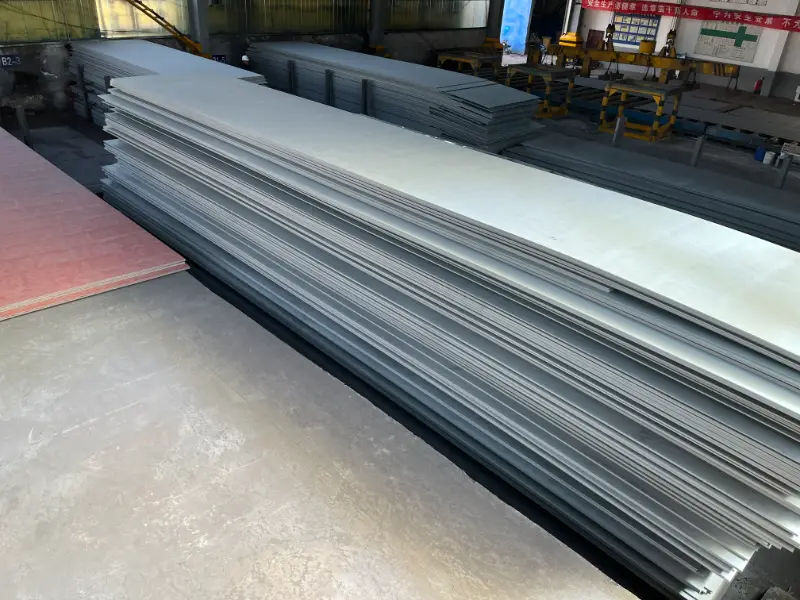
Q690F Quenched & Tempered High-Strength Steel Plate
Q690F Quenched & Tempered High-Strength Steel Plate - GB/T 16270 Datasheet & Global Substitutes
Detailed material datasheet for Q690F ultra-high strength steel plate defined in GB/T 16270. Includes chemical composition, mechanical and thermal properties, international equivalents, and typical applications in heavy machinery and welded structures.
Welding, cutting, cold bending, machining (after suitable heat treatment)
- Phone : +8618037372205
- Email : [email protected]
- WhatsApp: Contact via Whtsapp
- WeChat: +8618037372205
Q690F Quenched & Tempered High-Strength Steel Plate Introduction
Q690F is a quenched and tempered carbon low-alloy high-strength structural steel plate standardized in China under GB/T 16270. Yield strength ≥690 MPa, excellent low-temperature toughness (-60°C impact energy), and good weldability. It is primarily used in heavy-duty welded structures such as crane booms, mining machinery, bridges, and offshore platforms. The 'F' quality grade ensures guaranteed impact properties down to -60°C. Typical delivery condition is quenched and tempered (Q+T). This steel combines high strength, good formability, and sufficient toughness for critical structural applications in demanding environments.
Q690F Quenched & Tempered High-Strength Steel Plate Chemical Composition
The following chemical composition limits are specified in GB/T 16270 for Q690F steel. The steel is micro-alloyed and shall contain at least one of the grain-refining elements: Nb, V, Ti; aluminum can also be used as a grain refiner. Low sulfur and phosphorus ensure good toughness and weldability. Actual mill certificates may show tighter results.
| Chemical Element | Standard Value (wt%) | Remarks |
|---|---|---|
| Carbon (C) | ≤ 0.18 | |
| Silicon (Si) | ≤ 0.50 | |
| Manganese (Mn) | ≤ 1.70 | |
| Phosphorus (P) | ≤ 0.020 | |
| Sulfur (S) | ≤ 0.010 | |
| Chromium (Cr) | ≤ 1.00 | |
| Nickel (Ni) | ≤ 1.50 | |
| Molybdenum (Mo) | ≤ 0.50 | |
| Copper (Cu) | ≤ 0.50 | |
| Niobium (Nb) | ≤ 0.06 | Grain-refining element |
| Vanadium (V) | ≤ 0.08 | Grain-refining element |
| Titanium (Ti) | ≤ 0.05 | Grain-refining element |
| Boron (B) | ≤ 0.0050 | |
| Aluminum (Al) / Al_sol | ≥ 0.015 (acid-soluble) | Or sufficient Al total for grain refinement if Nb/V/Ti not added |
Q690F Quenched & Tempered High-Strength Steel Plate Thermal and Electrical Physical Properties
The following physical properties are typical for low-alloy high-strength quenched and tempered steels similar to Q690F. These values are not specified in GB/T 16270 but are provided for engineering calculations. Slight variations may occur depending on exact chemical composition and heat treatment condition.
| Property | Standard Requirement | Unit | Test Condition |
|---|---|---|---|
| Density (ρ) | 7.85 | g/cm³ | at 20°C |
| Elastic Modulus (E) | 206 | GPa | at 20°C |
| Shear Modulus (G) | 79.3 | GPa | at 20°C (calculated from E and ν) |
| Poisson's Ratio (ν) | 0.3 | typical for structural steel | |
| Thermal Expansion Coefficient (α) | 12.0 × 10⁻⁶ /K | K⁻¹ | 20°C to 100°C |
| Thermal Conductivity (λ) | 46 | W/(m·K) | at 20°C |
| Specific Heat Capacity (cp) | 460 | J/(kg·K) | at 20°C |
| Electrical Resistivity (ρe) | 0.20 | μΩ·m | at 20°C |
Q690F Quenched & Tempered High-Strength Steel Plate Mechanical Properties
Mechanical properties for Q690F as per GB/T 16270. Values are valid for quenched and tempered delivery condition. Impact test at -60°C is mandatory. Tensile test pieces are transverse unless otherwise agreed. Elongation gauge length L0 = 5.65√S0. Bending test uses a mandrel diameter (d) expressed as a multiple of specimen thickness (a).
| Property | Standard Requirement | Unit | Test Condition |
|---|---|---|---|
| Yield Strength (ReH) | ≥ 690 | MPa | Thickness ≤ 50 mm |
| Yield Strength (ReH) | ≥ 670 | MPa | 50 mm < Thickness ≤ 100 mm |
| Yield Strength (ReH) | ≥ 650 | MPa | 100 mm < Thickness ≤ 150 mm |
| Tensile Strength (Rm) | 770 – 940 | MPa | Thickness ≤ 150 mm |
| Elongation (A) | ≥ 14 | % | Thickness ≤ 50 mm (L0 = 5.65√S0) |
| Elongation (A) | ≥ 14 | % | 50 mm < Thickness ≤ 100 mm |
| Elongation (A) | ≥ 13 | % | 100 mm < Thickness ≤ 150 mm |
| Bending Test | 180° bend, d = 3a | – | Thickness ≤ 50 mm |
| Bending Test | 180° bend, d = 4a | – | 50 mm < Thickness ≤ 100 mm |
| Bending Test | 180° bend, d = 5a | – | 100 mm < Thickness ≤ 150 mm |
| Impact Energy (KV2) | ≥ 27 | J | Longitudinal, -60°C, V-notch (average of 3, min individual ≥ 70% avg.) |
Q690F Quenched & Tempered High-Strength Steel Plate Fully Equivalent Material Standards & Substitution Recommendations
| Country/Region | Standard | Designation | Remarks |
|---|---|---|---|
| Europe | EN 10025-6 | S690QL1 | Quenched and tempered; minimum impact at -60°C (KV ≥ 27J). Fully interchangeable with Q690F. |
| International | ISO 4950-3 | S690Q | High yield strength flat products; impact temperature may be agreed as -60°C. Equivalent when ordered appropriately. |
| USA | ASTM A514/A517 | Grade Q (with negotiated impact) | Strength matches, but standard impact testing down to -40°C or as agreed. Not fully equivalent without supplementary requirement for -60°C. |
| Japan | JIS G 3128 | SHY685N | Yield ≥ 685 MPa, impact at -40°C. Close substitute but not guaranteed for -60°C service. Can replace Q690F only if low-temperature toughness is verified. |
Q690F Quenched & Tempered High-Strength Steel Plate Application Introduction
Q690F is a high-performance structural steel designed for heavy welded fabrications that require high strength, good low-temperature toughness, and excellent weldability. It is widely delivered in the quenched and tempered condition, ready for fabrication with standard workshop procedures (preheating and PWHT may be required depending on thickness). Typical applications include:
Product Applications: Welded structural frames, booms, and chassis, High-load gear and bearing housings, Wind tower flanges and transition pieces, Mining dump truck bodies and shovel components, Lock gates and penstocks
Processed into products: Crane telescopic boom sections, Excavator arms and buckets, Bridge girder flanges, Offshore platform braces, Hydraulic press columns and platens, Heavy transport trailer beams
Application industries: Heavy machinery and construction equipment, Mining and mineral processing equipment, Crane and lifting equipment, Bridge engineering, Offshore and marine engineering (not for class certification without specific approval), Pressure vessels (subject to code acceptance)
Q690F Quenched & Tempered High-Strength Steel Plate Similar / Near-Substitute Material Recommendations
| Country/Region | Standard | Designation | Remarks |
|---|---|---|---|
| China | GB/T 16270 | Q690D / Q690E | Same strength class, but impact temperature at -20°C (D) or -40°C (E). Suitable for less severe low-temperature applications. |
| Europe | EN 10025-6 | S690QL | Yield ≥ 690 MPa, impact at -40°C. Very similar, but not certified for -60°C. |
| USA | ASTM A514 | Grade E / Grade F | High-strength T1 type steels with yield ~690 MPa; impact properties may differ. |
| Russia | GOST 19281 | 09G2S (???) or equivalent | Not directly comparable; mechanical properties may reach 590–690 MPa range, but different alloy system. |
Notes:
This material is supplied in the quenched and tempered condition. Welding consumables should match the base metal strength level and low-temperature impact requirements. Preheating and interpass temperature control are recommended to avoid hydrogen-induced cracking. Post-weld heat treatment may be required for thick sections or according to fabrication codes. Cold forming is possible, but allowance for springback should be made. For critical applications, consult the material supplier regarding actual guaranteed properties, especially for t > 150 mm.
- Share



