
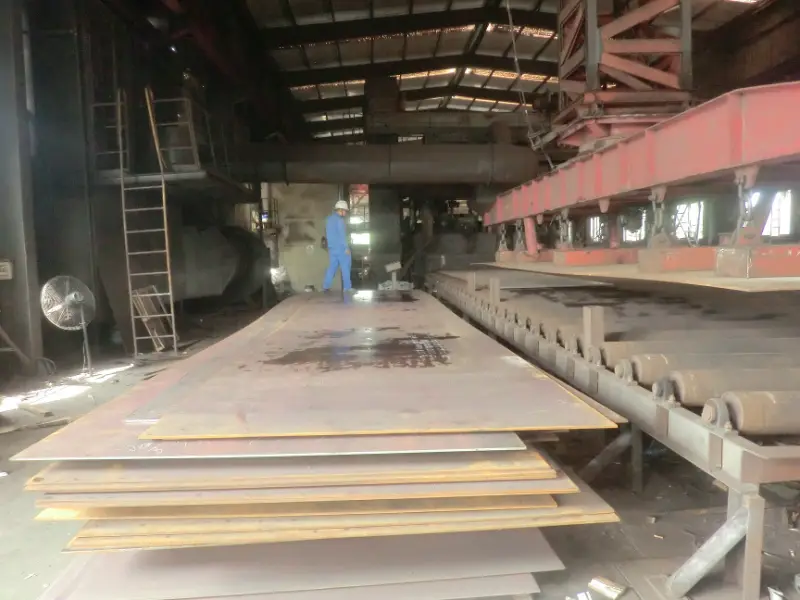
Q690E Quenched & Tempered High-Strength Steel Plate
Q690E Quenched & Tempered High-Strength Steel Plate: Composition, Properties & International Equivalents
Detailed material data for Q690E steel according to GB/T 16270, including chemical composition, mechanical properties, physical parameters, international equivalents, and application examples.
Flame cutting, plasma cutting, laser cutting, welding (SAW, SMAW, GMAW), cold bending, limited hot forming followed by re-tempering
- Phone : +8618037372205
- Email : [email protected]
- WhatsApp: Contact via Whtsapp
- WeChat: +8618037372205
Q690E Quenched & Tempered High-Strength Steel Plate Introduction
Q690E is a carbon and low-alloy high-strength structural steel plate supplied in the quenched and tempered (Q&T) condition according to Chinese standard GB/T 16270-2009. With a minimum yield strength of 690 MPa (ReH) and guaranteed impact toughness down to -40 °C, this grade is designed for demanding welded constructions.
Key characteristics include:
- Excellent combination of high strength and good low-temperature toughness.
- Good weldability using low-hydrogen processes and appropriate preheating.
- Formability suitable for bending and moderate cold forming.
- Available in thicknesses up to 150 mm with consistent mechanical properties across the cross-section.
Q690E Quenched & Tempered High-Strength Steel Plate Chemical Composition
The chemical composition shown below meets the requirements of GB/T 16270-2009 for grade Q690E. Values are maximum limits unless a range is specified. Fine-grain elements (Nb, V, Ti, Al) are added to achieve the required strength and toughness. The low phosphorus and sulfur content, combined with microalloying, ensures excellent weldability and low-temperature toughness.
| Element | Standard Value (max, %) | Remarks |
|---|---|---|
| C | ≤ 0.20 | Carbon; lower improves weldability |
| Si | ≤ 0.80 | Silicon; deoxidizer |
| Mn | ≤ 1.70 | Manganese; contributes to strength and hardenability |
| P | ≤ 0.020 | Phosphorus; restricted for toughness |
| S | ≤ 0.010 | Sulfur; restricted for toughness and weldability |
| Cr | ≤ 1.50 | Chromium; optional strengthening element |
| Ni | ≤ 2.00 | Nickel; enhances low-temperature toughness |
| Mo | ≤ 0.70 | Molybdenum; improves hardenability |
| B | ≤ 0.0050 | Boron; micro-alloy for hardenability |
| V | 0.01 – 0.12 | Vanadium; grain refiner and precipitation strengthener |
| Nb | 0.01 – 0.05 | Niobium; grain refiner |
| Ti | 0.006 – 0.05 | Titanium; grain refiner and nitrogen fixer |
| Al (total) | ≥ 0.015 | Aluminium; fine grain practice |
| Cu | ≤ 0.50 | Copper; residual or optional addition |
| N | ≤ 0.015 | Nitrogen; restricted |
| Other elements | According to agreement | Ni+Cr+Mo combined max may be specified |
Q690E Quenched & Tempered High-Strength Steel Plate Thermal and Electrical Physical Properties
The following physical properties are typical for low-alloy high-strength quenched and tempered steels like Q690E at room temperature, unless otherwise indicated. These values are provided for design and simulation purposes and may vary slightly depending on the actual chemical composition and heat treatment condition. Thermal properties are influenced by temperature.
| Physical Property | Typical Value | Unit | Test Condition / Temperature |
|---|---|---|---|
| Density, ρ | 7.85 | g/cm³ | At 20 °C |
| Modulus of elasticity, E | 210 | GPa | At 20 °C |
| Shear modulus, G | ≈ 80 | GPa | At 20 °C |
| Poisson's ratio, ν | 0.3 | – | At 20 °C (elastic range) |
| Thermal expansion coefficient, α | 11.1 | 10⁻⁶/K | 20 – 100 °C |
| Thermal expansion coefficient, α | 12.2 | 10⁻⁶/K | 20 – 200 °C |
| Thermal expansion coefficient, α | 13.3 | 10⁻⁶/K | 20 – 400 °C |
| Thermal conductivity, λ | 45 – 52 | W/(m·K) | At 20 °C |
| Thermal conductivity, λ | ≈ 42 | W/(m·K) | At 200 °C |
| Specific heat capacity, cp | ≈ 480 | J/(kg·K) | At 20 °C |
| Electrical resistivity, ρe | 0.25 – 0.30 | µΩ·m | At 20 °C |
Q690E Quenched & Tempered High-Strength Steel Plate Mechanical Properties
Mechanical properties are specified according to GB/T 16270-2009 for Q690E in the quenched and tempered condition. Values depend on product thickness. The impact energy KV2 is guaranteed at -40 °C (E grade). Bending tests are performed with the specimen axis transverse to the rolling direction. All tensile testing is carried out at room temperature.
| Property | Standard Required Value | Unit | Test Condition / Thickness Range |
|---|---|---|---|
| Upper yield strength, ReH | ≥ 690 | MPa | t ≤ 50 mm |
| Upper yield strength, ReH | ≥ 650 | MPa | 50 < t ≤ 100 mm |
| Upper yield strength, ReH | ≥ 630 | MPa | 100 < t ≤ 150 mm |
| Tensile strength, Rm | 770 – 940 | MPa | t ≤ 150 mm |
| Elongation after fracture, A | ≥ 14 | % | L0 = 5.65√S0; t ≤ 150 mm |
| Impact energy, KV2 (longitudinal) | ≥ 34 (average) | J | -40 °C; t ≤ 150 mm (one individual min. 27 J) |
| Bend test 180° (d = bending mandrel diameter, a = specimen thickness) | d = 2a | – | t ≤ 16 mm, no cracks |
| Bend test 180° | d = 3a | – | 16 < t ≤ 40 mm |
| Bend test 180° | d = 4a | – | 40 < t ≤ 63 mm |
| Bend test 180° | d = 5a | – | 63 < t ≤ 100 mm |
Q690E Quenched & Tempered High-Strength Steel Plate Completely Equivalent Material Standards and Substitution Grades
| Country/Region | Specification Standard | Grade Designation | Remarks |
|---|---|---|---|
| China | GB/T 16270-2009 | Q690E | Quenched and tempered, -40 °C impact test |
| European Union | EN 10025-6 | S690QL (1.8928) | Q&T, min. 690 MPa yield, -40 °C impact; close match |
| European Union | EN 10025-6 | S690QL1 (1.8988) | Q&T, -60 °C impact; superior low-temp toughness, usable as substitute |
| International | ISO 4950-3 | E690DD | High yield strength flat products, Q&T, -20 °C impact; check toughness requirement |
| Japan | JIS G 3128 | SHY685N | High yield strength plate for welded structures, Q&T, -40 °C impact toughness |
| USA | ASTM A514/A514M | Grade S | Q&T alloy steel plate, yield ≥ 690 MPa; Charpy test temperature by agreement (often -40 °C possible) |
Q690E Quenched & Tempered High-Strength Steel Plate Application Introduction
Q690E quenched and tempered steel is engineered for heavy-duty welded structures where high static and dynamic loads are combined with low-temperature conditions. Its properties allow reduced dead weight and thinner sections compared to lower strength grades, while still maintaining excellent safety against brittle fracture at -40 °C.
Typical industries and applications are listed below.
Product Applications: Excavator booms, arms and buckets, Crane telescopic and lattice booms, Dump truck bodies and cement mixer drums, High-strength welded bridge girders and box sections, Components of large mining shovels and draglines, Heavy-lift fork arms and spreader beams, Industrial storage tanks and silos, Subsea structural components and pile guides
Processed into products: Welded I-beams, channel sections, and built-up box members, Brake-pressed or roll-formed flanges and stiffeners, Cut and welded attachments (lifting eyes, lugs, pad-eyes), Bent plates for crane turntables and slew rings, Frame plates for presses, shears, and forging equipment, Transition joints between different strength plates, Repair doublers and reinforcement patches, Protective steel liners and wear plates (alternative to through-hardened wear steels when structural function is primary)
Application industries: Mining and earthmoving equipment, Mobile and crawler cranes, Heavy truck chassis and trailers, Bridge construction (especially long-span and orthotropic decks), Pressure vessel and boiler fabrication (subject to additional code approvals), Offshore and marine engineering (with special qualification), Hydraulic press frames and heavy machine tool structures, Wind tower base sections and yaw rings (in cold regions)
Q690E Quenched & Tempered High-Strength Steel Plate Similar / Alternative Materials with Comparable Properties
| Country/Region | Specification Standard | Grade Designation | Remarks |
|---|---|---|---|
| China | GB/T 16270-2009 | Q690D | Same strength level but only guaranteed Charpy at -20 °C; may be considered if operating temperature allows |
| China | GB/T 16270-2009 | Q550E | Lower yield strength (550 MPa) but excellent -40 °C toughness; possible downgauge with redesign |
| European Union | EN 10025-6 | S690Q (1.8931) | Quenched and tempered with Charpy at -20 °C; less demanding impact requirement |
| European Union | EN 10025-6 | S700MC | Thermomechanically rolled, min 700 MPa yield, but limited thickness availability and different toughness concept; not fully equivalent |
| European Union | EN 10025-6 | S890QL | Higher strength (890 MPa) Q&T steel; can be used when further weight reduction is needed, but requires stricter welding procedures |
| USA | ASTM A709/A709M | Grade HPS 70W | High-performance steel for bridges, yield 485–690 MPa, excellent toughness; can be tailored to match specifications |
Notes:
Welding information: Q690E exhibits good weldability with low-hydrogen processes. Preheating (typically 100–200 °C) and interpass temperature control are recommended to avoid cold cracking. Matching consumables (e.g., ER110S-G, E111T1-K4) or slightly undermatching fillers with proper joint design may be used. Post-weld heat treatment (PWHT) is generally avoided in Q&T steels to preserve tempering response; if PWHT is mandatory, it must be carried out below the original tempering temperature and verified by testing.
Cold forming: Bending radii should follow the recommendations given in the bending test table. Edge cracking may occur on flame-cut surfaces; grinding of edges is advised before cold forming. Hot forming above the tempering temperature will alter mechanical properties; subsequent re-tempering may be required to restore properties.
Certification: Q690E can be supplied with EN 10204 3.1 or 3.2 certificates. Additional testing (ultrasonic, Z-quality, through-thickness tensile) can be agreed upon purchase.
- Share



