
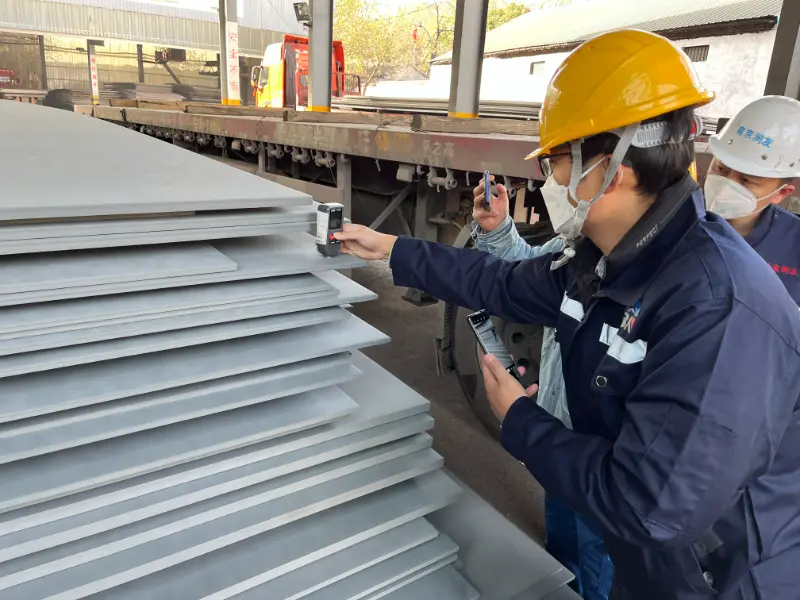
Q690D High-Strength Quenched & Tempered Steel Plate
Q690D High-Strength Quenched & Tempered Steel Plate - GB/T 16270 Properties & Equivalents
In-depth analysis of Q690D carbon and low-alloy high-strength steel plate to GB/T 16270, including chemical composition, mechanical properties, thermal and electrical data, international equivalents, and application guidance.
Hot rolling followed by quenching and tempering; thereafter can be cut, welded, formed, and machined
- Phone : +8618037372205
- Email : [email protected]
- WhatsApp: Contact via Whtsapp
- WeChat: +8618037372205
Q690D High-Strength Quenched & Tempered Steel Plate Introduction
Q690D is a Chinese standard quenched and tempered high-strength structural steel plate defined in GB/T 16270. It belongs to the category of carbon and low-alloy high-strength steels with a minimum nominal yield strength of 690 MPa. The 'D' suffix indicates that impact testing is guaranteed at -20 °C. It is designed for welded structures in heavy engineering, such as bridges, pressure vessels, lifting machinery, and offshore platforms, where high load-bearing capacity, good toughness, and weldability are required. The fine-grained microstructure achieved through controlled rolling and heat treatment ensures excellent strength, ductility, and low brittle transition temperature, making it suitable for use in harsh climate conditions.
Q690D High-Strength Quenched & Tempered Steel Plate Chemical Composition
Chemical requirements as per GB/T 16270 for Q690D, based on ladle analysis. The steel is characterized by controlled low carbon content for weldability, microalloying elements (Nb, V, Ti) for grain refinement and precipitation strengthening, and strict limits on phosphorus and sulfur to ensure toughness and cleanliness. Carbon equivalent (CEV) and weld crack susceptibility parameter (Pcm) are also specified to guarantee the steel can be safely welded.
| Chemical Element | Standard Value (max, unless range given) | Notes |
|---|---|---|
| Carbon (C) | ≤ 0.18 | |
| Silicon (Si) | ≤ 0.50 | |
| Manganese (Mn) | ≤ 1.70 | |
| Phosphorus (P) | ≤ 0.020 | |
| Sulfur (S) | ≤ 0.010 | Low sulfur for toughness |
| Chromium (Cr) | ≤ 0.70 | |
| Nickel (Ni) | ≤ 0.80 | |
| Molybdenum (Mo) | ≤ 0.30 | |
| Copper (Cu) | ≤ 0.30 | |
| Niobium (Nb) | ≤ 0.06 | Microalloying element |
| Vanadium (V) | ≤ 0.06 | Microalloying element |
| Titanium (Ti) | ≤ 0.05 | Microalloying element |
| Boron (B) | ≤ 0.005 | Optional for hardenability |
| Aluminum (Altot) | ≥ 0.015 | Min for grain refinement |
| CEV (max) | Typically ≤ 0.47–0.52 (thickness dependent) | Carbon equivalent formula: CEV = C + Mn/6 + (Cr+Mo+V)/5 + (Ni+Cu)/15 |
| Pcm (max) | Typically ≤ 0.25–0.30 | Weld crack susceptibility parameter |
Q690D High-Strength Quenched & Tempered Steel Plate Thermal and Electrical Physical Properties
Physical property data for Q690D grade steel at room temperature unless otherwise noted. These are typical values for high-strength low-alloy steels and can be used for engineering calculations. The density, elastic moduli, thermal expansion, thermal conductivity, specific heat, and electrical resistivity strongly influence design, heat treatment, and service performance in structures subjected to temperature variations. Poisson's ratio and shear modulus are derived from the elastic modulus.
| Property Item | Standard Required Value | Unit | Test Condition / Remarks |
|---|---|---|---|
| Density (ρ) | 7.85 | g/cm³ | Ambient temperature |
| Elastic Modulus (E) | ~ 210 | GPa | Room temperature, typical for steel |
| Shear Modulus (G) | ~ 81 | GPa | Calculated from E and ν (ν=0.3) |
| Poisson's Ratio (ν) | ~ 0.3 | — | Within elastic range |
| Thermal Expansion Coefficient (α) | ~ 12.0 × 10⁻⁶ | 1/K | 20–100 °C, typical steel value |
| Thermal Expansion Coefficient (α) | ~ 12.5 × 10⁻⁶ | 1/K | 20–200 °C |
| Thermal Expansion Coefficient (α) | ~ 13.1 × 10⁻⁶ | 1/K | 20–400 °C |
| Thermal Conductivity (λ) | ~ 50 | W/(m·K) | At 20 °C, typical for HSLA steel |
| Thermal Conductivity (λ) | ~ 45 | W/(m·K) | At 200 °C |
| Thermal Conductivity (λ) | ~ 38 | W/(m·K) | At 400 °C |
| Specific Heat Capacity (cp) | ~ 460 | J/(kg·K) | 20–100 °C |
| Electrical Resistivity (ρ_e) | ~ 0.20 – 0.25 × 10⁻⁶ | Ω·m | At 20 °C |
Q690D High-Strength Quenched & Tempered Steel Plate Mechanical Properties
Mechanical properties for Q690D plates in quenched and tempered condition according to GB/T 16270. Values vary with plate thickness. The guaranteed yield strength (ReH), tensile strength (Rm), elongation (A), and impact energy (KV₂) are listed for the most common thickness range ≤ 50 mm. Bend test requirements ensure forming workability without cracking. Impact toughness at -20 °C is a key feature of D-grade material.
| Property Item | Standard Required Value | Unit | Test Condition / Remarks |
|---|---|---|---|
| Yield Strength (ReH) | ≥ 690 | MPa | Plate thickness ≤ 50 mm, transverse test |
| Yield Strength (ReH) | ≥ 670 | MPa | 50 mm < thickness ≤ 100 mm |
| Yield Strength (ReH) | ≥ 650 | MPa | 100 mm < thickness ≤ 150 mm |
| Tensile Strength (Rm) | 770 – 940 | MPa | Plate thickness ≤ 50 mm |
| Tensile Strength (Rm) | 750 – 920 | MPa | 50 mm < thickness ≤ 100 mm |
| Tensile Strength (Rm) | 720 – 900 | MPa | 100 mm < thickness ≤ 150 mm |
| Elongation (A) | ≥ 14 | % | Longitudinal, gauge length 5.65√S₀, thickness ≤ 50 mm |
| Elongation (A) | ≥ 14 | % | Thickness > 50 mm (may be slightly reduced) |
| Bend Test (Mandrel diameter) | d=3a (180°) | a = specimen thickness, crack-free | |
| Impact Energy (KV₂, -20 °C) | ≥ 47 | J | Longitudinal, average of three tests, single min ≥ 33 J |
| Impact Energy (KV₂, -20 °C) | ≥ 27 | J | Transverse (if agreed) |
Q690D High-Strength Quenched & Tempered Steel Plate Fully Equivalent Material Standards and Substitutable Designations
| Country/Region | Standard | Designation | Remarks |
|---|---|---|---|
| Europe | EN 10025-6 | S690QL | Q denotes quenched and tempered; similar -20°C toughness if option L1 |
| USA | ASTM A514 / A517 | Grade Q | Quenched and tempered alloy steel plate, yield ≥ 690 MPa; check thickness scope |
| Japan | JIS G 3128 | SHY685 | High yield strength steel for welded structures; +Q+T condition |
| International | ISO 4951-2 | S690Q | Quenched and tempered; impact energy at -20 °C must be verified |
| China | GB/T 16270 (original) | Q690D | Primary standard; Q690D directly matches S690QL with controlled composition |
Q690D High-Strength Quenched & Tempered Steel Plate Application Introduction
Q690D steel is widely employed in heavy engineering sectors where a combination of high strength, low weight, and excellent notch toughness is essential. It is especially suited for welded constructions exposed to dynamic loads and low ambient temperatures. The steel can be flame-cut, formed, and welded using appropriate procedures, including preheating and controlled heat input to avoid hydrogen-induced cracking. Post-weld heat treatment is generally not required for thicknesses below certain limits. Typical applications span from mobile crane booms to offshore platform components.
Product Applications: Welded bridge girders and box sections, Excavator and loader booms, arms, and frames, Offshore platform legs and deck structures, Crane lattice booms and telescopic booms, Mining dump truck bodies, Pressure vessel shells and heads (subject to additional certifications), Wind turbine tower flanges and transition pieces
Processed into products: Flat bar and plate cut parts, Bent and formed reinforcements, Welded T-joints and stiffeners, Machined pins and bushings (after flame cutting), Box-welded sections for machinery frames, Flame-cut sprockets, gears, and wear liners, Heavy-duty mounting brackets
Application industries: Construction and Infrastructure (bridges, high-rise structures), Mining and Earthmoving Equipment, Marine and Offshore Engineering, Heavy Transport and Automotive (chassis, trailers), Pressure Vessel and Storage Tank Manufacturing (if compliant with pressure equipment codes), Lifting and Material-Handling Machinery, Wind Energy (turbine towers, foundations)
Q690D High-Strength Quenched & Tempered Steel Plate Similar / Near-Equivalent Material Recommendations
| Country/Region | Standard | Designation | Remarks |
|---|---|---|---|
| Europe | EN 10025-6 | S690Q | Slightly less restrictive on low-temperature impact than S690QL, but mechanical properties identical |
| Europe | EN 10210-1 (hot-finished hollow sections) | S690QH | For tubular sections, similar strength grade |
| USA | ASTM A514 | Grade S | Quenched and tempered, yields 690 MPa, but composition enables higher hardenability |
| USA | ASTM A709 | Grade 690W (HPS 690W) | High-performance steel for bridges, weldable, good toughness |
| Korea | KS D 3542 | SH690 | High yield strength steel plate, equivalent to JIS SHY685 |
| Russia | GOST 19281 | 09G2S (enhanced variants) | Not exact equivalent but with microalloying can reach 690 MPa yield |
Notes:
Welding recommendations: Use low-hydrogen consumables with matching strength, preheat to 75–150°C depending on thickness, interpass temperature max 250°C. Post-weld heat treatment is generally not required for thicknesses up to 50 mm when using appropriate procedures. Surface condition: Plates are supplied descaled or with slight mill scale; for critical fatigue applications, grinding of weld toes is advised. Certifications according to EN 10204 3.1 or 3.2 can be provided. For applications requiring Z-direction properties, plates with guaranteed thickness-direction tensile test values (e.g., Z25, Z35) can be ordered under supplementary agreement.
- Share



