
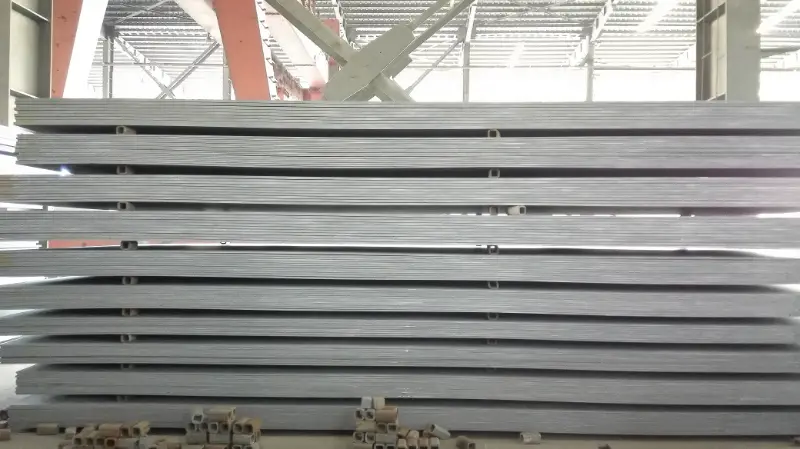
Q690C High-Strength Quenched & Tempered Steel Plate
Q690C High-Strength Quenched & Tempered Steel Plate | GB/T 16270 Properties
Q690C is a high-strength low-alloy structural steel with a minimum yield of 690 MPa, supplied in quenched and tempered condition. Ideal for demanding welded structures.
Quenching and tempering (Q+T), welding (with preheat and low-hydrogen consumables), flame/plasma/laser cutting, cold forming (limited), machining
- Phone : +8618037372205
- Email : [email protected]
- WhatsApp: Contact via Whtsapp
- WeChat: +8618037372205
Q690C High-Strength Quenched & Tempered Steel Plate Introduction
Q690C is a high-strength, quenched and tempered structural steel plate defined under Chinese standard GB/T 16270. It belongs to the carbon and low-alloy high-strength steel family, offering a minimum yield strength of 690 MPa for thicknesses up to 50 mm, combined with good toughness at low temperatures. The chemical composition is characterized by controlled carbon, manganese, and microalloying elements (Nb, V, Ti, etc.) to achieve fine grain structure and excellent weldability. The Q+T heat treatment ensures a favorable balance between strength and ductility, making it suitable for heavy-duty applications where weight savings and structural integrity are critical. Typical delivery condition is quenched and tempered, with additional requirements for notch toughness at -20°C (designated by the 'C' suffix). International equivalents include EN 10025-6 S690Q and ASTM A514 grade S.
Q690C High-Strength Quenched & Tempered Steel Plate Chemical Composition
The table shows the typical chemical requirements for Q690C as specified in GB/T 16270. The steel relies on a low carbon equivalent and microalloying to achieve high strength and toughness. Microalloying elements (Nb, V, Ti, Cr, Ni, Mo, Cu, B) may be added singly or in combination, with the total content not exceeding 5.0%, to refine grain size and improve mechanical properties.
| Element | Specified Value (max, unless noted) | Remarks |
|---|---|---|
| C | ≤ 0.20% | Heat analysis, ensures weldability |
| Si | ≤ 0.80% | Deoxidizer, strength contributor |
| Mn | ≤ 1.80% | Hardenability and strength |
| P | ≤ 0.020% | Harmful element, controlled low |
| S | ≤ 0.010% | Harmful element, very low for toughness |
| Al (total) | ≥ 0.015% | Grain refining, deoxidation |
| Microalloying elements (Nb, V, Ti, Cr, Ni, Mo, Cu, B) | Total ≤ 5.0% | May be added for property enhancement; exact limits by agreement |
Q690C High-Strength Quenched & Tempered Steel Plate Thermal and Electrical Physical Properties
The data below are typical for low-alloy quenched and tempered steels and serve as engineering references. Actual values may vary slightly with composition and heat treatment condition. All properties are measured at room temperature unless otherwise stated.
| Property | Typical Value | Unit | Test Condition |
|---|---|---|---|
| Density (ρ) | 7.85 | g/cm³ | 20 °C |
| Modulus of elasticity (E) | 210 | GPa | 20 °C, static |
| Shear modulus (G) | 80 | GPa | 20 °C, estimated |
| Poisson's ratio (ν) | 0.30 | – | 20 °C, elastic range |
| Thermal expansion coefficient (α) | 12.5 | 10⁻⁶/K | 20–100 °C |
| Thermal expansion coefficient (α) | 13.4 | 10⁻⁶/K | 20–200 °C |
| Thermal expansion coefficient (α) | 14.0 | 10⁻⁶/K | 20–400 °C |
| Thermal conductivity (λ) | 42 | W/(m·K) | 20 °C |
| Specific heat capacity (cₚ) | 460 | J/(kg·K) | 20 °C |
| Electrical resistivity (ρₑ) | 0.20 | 10⁻⁶ Ω·m | 20 °C |
Q690C High-Strength Quenched & Tempered Steel Plate Mechanical Properties
The following values are guaranteed for quenched and tempered condition in accordance with GB/T 16270. Transverse testing is typical for impact values (though longitudinal values may be specified). The bending test is carried out with a mandrel diameter d equal to three times the specimen thickness a. Tensile tests are performed at room temperature.
| Property | Required Value | Unit | Test Condition / Thickness (mm) |
|---|---|---|---|
| Yield Strength (ReH) | ≥ 690 | MPa | Plate thickness ≤ 50 mm |
| Yield Strength (ReH) | ≥ 670 | MPa | 50 < thickness ≤ 100 mm |
| Yield Strength (ReH) | ≥ 640 | MPa | 100 < thickness ≤ 150 mm |
| Tensile Strength (Rm) | 770 – 940 | MPa | All thicknesses up to 150 mm |
| Elongation after fracture (A) | ≥ 14 | % | Gauge length 5.65√S₀, all thicknesses |
| Charpy V-notch impact (KV₂) | ≥ 47 | J | Longitudinal, test temperature -20 °C |
| Bend test (180°) | No cracks | – | Mandrel diameter d = 3a, all thicknesses |
Q690C High-Strength Quenched & Tempered Steel Plate Direct Equivalent Standards and Substitute Grades
These international grades are considered direct equivalents based on comparable chemical and mechanical requirements.
| Country / Region | Standard | Grade | Remarks |
|---|---|---|---|
| Europe | EN 10025-6 | S690Q | Quenched and tempered, comparable yield and toughness at -20 °C |
| USA | ASTM A514 / A517 | Grade S | Yield ≥ 690 MPa, Q+T plate, similar weldability |
| Japan | JIS G 3128 | SHY685 | Yield ≥ 685 MPa, similar application range |
| International | ISO 4950-2 | E690DD | High yield strength structural steel, Q+T |
Q690C High-Strength Quenched & Tempered Steel Plate Application Introduction
Q690C high-strength steel is primarily employed in weight-critical, dynamically loaded welded structures. Its excellent strength-to-weight ratio and good weldability make it ideal for the following areas:
Product Applications: Welded crane booms and chassis, Bridge box girders and orthotropic decks, Offshore platform nodes and jacket legs, Mining dump truck bodies (high abrasion resistance interiors can be lined), Cement mixer drums, Underframes and coupler components for rail vehicles, Hydraulic cylinder bodies and piston rods (when wear properties are enhanced)
Processed into products: Boom sections and turntables, Cutting edges and wear plates (after special surface hardening), Flanges and webs of plate girders, Node cans for offshore jackets, Column base plates and cap plates in high-rise steel structures, Fabricated axle housings and torque arms
Application industries: Heavy machinery and earth moving equipment, Mobile and crawler cranes, Bridge building (structural girders, box sections), Offshore oil & gas platforms and wind turbine foundations, Mining trucks, excavator booms, and dump bodies, Pressure vessels and industrial storage tanks, High-rise building columns and seismic-resistant frames
Q690C High-Strength Quenched & Tempered Steel Plate Closely Related Substitute Materials
These grades offer similar strength levels and may be used as alternatives, provided design and code requirements allow.
| Country / Region | Standard | Grade | Remarks |
|---|---|---|---|
| Europe | EN 10025-6 | S690QL | Extra low temperature toughness, -40 °C impact option |
| USA | ASTM A514 | Grade H / F | Slightly different chemistry but same min. yield strength |
| Japan | JIS G 3106 | SM570 (Q+T) | Lower strength (570 MPa yield) but often used in similar structures |
| China | GB/T 16270 | Q690D / Q690E | Improved low-temperature toughness (-40 °C, -60 °C) |
Notes:
Welding recommendations: Low-hydrogen processes (SMAW, SAW, GMAW) with controlled heat input are essential. Typical preheat temperature depends on thickness (often 75-150 °C). Post-weld heat treatment is generally not required. Forming: Cold forming should account for the steel's high strength; minimum bending radius should follow supplier's guidelines (typically ≥ 3t). Availability: Standard plate widths up to 3000 mm and lengths up to 12000 mm; thicker plates may require mill rolling schedules.
- Share



