
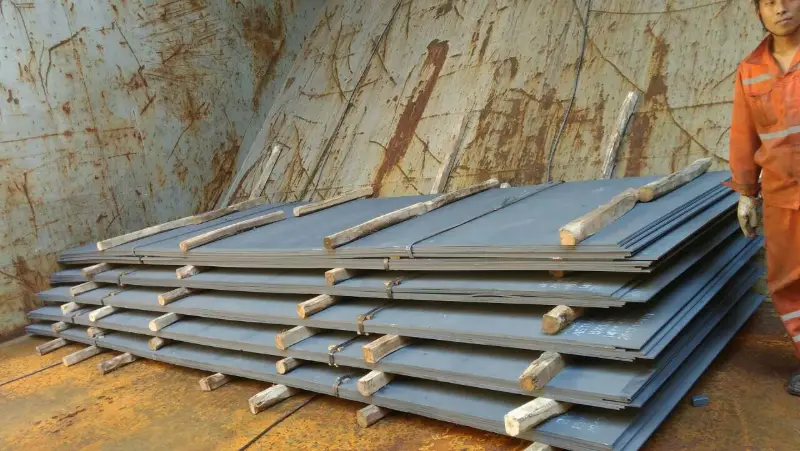
Q550NH Weather Resistant Steel Plate
Q550NH Weather Resistant Steel Plate: High-Strength Atmospheric Corrosion Resistant Structural Steel
Explore the comprehensive material properties of Q550NH weather resistant steel plate, a high-strength low-alloy structural steel with enhanced atmospheric corrosion resistance, ideal for bridges, buildings, and containers.
Hot rolling, cold forming, welding, cutting, machining
- Phone : +8618037372205
- Email : [email protected]
- WhatsApp: Contact via Whtsapp
- WeChat: +8618037372205
Q550NH Weather Resistant Steel Plate Introduction
Q550NH is a high-strength weather resistant structural steel defined in China standard GB/T 4171-2008. It belongs to the category of atmospheric corrosion-resisting steels, offering minimum yield strength of 550 MPa. The steel develops a stable, protective rust-like oxide layer when exposed to the atmosphere, which significantly slows further corrosion, eliminating the need for painting in many applications. Key characteristics include good weldability, excellent toughness, and high resistance to atmospheric corrosion, making it suitable for welded structures in bridges, architectural structures, railway vehicles, and containers. The "NH" designation indicates high atmospheric corrosion resistance.
Q550NH Weather Resistant Steel Plate Chemical Composition
The chemical composition of Q550NH is carefully balanced to achieve high strength and superior atmospheric corrosion resistance. Copper, chromium, and nickel are the primary alloying elements promoting the formation of a dense, adherent protective patina. Micralloying elements like niobium, vanadium, and titanium refine grain structure and contribute to precipitation strengthening.
| Element | Specified Value (wt%) | Remarks |
|---|---|---|
| Carbon (C) | ≤ 0.16 | Heat analysis |
| Silicon (Si) | 0.10 – 0.50 | Enhances strength |
| Manganese (Mn) | 0.50 – 1.50 | Deoxidizer and strength contributor |
| Phosphorus (P) | ≤ 0.030 | Low for toughness |
| Sulfur (S) | ≤ 0.030 | Low for cleanliness |
| Copper (Cu) | 0.20 – 0.55 | Primary atmospheric corrosion resistance element |
| Chromium (Cr) | 0.30 – 1.25 | Improves corrosion resistance and hardenability |
| Nickel (Ni) | ≤ 0.65 | Enhances corrosion resistance and toughness |
| Molybdenum (Mo) | ≤ 0.30 | For high temperature strength and creep resistance |
| Niobium (Nb) | 0.015 – 0.060 | Grain refinement and precipitation hardening |
| Vanadium (V) | 0.02 – 0.12 | Precipitation strengthening |
| Titanium (Ti) | 0.02 – 0.10 | Grain refinement |
| Aluminum (Al) | ≥ 0.020 | Deoxidation and grain refinement |
| Nitrogen (N) | ≤ 0.015 | Controlled for ductility |
| Zirconium (Zr) | ≤ 0.15 | Optional addition for sulfide shape control |
Q550NH Weather Resistant Steel Plate Physical, Thermal, and Electrical Properties
Values are typical for low-alloy structural steels and serve as reference for engineering calculations. Slight variations may occur depending on exact composition and processing. The density is similar to that of plain carbon steel.
| Property | Typical Value | Unit | Condition / Temperature |
|---|---|---|---|
| Density (ρ) | 7.85 | g/cm³ | At 20°C |
| Elastic modulus (E) | 210 | GPa | At 20°C |
| Shear modulus (G) | 81 | GPa | At 20°C |
| Poisson's ratio (ν) | 0.3 | In elastic range | |
| Thermal expansion coefficient (α) | 12.0 ×10⁻⁶ | 1/K | 20–100°C |
| Thermal conductivity (λ) | 45 | W/(m·K) | At 20°C |
| Specific heat capacity (cp) | 460 | J/(kg·K) | At 20°C |
| Electrical resistivity (ρe) | 0.25 ×10⁻⁶ | Ω·m | At 20°C |
Q550NH Weather Resistant Steel Plate Mechanical Properties
Mechanical properties are guaranteed at room temperature for delivery condition. The values depend on plate thickness. The steel exhibits high yield and tensile strength, adequate elongation, and good impact toughness. Charpy V-notch impact energy is measured at 0°C. Transverse specimens may show slightly lower elongation.
| Property | Specified Requirement | Unit | Test Condition / Thickness |
|---|---|---|---|
| Upper yield strength (ReH) | ≥ 550 | MPa | Thickness ≤ 16 mm |
| Upper yield strength (ReH) | ≥ 530 | MPa | Thickness 16–40 mm |
| Upper yield strength (ReH) | ≥ 520 | MPa | Thickness 40–60 mm |
| Upper yield strength (ReH) | ≥ 480 | MPa | Thickness 60–100 mm |
| Tensile strength (Rm) | 600 – 760 | MPa | Thickness ≤ 40 mm |
| Tensile strength (Rm) | 580 – 740 | MPa | Thickness 40–60 mm |
| Tensile strength (Rm) | 570 – 720 | MPa | Thickness 60–100 mm |
| Elongation after fracture (A) | ≥ 18 | % | Thickness ≤ 40 mm, longitudinal, gauge length 5.65√So |
| Elongation after fracture (A) | ≥ 17 | % | Thickness 40–60 mm |
| Elongation after fracture (A) | ≥ 16 | % | Thickness 60–100 mm |
| Charpy impact energy (KV2) | ≥ 47 | J | At 0°C, longitudinal specimen |
| Bend test (mandrel diameter) | d = 2a (bending 180°) | Thickness ≤ 60 mm; a = plate thickness; no cracks on outside surface |
Q550NH Weather Resistant Steel Plate Identical Material Standards and Substitute Grades
| Country/Region | Standard | Grade | Remarks |
|---|---|---|---|
| China | GB/T 4171-2008 | Q550NH | Original specification; the grade is unique to this standard. |
| International | – | – | No internationally identical equivalent exists. |
Q550NH Weather Resistant Steel Plate Application Introduction
Q550NH is intended for welded, bolted, or riveted structures in outdoor environments where atmospheric corrosion resistance is essential. The steel is often used unpainted, relying on the stable patina for protection. Typical applications span transportation, energy, and construction sectors.
Product Applications: Weather-resistant steel plates for bridge girders, Structural steel plates for building envelopes, Roll-formed profiles for railcars, Welded box sections for containers, Laser-cut parts for architectural cladding, High-strength bolts and fasteners (subject to compatibility)
Processed into products: Bridge main girders, cross beams, and stiffeners, Welded structural nodes and gussets, Container corner posts and rails, Tower legs and bracing members, Boom sections for cranes, Excavator bucket shells
Application industries: Bridge engineering (highway and railway bridges), Architectural and building construction (facades, sculptures, exposed frameworks), Railway rolling stock (wagons, coaches), Container manufacturing (shipping containers), Transmission line towers and poles, Mining and earthmoving equipment, Offshore and coastal structures (not immersed)
Q550NH Weather Resistant Steel Plate Similar or Closely Related Substitute Materials
| Country/Region | Standard | Grade | Remarks |
|---|---|---|---|
| China | GB/T 4171-2008 | Q500NH | Slightly lower strength (min yield 500 MPa), similar corrosion resistance. |
| China | GB/T 4171-2008 | Q460NH | Lower yield strength, widely used for general atmospheric corrosion-resistant structures. |
| EU | EN 10025-5 | S460J0W | Lower yield (460 MPa), good atmospheric corrosion resistance, not a direct strength match. |
| USA | ASTM A588 / A709 | Grade K | Yield 485 MPa, comparable corrosion concept but lower strength. |
| Japan | JIS G 3125 | SPA-H | Weather resistant steel for rolled shapes, yield approx 355 MPa, not high strength. |
| South Korea | KS D 3529 | SMA570W | High-strength atmospheric corrosion resistant steel, yield 460-550 MPa range, close in strength but different standard. |
Notes:
Welding considerations: Use low-hydrogen welding processes and appropriately matched filler metals (e.g., AWS E80C-Ni1) to avoid hydrogen-induced cracking in thicker sections. Preheating may be required above 25 mm thickness. The steel exhibits good cold formability; bend radii should meet the minimum specified. Corrosion behavior: The protective patina develops fully after 1–3 years of exposure; designs must avoid water traps and ensure proper drainage. Supply condition: Typically delivered with inspection certificates according to EN 10204 Type 3.1 or equivalent.
- Share



