
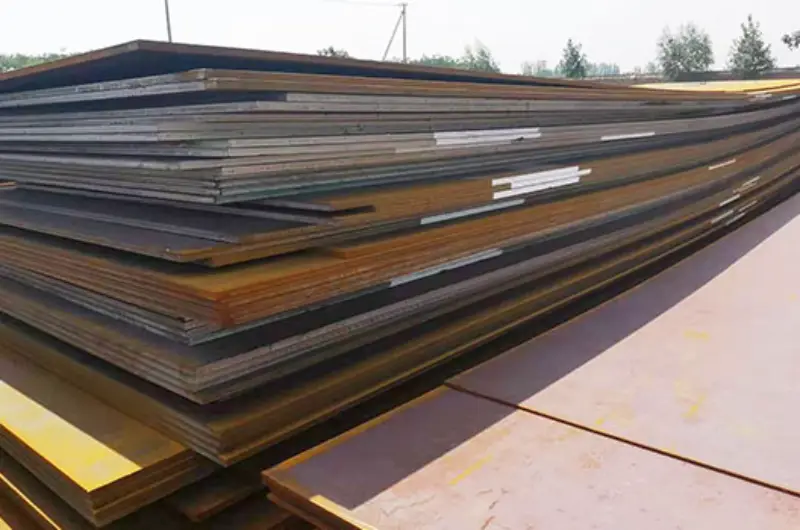
GB/T 4171 Q500NH Weather Resistant Steel Plate
GB/T 4171 Q500NH Weather Resistant Steel Plate - High Strength 500MPa
Complete data on Q500NH weathering steel under GB/T 4171: chemical composition, mechanical properties (yield strength ≥500 MPa), thermal and electrical physical properties, international equivalents including S500J0W, and applications in bridges, structures, and containers.
Hot Rolling, Quenching, Tempering, Welding, Cutting, Forming (limited cold formability due to strength)
- Phone : +8618037372205
- Email : [email protected]
- WhatsApp: Contact via Whtsapp
- WeChat: +8618037372205
GB/T 4171 Q500NH Weather Resistant Steel Plate Introduction
Q500NH is a high-strength weathering structural steel quenched and tempered according to China's GB/T 4171 standard. It provides a minimum yield strength of 500 MPa and excellent atmospheric corrosion resistance, achieved through alloying elements like copper, chromium, and nickel that form a protective patina. Key features:
- High strength-to-weight ratio suitable for heavy welded structures
- Good low-temperature toughness (≥47 J at -20°C)
- Superior corrosion resistance in unpainted service conditions
- Delivery condition: quenched + tempered
Commonly available as plates and wide flats, Q500NH is widely used in bridges, building frames, containers, and railway vehicles where durability and reduced maintenance are critical.
GB/T 4171 Q500NH Weather Resistant Steel Plate Chemical Composition
Typical ladle analysis according to GB/T 4171-2008 for Q500NH. Microalloying elements such as Nb, V, Ti may be added singly or in combination to refine grain structure and improve strength/toughness. The sum of Nb+V+Ti is typically ≤0.22%. Carbon equivalent (CEV) is usually controlled to ensure weldability. Residual elements like Mo, B are sometimes used in minor amounts.
| Element | Typical Value (%) | Remarks |
|---|---|---|
| Carbon (C) | ≤0.12 | Max |
| Silicon (Si) | ≤0.75 | Max |
| Manganese (Mn) | ≤2.00 | Max |
| Phosphorus (P) | ≤0.025 | Max |
| Sulfur (S) | ≤0.020 | Max |
| Copper (Cu) | 0.20 - 0.55 | Range |
| Chromium (Cr) | 0.30 - 1.25 | Range |
| Nickel (Ni) | ≤0.65 | Max |
| Niobium (Nb) | ≤0.05 | Optional addition |
| Vanadium (V) | ≤0.10 | Optional addition |
| Titanium (Ti) | ≤0.10 | Optional addition |
| Molybdenum (Mo) | ≤0.30 | If agreed |
| Boron (B) | ≤0.005 | If specified |
GB/T 4171 Q500NH Weather Resistant Steel Plate Thermal & Electrical Physical Properties
Values are typical for low-alloy high-strength steels at room temperature unless noted otherwise. They serve as engineering design references; actual values may vary slightly with composition and heat treatment. Corrosion-resistant patina does not significantly alter thermal or electrical properties.
| Property | Typical Value | Unit | Test Condition |
|---|---|---|---|
| Density (ρ) | 7.85 | g/cm³ | 20°C |
| Modulus of elasticity (E) | 206 | GPa | 20°C |
| Shear modulus (G) | 79 | GPa | 20°C |
| Poisson's ratio (ν) | 0.30 | - | 20°C |
| Thermal expansion coefficient (α) | 11.5 x 10⁻⁶ | 1/K | 20-100°C |
| Thermal expansion coefficient (α) | 12.1 x 10⁻⁶ | 1/K | 20-200°C |
| Thermal conductivity (λ) | 45 | W/(m·K) | 20°C |
| Specific heat capacity (c) | 460 | J/(kg·K) | 20°C |
| Electrical resistivity (ρe) | 0.22 x 10⁻⁶ | Ω·m | 20°C |
GB/T 4171 Q500NH Weather Resistant Steel Plate Mechanical Properties
Longitudinal test results as required by GB/T 4171 for quenched and tempered condition. Impact energy determined on Charpy V-notch specimens at -20°C. Bending test agreed upon ordering; typical bend ratio is 3a for plate thickness ≤40 mm. Note: The values below are for as-delivered condition; welding may affect properties in heat-affected zone.
| Property | Standard Requirement | Unit | Test Condition |
|---|---|---|---|
| Yield Strength (ReH) - Upper | ≥500 | MPa | Thickness ≤16 mm |
| Yield Strength (ReH) - Upper | ≥500 | MPa | Thickness >16 - ≤40 mm |
| Yield Strength (ReH) - Upper | ≥500 | MPa | Thickness >40 - ≤63 mm |
| Tensile Strength (Rm) | 600 - 750 | MPa | Thickness ≤16 mm |
| Tensile Strength (Rm) | 600 - 750 | MPa | Thickness >16 - ≤40 mm |
| Tensile Strength (Rm) | 600 - 750 | MPa | Thickness >40 - ≤63 mm |
| Elongation after fracture (A) | ≥18 | % | Thickness ≤16 mm, L0=5.65√So |
| Elongation after fracture (A) | ≥18 | % | Thickness >16 - ≤40 mm |
| Elongation after fracture (A) | ≥17 | % | Thickness >40 - ≤63 mm |
| Impact Energy (KV2) | ≥47 | J | -20°C, longitudinal |
GB/T 4171 Q500NH Weather Resistant Steel Plate Full Equivalent Standards & Replaceable Grades
| Country/Region | Standard | Grade | Remarks |
|---|---|---|---|
| China | GB/T 4171 | Q500NH | Original grade; quenched and tempered weathering steel |
| Europe | EN 10025-5 | S500J0W | Closest equivalent; slightly different chemistry (e.g., Cr ≤1.25%, Cu ≤0.55%); impact energy ≥27J at 0°C (J0) but often tested at -20°C per agreement; similar mechanical envelope |
| Europe | EN 10025-5 | S500J0WP | More phosphorus for enhanced corrosion resistance; yield ≥500 MPa; specialized variant |
| International | ISO 5952 | S500W | High-strength weathering steel, but specific data may vary; not an exact match |
GB/T 4171 Q500NH Weather Resistant Steel Plate Application Introduction
Q500NH steel plates are engineered for unpainted and painted structural applications where enhanced corrosion resistance and high strength are required simultaneously. Design considerations: Due to its quenched and tempered condition, preheating is recommended during welding to avoid cold cracking. Proper drainage and design detailing are necessary to allow the protective patina to form uniformly in outdoor exposures. Maintenance: Periodic inspection of bolted or crevice areas is advised. It can be painted for aesthetic reasons or extreme marine/industrial atmospheres.
Product Applications: Welded plate girders and H-beams, Cut-to-size structural plates (flanges, webs), Box-section columns and truss members, Weather-resistant container panels (corrugated sheets), Bridge deck plates and stiffeners, Wind turbine tower segments
Processed into products: Bridge main girders, crossbeams, and bracing, Building columns, beams, and base plates, Container side panels, end frames, and corner posts, Railcar side sills, bolster beams, and draft sills, Transmission tower legs and gusset plates, Excavator booms, truck chassis frames
Application industries: Bridge Engineering (road/rail bridges, footbridges), Building & Construction (high-rise frames, stadium roofs, hangars), Container Manufacturing (ISO shipping containers, swap bodies), Railway Rolling Stock (wagon bodies, underframes), Power Transmission (lattice towers, poles), Offshore & Marine (deck frames, structural modules), Mining & Heavy Equipment (dump bodies, excavator frames)
GB/T 4171 Q500NH Weather Resistant Steel Plate Similar / Close Substitution Materials
| Country/Region | Standard | Grade | Remarks |
|---|---|---|---|
| China | GB/T 4171 | Q460NH | Lower yield strength (≥460 MPa); similar weathering characteristics; often used where Q500NH is over-specified |
| Europe | EN 10025-5 | S460J0W/S460J2W | 460 MPa yield; wider availability; useful substitute with reduced strength |
| USA | ASTM A871 / A871M | Grade 65 (Type II or IV) | Minimum yield 450 MPa with weathering properties; slightly lower strength than Q500NH |
| Japan | JIS G3125 | SPA-H | 355 MPa yield; classical corten steel; for less demanding structural components |
| China | GB/T 4171 | Q550NH | Higher yield (≥550 MPa); may replace Q500NH where even higher strength is needed if suitable welding procedures are used |
Notes:
- Welding: Preheat (≥75°C) and controlled interpass temperature. Use low-hydrogen electrodes or wires. Post-weld heat treatment is generally not required due to the tempering but may be specified for thick sections.
- Forming: Hot bending or warm forming (≥600°C) preferred; cold forming is limited to small deformations due to high strength and springback.
- Corrosion performance: The weathering index (resistance to atmospheric corrosion) is optimized by the Cu-Cr-Ni system. In aggressive marine or industrial environments, painting or periodic washing may be needed.
- Testing: Ultrasonic testing (UT) per GB/T 2970 or equivalent may be applied if internal quality is required.
- Share



