
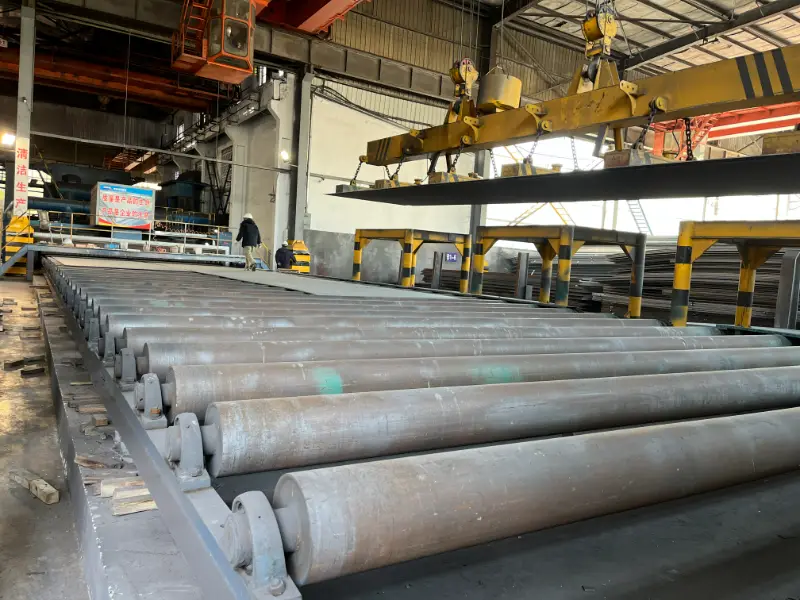
NK Grade E36 Shipbuilding Steel Plate
NK Grade E36 Shipbuilding Steel Plate - High Strength Low Temperature Toughness Marine Steel
Comprehensive data sheet for NK Grade E36 (equivalent to EH36) shipbuilding steel plate per Nippon Kaiji Kyokai Rules, covering chemical composition, mechanical properties, physical properties, equivalent grades, and application guidance.
Welding, flame cutting, cold forming, hot forming, machining
- Phone : +8618037372205
- Email : [email protected]
- WhatsApp: Contact via Whtsapp
- WeChat: +8618037372205
NK Grade E36 Shipbuilding Steel Plate Introduction
NK Grade E36 (commonly referred to as NK EH36) is a high-strength hull structural steel plate standardized by Nippon Kaiji Kyokai (ClassNK). It belongs to the E-grade category with guaranteed impact toughness at -40°C, making it suitable for ships and offshore structures operating in cold environments. The steel combines a minimum yield strength of 355 MPa with good weldability and formability. Its balanced chemistry, often microalloyed with niobium, vanadium, or titanium, refines grain size and enhances toughness. Delivery condition is typically normalized (N) or thermo-mechanically controlled processed (TMCP), ensuring consistent properties across plate thicknesses up to 100 mm. NK E36 is fully equivalent to other IACS member grades such as ABS EH36, LR EH36, and DNV EH36.
NK Grade E36 Shipbuilding Steel Plate Chemical Composition
Chemical requirements according to IACS UR W11 for EH36 grade. Grain refining elements (Nb, V, Ti, Al) may be used individually or in combination; acceptance values depend on the specific microalloying route. Residual elements Cr, Ni, Mo, Cu are restricted unless otherwise agreed. All values are ladle analysis limits.
| Chemical Element | Standard Value (%) | Remarks |
|---|---|---|
| Carbon (C) | ≤ 0.18 | Maximum |
| Silicon (Si) | ≤ 0.50 | Maximum |
| Manganese (Mn) | 0.90 – 1.60 | Range |
| Phosphorus (P) | ≤ 0.035 | Maximum |
| Sulfur (S) | ≤ 0.035 | Maximum |
| Chromium (Cr) | ≤ 0.20 | Residual, unless otherwise agreed |
| Nickel (Ni) | ≤ 0.40 | Residual, unless otherwise agreed |
| Molybdenum (Mo) | ≤ 0.08 | Residual, unless otherwise agreed |
| Copper (Cu) | ≤ 0.35 | Residual, unless otherwise agreed |
| Niobium (Nb) | 0.02 – 0.05 | When used as grain refiner |
| Vanadium (V) | 0.05 – 0.10 | When used as grain refiner |
| Titanium (Ti) | ≤ 0.02 | When used as grain refiner |
| Aluminum (sol. Al) | ≥ 0.015 | When aluminum killed or used as grain refiner |
NK Grade E36 Shipbuilding Steel Plate Thermal and Electrical Physical Properties
Typical physical properties for low-alloy structural steel comparable to EH36 grade. Values are provided for general engineering calculations and are not part of the mandatory specification. Slight variations may occur depending on heat treatment and exact chemistry.
| Property | Typical Value | Unit | Remarks / Test Condition |
|---|---|---|---|
| Density (ρ) | 7.85 | g/cm³ | At 20°C |
| Elastic Modulus (E) | 205 | GPa | At room temperature, tensile |
| Shear Modulus (G) | 80 | GPa | Calculated from E and ν |
| Poisson's Ratio (ν) | 0.3 | – | Elastic range, room temperature |
| Thermal Expansion Coefficient (α) | 12.0 × 10⁻⁶ | K⁻¹ | Mean value 20–100°C |
| Thermal Conductivity (λ) | ~50 | W/m·K | At 20°C, typical for low-alloy steel |
| Specific Heat Capacity (cp) | ~460 | J/kg·K | At 20°C, typical for structural steel |
| Electrical Resistivity (ρe) | ~0.15 × 10⁻⁶ | Ω·m | At room temperature |
NK Grade E36 Shipbuilding Steel Plate Mechanical Properties
Mechanical property requirements per IACS UR W11 for EH36 grade, tested in delivery condition (N or TMCP). Yield strength, tensile strength, and elongation depend on plate thickness. Impact toughness is verified with Charpy V-notch specimens at -40°C. Bend test ensures formability without cracking.
| Property | Standard Required Value | Unit | Test Condition |
|---|---|---|---|
| Yield Strength (ReH) | ≥ 355 | MPa | Plate thickness ≤ 100 mm |
| Tensile Strength (Rm) | 490 – 630 | MPa | Plate thickness ≤ 50 mm |
| Tensile Strength (Rm) | 490 – 630 | MPa | Plate thickness 50 < t ≤ 70 mm |
| Tensile Strength (Rm) | 470 – 610 | MPa | Plate thickness 70 < t ≤ 100 mm |
| Elongation (A5) | ≥ 22 | % | Gauge length 5.65√S₀, t ≤ 50 mm |
| Elongation (A5) | ≥ 21 | % | Gauge length 5.65√S₀, 50 < t ≤ 70 mm |
| Elongation (A5) | ≥ 20 | % | Gauge length 5.65√S₀, 70 < t ≤ 100 mm |
| Impact Energy (KV) | ≥ 34 (longitudinal) ≥ 24 (transverse) | J | Charpy V-notch, -40°C |
| Bend Test (180°) | d = 3a | – | Bending angle 180°, mandrel diameter 3× thickness, for t ≤ 100 mm |
NK Grade E36 Shipbuilding Steel Plate Fully Equivalent Material Standards and Substitutable Grades
| Country / Region | Standard | Grade | Remarks |
|---|---|---|---|
| International (IACS) | IACS UR W11 | EH36 | Base unified requirement for high strength hull steel at -40°C |
| Japan | NK Rules Part K | EH36 | Nippon Kaiji Kyokai classification |
| USA | ABS Rules | EH36 | American Bureau of Shipping |
| UK | LR Rules | EH36 | Lloyd's Register |
| Norway/Germany | DNV Rules | EH36 | DNV (formerly DNVGL) |
| France | BV Rules | EH36 | Bureau Veritas |
| China | CCS Rules | EH36 | China Classification Society |
| South Korea | KR Rules | EH36 | Korean Register |
| Italy | RINA Rules | EH36 | Registro Italiano Navale |
NK Grade E36 Shipbuilding Steel Plate Application Introduction
NK E36 steel is designed for critical welded structures in shipbuilding and offshore engineering where low-temperature toughness is essential. It can be used in all parts of a vessel subjected to high stress and cold ambient conditions. Typical processing includes cutting, forming, and multi-pass welding without preheat in moderate thicknesses.
Product Applications: Hull plates for ice-class ships, bulk carriers, container ships, tankers, Deck plates and longitudinal stiffeners, Transverse bulkheads and shell plating, Legs, bracings, and nodes of jack-up rigs, Transition pieces and monopiles for offshore wind turbines
Processed into products: Hull skins and strakes, Stiffeners, brackets, and floor plate, Hatch coaming and coaming stays, Rudder horns and stern frame plates, Deckhouse and superstructure components (when low temperature performance is required)
Application industries: Shipbuilding (commercial and naval vessels), Offshore oil & gas platforms and FPSOs, Marine renewable energy (offshore wind turbine foundations), Bridge and heavy infrastructure (due to toughness and weldability)
NK Grade E36 Shipbuilding Steel Plate Similar / Alternative Material Recommendations
| Country / Region | Standard | Grade | Remarks |
|---|---|---|---|
| EU | EN 10025-3 | S355NL | 355 MPa yield, impact toughness at -50°C (similar level), not pre-certified for marine classification – requires separate approval |
| EU | EN 10025-4 | S355ML | TMCP delivered, same strength and low-temperature toughness, similar approval note |
| International | API Spec 2H | Grade 50 | Offshore structural plate, yield 345–517 MPa, impact test often at -40°C possible, but not mandatory; verify certifications |
| USA | ASTM A131 / A131M | EH36 | Structural steel for ships; identical grade under ASTM shipbuilding standard |
Notes:
- All deliveries must be accompanied by ClassNK certification with traceability to the heat number.
- Welding: Use low-hydrogen electrodes or processes; preheat may be recommended for thicknesses above 50 mm depending on carbon equivalent (Ceq).
- Deoxidation practice: Fine grain practice (Al killed) with optional microalloy additions. The manufacturer reports all grain refining elements used.
- Tolerances on thickness, flatness, and dimensions comply with NK Rules or agreed standards (e.g., EN 10029).
- Share



