
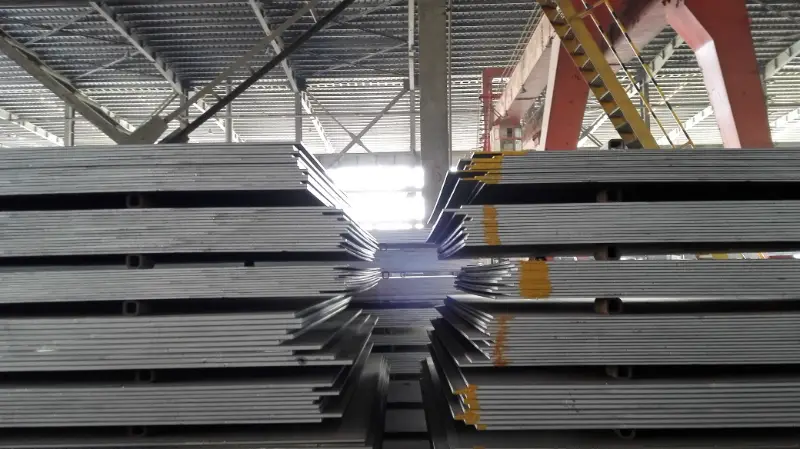
NK Grade D36 Shipbuilding Steel Plate
NK Grade D36 Shipbuilding Steel Plate: High-Strength Marine Structural Material
Comprehensive data sheet for NK Grade D36 shipbuilding steel plate with chemical composition, mechanical properties, thermal and electrical physical properties, equivalent grades, and application guide.
Hot rolling, normalizing, TMCP (thermo-mechanical control process), cutting, welding, forming, bending
- Phone : +8618037372205
- Email : [email protected]
- WhatsApp: Contact via Whtsapp
- WeChat: +8618037372205
NK Grade D36 Shipbuilding Steel Plate Introduction
NK Grade D36 is a normalized or thermo-mechanically rolled high-strength shipbuilding steel plate specified by Nippon Kaiji Kyokai (ClassNK). It belongs to the high-tensile hull structural steel category with a minimum yield strength of 355 MPa and good notch toughness at 0 °C. The grade is primarily used in the construction of ocean-going vessels, offshore structures, and marine equipment requiring a combination of high strength, excellent weldability, and guaranteed low-temperature impact properties. Its balanced chemistry with microalloying elements ensures fine grain refinement and consistent mechanical performance across a wide range of plate thicknesses. Delivery condition is typically as-rolled, normalized, or thermo-mechanical controlled processed (TMCP).
NK Grade D36 Shipbuilding Steel Plate Chemical Composition
The chemical composition of NK Grade D36 conforms to ClassNK Rules for high-strength hull structural steels. The steel is supplied as fully killed and fine-grain treated. Maximum limits guarantee good weldability and toughness. Elements such as Nb, V, Ti, Al may be added singly or in combination to achieve grain refinement. The steel is normally delivered with a carbon equivalent (CEV) of approximately 0.38–0.43% to ensure ease of welding.
| Element | Standard Value (max, unless range given) | Remarks |
|---|---|---|
| Carbon (C) | 0.18 % | Ladle analysis |
| Silicon (Si) | 0.10 - 0.50 % | |
| Manganese (Mn) | 0.90 - 1.60 % | |
| Phosphorus (P) | 0.035 % max | |
| Sulfur (S) | 0.035 % max | |
| Aluminum (Al, acid soluble) | 0.015 % min (if added) | Normally used as grain refining element |
| Niobium (Nb) | 0.02 - 0.05 % (if added) | Optional microalloy |
| Vanadium (V) | 0.05 - 0.10 % (if added) | Optional microalloy |
| Titanium (Ti) | 0.02 % max (if added) | Optional microalloy |
| Nitrogen (N) | 0.009 % max (product analysis) | If not combined with strong nitride formers |
| Copper (Cu) | 0.35 % max | May be present as residual |
| Chromium (Cr) | 0.20 % max | May be present as residual |
| Nickel (Ni) | 0.40 % max | May be present as residual |
| Molybdenum (Mo) | 0.08 % max | May be present as residual |
NK Grade D36 Shipbuilding Steel Plate Thermal and Electrical Physical Properties
These physical properties are typical for normalized or TMCP C-Mn and microalloyed structural steels at room temperature. They are provided as general guidance and are not part of NK specification requirements. Variations exist depending on exact composition and processing history.
| Property | Typical Value | Unit | Test Condition / Remarks |
|---|---|---|---|
| Density (ρ) | 7.85 | g/cm³ | at 20 °C |
| Elastic modulus (E) | 205 – 210 | GPa | at 20 °C, static loading |
| Shear modulus (G) | ~80 | GPa | at 20 °C, calculated from E and ν |
| Poisson's ratio (ν) | 0.29 – 0.30 | – | |
| Thermal expansion coefficient (α) | 11.7 × 10⁻⁶ | K⁻¹ | between 20 °C and 100 °C |
| Thermal expansion coefficient (α) | 12.5 × 10⁻⁶ | K⁻¹ | between 20 °C and 200 °C |
| Thermal expansion coefficient (α) | 13.5 × 10⁻⁶ | K⁻¹ | between 20 °C and 400 °C |
| Thermal conductivity (λ) | 50 – 52 | W/(m·K) | at 20 °C |
| Thermal conductivity (λ) | 47 | W/(m·K) | at 200 °C |
| Thermal conductivity (λ) | 42 | W/(m·K) | at 400 °C |
| Specific heat capacity (cp) | 460 – 480 | J/(kg·K) | at 20 – 100 °C |
| Electrical resistivity (ρe) | 0.20 – 0.25 | µΩ·m | at 20 °C |
NK Grade D36 Shipbuilding Steel Plate Mechanical Properties
Mechanical properties are determined on test pieces taken transverse to the rolling direction unless otherwise agreed. Tensile and impact tests are mandatory. Bending test is required for classification. These values are in accordance with NK Rules Part K for Grade D36. Impact test temperature is 0 °C with longitudinal Charpy V-notch specimens.
| Property | Required Value | Unit | Test Conditions / Remarks |
|---|---|---|---|
| Yield strength (ReH) | ≥ 355 | MPa | Plate thickness t ≤ 50 mm |
| Yield strength (ReH) | ≥ 355 | MPa | 50 < t ≤ 70 mm |
| Yield strength (ReH) | ≥ 355 | MPa | 70 < t ≤ 100 mm |
| Tensile strength (Rm) | 490 – 620 | MPa | All thicknesses |
| Elongation (A, 5.65√So) | ≥ 21 | % | t ≤ 50 mm, longitudinal or transverse |
| Elongation (A, 5.65√So) | ≥ 21 | % | 50 < t ≤ 70 mm |
| Elongation (A, 5.65√So) | ≥ 21 | % | 70 < t ≤ 100 mm |
| Impact energy (KV, average) | ≥ 34 | J | at 0 °C, longitudinal, V-notch, t ≤ 50 mm |
| Impact energy (KV, average) | ≥ 41 | J | at 0 °C, longitudinal, V-notch, 50 < t ≤ 70 mm |
| Impact energy (KV, average) | ≥ 50 | J | at 0 °C, longitudinal, V-notch, 70 < t ≤ 100 mm |
| Bend test, 180° | No cracks | – | Bend diameter 3a (a=thickness) for t ≤ 25 mm |
| Bend test, 180° | No cracks | – | Bend diameter 4a for t > 25 mm up to 50 mm, 5a for t > 50 mm |
NK Grade D36 Shipbuilding Steel Plate Directly Equivalent Standards and Grades
| Country / Society | Standard | Grade / Designation | Remarks |
|---|---|---|---|
| IACS (Int. Assoc. Class. Soc.) | UR W11 | Grade D36 | Common requirement for all IACS members |
| American Bureau of Shipping | ABS Rules Part 2 | ABS Grade D36 (or ABS DH36) | Officially equivalent; same strength and 0 °C impact |
| Bureau Veritas | BV Rules | BV D36 | Same chemistry/mechanical requirements |
| China Classification Society | CCS Rules | CCS D36 (or CCS DH36) | Identical to NK D36 |
| DNV | DNV Rules Pt2 Ch2 | DNV D36 (NV D36) | Now DNV class; fully equivalent |
| Lloyd's Register | LR Rules | LR D36 | Mutually recognised |
| Registro Italiano Navale | RINA Rules | RINA D36 | Equivalent |
| Korean Register | KR Rules | KR D36 | Equivalent |
| Polish Register of Shipping | PRS Rules | PRS D36 | Equivalent |
| Russian Maritime Register | RS Rules | RS D36 | Equivalent |
NK Grade D36 Shipbuilding Steel Plate Application Introduction
NK Grade D36 is designed for primary structural members that require high tensile strength and reliable low-temperature impact properties. It can be welded using all conventional shipyard processes (SMAW, SAW, GMAW, FCAW) with appropriate preheat when thickness exceeds 30 mm. The material is suitable for both cold and hot forming, though hot forming may necessitate subsequent normalizing to restore toughness. Machining is similar to other C-Mn structural steels.
Product Applications: Hull shell plates and stiffeners, Decks, bulkheads, and tank tops, Deck girders and hatch coamings, Offshore flare booms and helidecks, Wind turbine tower flanges and base structures, Caisson structures and dock gates
Processed into products: Longitudinal and transverse frames, Keel and bilge plates, Transverse webs, Beams and pillars, Reinforcement pads and brackets, Crane pedestals and foundation plates, Connecting plates for structural nodes
Application industries: Shipbuilding and ship repair, Offshore oil & gas (platforms, jackets, FPSOs), Marine engineering (barges, tugs, workboats), Civil engineering (bridge girders, lock gates), Renewable energy (offshore wind tower transition pieces), Heavy machinery and transport, Pressure vessels (when approved with supplementary requirements)
NK Grade D36 Shipbuilding Steel Plate Similar or Alternative Materials
| Standard | Grade | Country / Region | Remarks |
|---|---|---|---|
| ASTM A131 / A131M | AH36 / DH36 / EH36 | USA / International | AH36 same 0 °C impact; DH36 also 0 °C with lower S; EH36 is -40 °C. Close substitute for shipbuilding. |
| EN 10025-3 | S355N / S355NL | Europe (EU) | Normalized structural steel with 355 MPa yield and impact at -20 °C (N) or -50 °C (NL). Not classed for marine; requires additional approval. |
| EN 10025-4 | S355M / S355ML | Europe (EU) | Thermo-mechanical rolled; M versions have -20 °C impact. Good substitute for offshore structures. |
| GB/T 1591 | Q355D / Q355E | China | Yield 355 MPa; D grade provides 0 °C, E grade -40 °C. Not automatically accepted as ship plate without certification. |
| JIS G 3106 | SM490A / SM490B | Japan | Welded structural steel; 490 MPa tensile class with adequate toughness. Often used in bridges and marine if class-approved. |
| API 2W / 2Y | Grade 50 / 50T | USA (offshore) | Offshore structural steel with 345–355 MPa yield and CTOD toughness. Suitable for fixed platforms and jackets. |
Notes:
Notes:
- NK Grade D36 is normally supplied with NK surveyors' certificates (3.2 class certificate) or equivalent inspection documents.
- Ultrasonic testing according to NK rules may be requested for critical zones.
- For thicknesses >50 mm additional impact tests and may be required, and minimum values increase as shown in the mechanical table.
- The material is generally weldable with a low carbon equivalent (typically CEV ≤0.43%) and does not require post-weld heat treatment for common thicknesses.
- If the steel is to be used at sub-zero design temperatures, consideration should be given to the fracture toughness and the use of DH36 or EH36 grades with lower impact test temperatures.
- Share



