
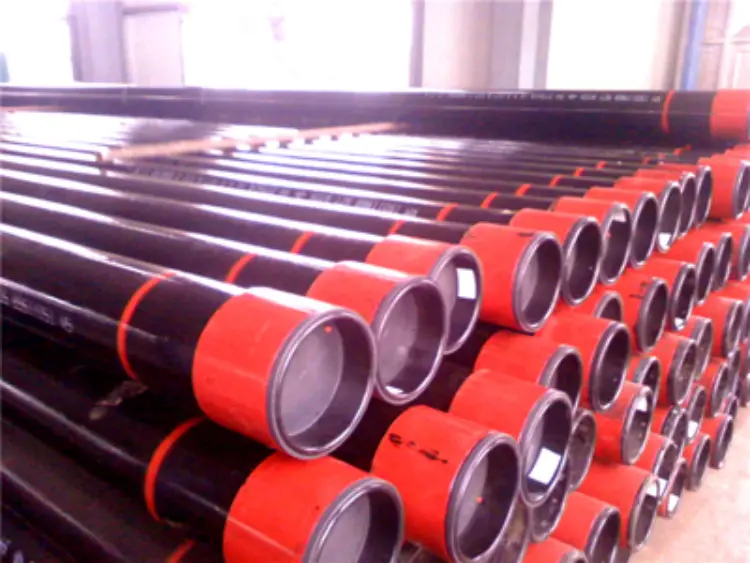
L320 (X46) ERW Line Pipe to GB/T 9711-2011 PSL1
L320 (X46) ERW Line Pipe to GB/T 9711-2011 PSL1: Chemical, Mechanical & Physical Properties
Complete material data for L320 (X46) ERW pipe conforming to GB/T 9711-2011 PSL1, including chemical composition, mechanical and thermal properties, equivalents, and applications.
Hot-rolled strip, cold forming, electric resistance welding, optional normalizing or stress relieving
- Phone : +8618037372205
- Email : [email protected]
- WhatsApp: Contact via Whtsapp
- WeChat: +8618037372205
L320 ERW Line Pipe to GB/T 9711-2011 PSL1 Introduction
L320 steel grade, defined in GB/T 9711-2011 (ISO 3183:2007) PSL1, is a low-carbon microalloyed steel used for electric resistance welded (ERW) line pipes in petroleum and natural gas transportation. It offers a minimum yield strength of 320 MPa, good weldability, and adequate toughness for moderate conditions. PSL1 represents standard quality level with basic chemical and mechanical requirements; supplementary testing may be agreed for impact and tighter composition.
L320 ERW Line Pipe to GB/T 9711-2011 PSL1 Chemical Composition
Basic chemical requirements for PSL1 L320 according to GB/T 9711-2011 (ISO 3183). Limits for C, Mn, P, S are mandatory. Microalloying elements (Nb, V, Ti) may be added under supplementary agreement; typical total ≤0.15%. Silicon is not specified but usually kept ≤0.35%. Carbon equivalent (CEV) is often controlled for weldability.
| Element | Standard Value (max %) | Remarks |
|---|---|---|
| C | ≤0.28 | PSL1 requirement |
| Mn | ≤1.40 | PSL1 requirement |
| P | ≤0.030 | PSL1 requirement |
| S | ≤0.030 | PSL1 requirement |
| Si | Typically ≤0.35 | Not mandatory; residual element |
| Nb + V + Ti | ≤0.15 (if added) | Per supplementary agreement |
L320 ERW Line Pipe to GB/T 9711-2011 PSL1 Physical Properties
Physical properties of low‑carbon steel applicable to L320 grade. These values are typical and may vary slightly with composition and processing.
| Property | Value | Unit | Condition / Note |
|---|---|---|---|
| Density (ρ) | 7.85 | g/cm³ | Room temperature |
| Modulus of elasticity (E) | 207 | GPa | Tension |
| Shear modulus (G) | 80 | GPa | Typical |
| Poisson's ratio (ν) | 0.30 | — | — |
| Thermal expansion coefficient (α) | 11.7 | 10⁻⁶/K | 20–100 °C average |
| Thermal conductivity (λ) | 50 | W/(m·K) | At 20 °C |
| Specific heat capacity (cₚ) | 460 | J/(kg·K) | At 20 °C |
| Electrical resistivity (ρₑ) | 0.22 | μΩ·m | At 20 °C |
L320 ERW Line Pipe to GB/T 9711-2011 PSL1 Mechanical Properties
Mechanical properties of L320 PSL1 ERW pipe as per GB/T 9711-2011. Tensile test is transverse strip; yield strength is minimum 320 MPa; tensile strength between 455 and 760 MPa. Elongation is calculated from actual tensile strength using the formula. Bend test requires no cracks after 180° bending. Impact testing is not required for PSL1 unless specified.
| Property | Value | Unit | Condition |
|---|---|---|---|
| Yield strength (ReH) | ≥320 | MPa | Transverse strip; all wall thicknesses |
| Tensile strength (Rm) | 455 – 760 | MPa | Transverse strip |
| Elongation after fracture (A) | Calculated per formula (typical ≥22%) | % | Gauge length 50 mm, wall thickness ≤10 mm; Af = 1940×(A₀⁰·²/Rₘ⁰·⁹) |
| Bend test | No cracks after 180° bend | — | Bend diameter = t (for t ≤20 mm); = 2t for t >20 mm |
| Charpy impact (KV) | Not required | J | PSL1; optional by agreement |
L320 ERW Line Pipe to GB/T 9711-2011 PSL1 Fully Equivalent Material Standards & Grades
| Country/Region | Standard | Grade | Remarks |
|---|---|---|---|
| International | ISO 3183:2007 | L320 PSL1 | Identical specification; basis of GB/T 9711 |
| USA | API 5L (46th Ed.) | X46 PSL1 | Equivalant; API 5L adopted ISO 3183 for PSL1 |
| Europe | EN ISO 3183:2012 | L320 PSL1 | European adoption of ISO 3183 |
L320 ERW Line Pipe to GB/T 9711-2011 PSL1 Application Introduction
L320 ERW pipes are widely applied in moderate‑pressure line‑pipe systems. Their balanced strength and weldability make them suitable for fabrication into spools, bends, and flanged connections. Typical service includes oil and gas gathering lines, distribution networks, and water mains.
Product Applications: ERW line pipe (sizes up to 24 inch or larger), Casing and tubing (non‑critical), Pressure piping per ASME B31, Structural hollow sections
Processed into products: Straight seam welded pipes, Cold‑formed elbows and bends, Tee and reducer fittings (welded from pipe), Flanges (slip‑on, weld‑neck), Pipe piles and structural columns
Application industries: Oil & Gas (transmission pipelines), Petrochemical, Water & wastewater, Construction (structural support), Mining (slurry transport)
L320 ERW Line Pipe to GB/T 9711-2011 PSL1 Similar / Alternative Material Grades
| Country/Region | Standard | Grade | Remarks |
|---|---|---|---|
| International/China | ISO 3183 / GB/T 9711 | L290 (X42) | Lower yield strength (290 MPa); similar chemistry, less demanding |
| International/China | ISO 3183 / GB/T 9711 | L360 (X52) | Higher yield strength (360 MPa); requires stricter processing |
| USA | API 5L | X52 PSL1 | Higher strength option; common in pipeline applications |
Notes:
For severe service (sour, low temperature, or high pressure), PSL2 grades (L320M or L320Q) with mandatory CVN impact tests and tighter chemistry (e.g., S ≤0.015%, P ≤0.020%) are recommended. ERW welds should undergo NDT per the standard (ultrasonic or eddy current). Supplementary requirement for CEV ≤0.43 may be imposed for weldability.
- Share



