
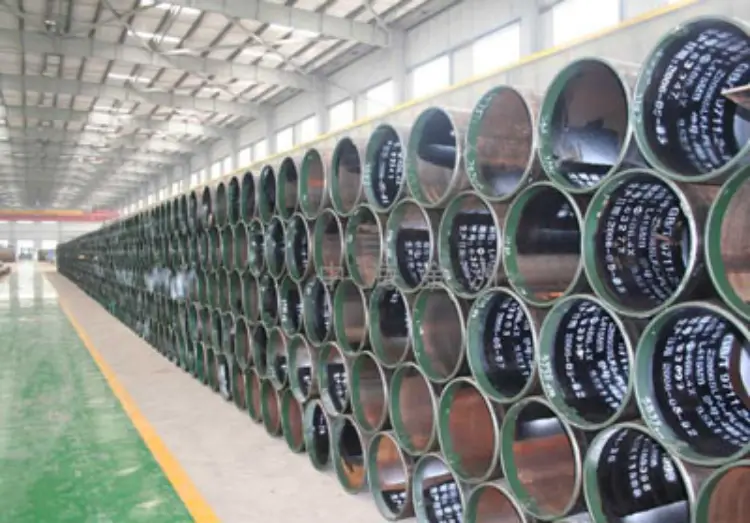
GB/T 9711-2011 PSL1 L290 ERW Pipe
GB/T 9711-2011 PSL1 L290 ERW Pipe: A Reliable Pipeline Steel for Oil and Gas Transport
Comprehensive material data for GB/T 9711-2011 PSL1 L290 electric resistance welded steel pipe used in pipeline transportation systems, including chemical composition, mechanical properties, and equivalents.
Electric resistance welding (ERW), then forming, welding, heat treatment of weld seam, sizing, cutting, and optional coating
- Phone : +8618037372205
- Email : [email protected]
- WhatsApp: Contact via Whtsapp
- WeChat: +8618037372205
GB/T 9711-2011 PSL1 L290 ERW Pipe Introduction
GB/T 9711-2011 specifies the technical delivery conditions for steel pipes for pipeline transportation systems in the petroleum and natural gas industries. Grade L290 under product specification level 1 (PSL1) is a widely used low-carbon structural steel pipe manufactured by electric resistance welding (ERW). L290 corresponds to a minimum yield strength of 290 MPa (42 ksi) and offers good weldability, formability, and toughness for moderate service conditions. It is primarily used for onshore and offshore pipelines conveying oil, gas, and water. The ERW process ensures a cost-effective, high-quality pipe with consistent dimensions and surface finish. This grade is frequently specified when moderate strength and standard corrosion resistance are adequate, without the need for supplementary impact testing or tighter chemical controls required by PSL2.
GB/T 9711-2011 PSL1 L290 ERW Pipe Chemical Composition
The following table presents the maximum allowable chemical composition for L290 PSL1 as specified by GB/T 9711-2011, which is identical to ISO 3183:2007. No other elements are specified for PSL1; however, manufacturers may add microalloying elements to achieve mechanical properties. The sum of niobium, vanadium, and titanium (if used) is typically limited to ≤0.15%, but this is not a mandatory requirement for PSL1.
| Element | Max. Value | Remarks |
|---|---|---|
| C (Carbon) | 0.26% | For improved weldability, often lower (<0.18%) |
| Mn (Manganese) | 1.20% | May be adjusted for strength |
| P (Phosphorus) | 0.030% | Residual element |
| S (Sulfur) | 0.030% | Residual element |
GB/T 9711-2011 PSL1 L290 ERW Pipe Physical Properties
The following values are typical for L290 (X42) low-carbon steel and are not part of the standard specification. They are provided for design and simulation purposes only. Actual properties may vary slightly with specific manufacturing process and minor alloying.
| Property | Typical Value | Unit | Test Condition / Note |
|---|---|---|---|
| Density (ρ) | 7.85 | g/cm³ | At 20 °C |
| Elastic Modulus (E) | 207 | GPa | Room temperature |
| Shear Modulus (G) | 80 | GPa | Approximate, from E and ν |
| Poisson's Ratio (ν) | 0.3 | - | Room temperature |
| Thermal Expansion Coeff. (α) | 11.7 × 10⁻⁶ | /K | 20 °C to 100 °C |
| Thermal Conductivity (λ) | 52 | W/(m·K) | At 20 °C |
| Specific Heat Capacity | 486 | J/(kg·K) | At 20 °C |
| Electrical Resistivity (ρ_e) | 0.15 | μΩ·m | At 20 °C |
GB/T 9711-2011 PSL1 L290 ERW Pipe Tensile and Flattening Properties
Mechanical properties are based on GB/T 9711-2011 PSL1 requirements for pipe body and weld. Yield strength (ReH) and tensile strength (Rm) are measured from transverse strip specimens. Elongation depends on specimen geometry and is calculated per ISO 2566. ERW pipe also undergoes flattening test and weld ductility test, but no Charpy impact requirement exists for PSL1.
| Property | Required Value | Unit | Test Condition |
|---|---|---|---|
| Yield Strength (ReH) | 290 min (no upper limit) | MPa | Transverse strip, 0.5% elongation under load, room temperature |
| Tensile Strength (Rm) | 415 min (no upper limit) | MPa | Room temperature, transverse strip |
| Elongation (A) | Determined per ISO 2566 (typically ≥21% for a 12.5 mm wide strip) | % | Gauge length 5.65√Sₒ, room temperature |
| Flattening Test | No cracks or breaks until distance between plates equals 2/3 of outside diameter (for D/t >10) | - | Stepwise pressing, room temperature |
GB/T 9711-2011 PSL1 L290 ERW Pipe Full Equivalent Material Standards and Grades
| Country/Region | Standard | Grade | Remarks |
|---|---|---|---|
| International | ISO 3183:2007 | L290 PSL1 | Identical technical requirements |
| USA | API 5L 46th Edition | X42 PSL1 | Equivalent yield strength (42 ksi = 290 MPa) |
| Europe | EN 10208-2:2009 | L290NB | Slightly different chemical limits may apply, but mechanically equivalent |
| Russia/CIS | GOST R 54882 | K42 | Based on GOST, similar strength class |
GB/T 9711-2011 PSL1 L290 ERW Pipe Application Introduction
L290 ERW pipe is extensively employed in mid- to low-pressure onshore and offshore pipeline systems for transporting crude oil, natural gas, refined products, and water. Its moderate strength and excellent weldability simplify field joint welding and repair. ERW manufacturing ensures tight tolerances and a smooth surface, facilitating external coating and internal lining. Typical applications include:
Product Applications: Line pipe for gathering systems and transmission pipelines (up to 24 inch OD), Flowlines and risers (with proper corrosion protection), Casing and tubing for shallow wells (subject to design verification), Fire protection pipes (as per engineering design), Offshore platform piping (non-sour service)
Processed into products: Plain-end pipe sections, beveled for welding, Flanged spools and fittings, Bends and elbows manufactured from pipe (with heat treatment if needed), Special lengths for pilings, with or without end plates, Coated pipe (FBE, 3LPE, etc.) for buried pipelines
Application industries: Oil and gas upstream and midstream transportation, Water supply and sewage pipelines, Structural steel construction (poles, piling, scaffolding), Mechanical engineering (conveyor pipes, hydraulic pipes), Mining (slurry and process water lines)
GB/T 9711-2011 PSL1 L290 ERW Pipe Closely Related / Alternative Grades
| Country/Region | Standard | Grade | Remarks |
|---|---|---|---|
| USA | API 5L | X42MSO | Offshore specification with tighter chemistry for sour service; similar strength, improved HIC resistance |
| China | GB/T 9711-2011 | L290 PSL2 | PSL2 version offers additional toughness testing, lower composition limits, and mandatory Charpy impact |
| International | ISO 3183 | L320 (X46) | Higher strength grade with min yield 320 MPa; substitute when increased load-bearing capacity is needed |
| Europe | EN 10208-2 | L290GA | Gas cylinder / higher purity variant; may have lower impurity limits for pressure containers |
Notes:
- PSL1 grade does not require Charpy impact testing; for low-temperature or critical service, consider L290 PSL2 or supplementary SR18.
- ERW pipe weld seam shall be fully normalized or solution-annealed to ensure uniform properties.
- Hydrostatic testing is mandatory at a pressure to achieve hoop stress ≥ 60% of SMYS, unless otherwise agreed.
- When ordering, specify diameter, wall thickness, length, and end finish as per GB/T 9711 requirements.
- Share



