
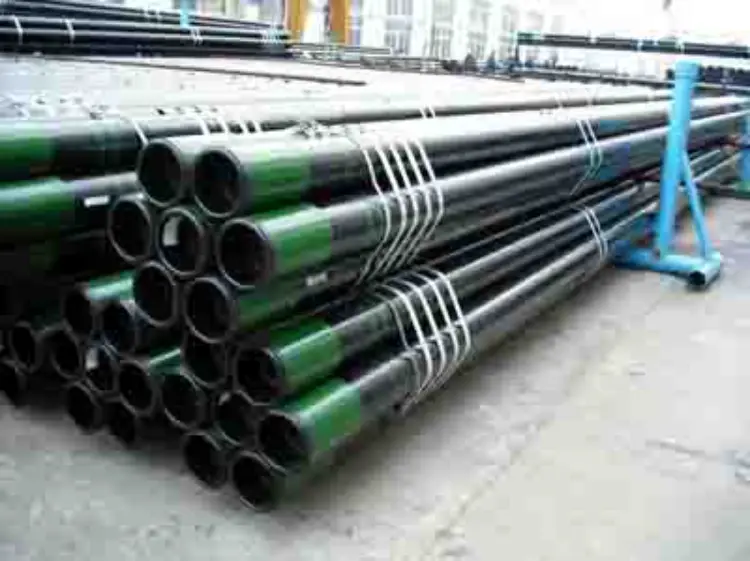
L245 ERW Steel Pipe - GB/T 9711-2011 PSL1
L245 ERW Steel Pipe - GB/T 9711-2011 PSL1 | Pipeline Material Data
Detailed material specification for L245 ERW pipe according to GB/T 9711-2011 PSL1. Includes chemical composition, mechanical and physical properties, equivalent grades, and application guide for pipeline transportation systems.
Welding, bending, cutting, threading, coating
- Phone : +8618037372205
- Email : [email protected]
- WhatsApp: Contact via Whtsapp
- WeChat: +8618037372205
L245 ERW Steel Pipe - GB/T 9711-2011 PSL1 Introduction
L245 is a pipe grade for seamless and welded line pipe for petroleum and natural gas industries, defined in GB/T 9711-2011 PSL1 (equivalent to ISO 3183:2012). This grade has a minimum yield strength of 245 MPa and is commonly supplied in ERW (Electric Resistance Welded) form. It offers good weldability and sufficient toughness for moderate temperature and pressure conditions, making it suitable for onshore and offshore pipeline transportation of oil, gas, and water. With controlled carbon and manganese content, L245 ensures reliable performance in low-risk environments.
L245 ERW Steel Pipe - GB/T 9711-2011 PSL1 Chemical Composition for L245 PSL1 per GB/T 9711-2011
The chemical composition limits are per heat analysis as specified in GB/T 9711-2011 for PSL1 grade L245. Trace microalloying elements may be added to achieve required strength and toughness; the sum of V, Nb, Ti shall not exceed 0.15%. Carbon equivalent CEV is limited for weldability.
| Element | Standard Value (max %) | Remarks |
|---|---|---|
| C (Carbon) | 0.28 | Maximum; lower carbon allowed if Mn increased according to standard |
| Mn (Manganese) | 1.20 | Maximum; may be increased up to 1.35% if carbon ≤0.26% |
| P (Phosphorus) | 0.030 | Maximum |
| S (Sulfur) | 0.030 | Maximum |
| Si (Silicon) | — | No specified limit; typically 0.10–0.35% |
| V (Vanadium) | — | Sum of V+Nb+Ti ≤0.15% |
| Nb (Niobium) | — | Sum of V+Nb+Ti ≤0.15% |
| Ti (Titanium) | — | Sum of V+Nb+Ti ≤0.15% |
| CEV (Carbon Equivalent) | 0.43 (for t ≤25.4 mm) | CEV = C + Mn/6 + (Cr+Mo+V)/5 + (Ni+Cu)/15; if t>25.4 mm by agreement |
L245 ERW Steel Pipe - GB/T 9711-2011 PSL1 Thermal and Electrical Physical Properties
The following physical properties are typical for carbon steel line pipe grade L245 at room temperature. They may vary slightly with exact composition and manufacturing conditions.
| Property | Typical Value | Unit | Condition |
|---|---|---|---|
| Density (ρ) | 7.85 | g/cm³ | At 20°C |
| Modulus of Elasticity (E) | 210 | GPa | At 20°C |
| Shear Modulus (G) | 80 | GPa | Calculated |
| Poisson's Ratio (ν) | 0.3 | — | Typical |
| Thermal Expansion Coefficient (α) | 12.2 | 10⁻⁶/K | 20-100°C |
| Thermal Conductivity (λ) | 50 | W/(m·K) | At 20°C |
| Specific Heat Capacity | 500 | J/(kg·K) | At 20°C |
| Electrical Resistivity (ρ_e) | 0.17 | Ω·mm²/m | At 20°C |
L245 ERW Steel Pipe - GB/T 9711-2011 PSL1 Mechanical Properties of L245 PSL1 Pipe
Mechanical testing must be performed on pipe body for transverse specimens (or longitudinal for smaller sizes). The values are minimum unless a range is given. Bend test applies to ERW pipes. No Charpy impact requirement for PSL1 unless agreed.
| Property | Standard Requirement | Unit | Test Condition / Remarks |
|---|---|---|---|
| Yield Strength (ReL or Rt0.5) | 245 - 450 | MPa | Transverse strip test; 0.5% total extension under load |
| Tensile Strength (Rm) | ≥ 415 | MPa | Transverse strip test |
| Elongation after fracture (A) | ≥ 21 | % | For wall thickness ≤25.4 mm, gauge length 50 mm; see standard table for other thicknesses |
| Elongation after fracture (A) | ≥ 20 | % | Wall thickness >25.4 mm and ≤38.1 mm |
| Elongation after fracture (A) | ≥ 18 | % | Wall thickness >38.1 mm and ≤50.8 mm |
| Guided Bend Test (ERW) | No cracks ≥3 mm | — | Bend angle 180°, former diameter 6 times wall thickness |
L245 ERW Steel Pipe - GB/T 9711-2011 PSL1 Exactly Equivalent Material Standards and Alternative Grades
| Region/Standard | Standard | Grade | Remarks |
|---|---|---|---|
| International / ISO | ISO 3183:2012 | L245 PSL1 | Identical technical delivery conditions |
| USA / API | API Spec 5L | Grade B PSL1 | API 5L Grade B covers the same strength level; verify chemical limits may differ slightly but acceptable per standard |
| Europe / EN | EN 10208-1 | L245GA | EN grade for gas pipelines, comparable in strength and composition |
| Russia / GOST | GOST R 52079-2003 | K52 (roughly equivalent) | Strength level similar, but check specific requirements |
L245 ERW Steel Pipe - GB/T 9711-2011 PSL1 Application Introduction
L245 PSL1 ERW pipes are widely used in onshore and offshore pipeline projects for transporting oil, gas, and water. They are suitable for low to moderate pressure systems and ambient temperature service. The ERW process provides good diameter and wall thickness accuracy, making them reliable for field welding and coating.
Product Applications: Line pipes for gathering and transmission lines, Flowlines, Water injection pipelines, Casing or conductor pipes in shallow wells
Processed into products: Straight pipe sections, Pipe bends and elbows (cold formed), Flanges (welding neck), Tees and reducers, Valve bodies (for low-pressure classes), Couplings and connectors
Application industries: Oil and Gas (pipeline transport), Water treatment and supply, Structural applications in pipeline systems, Petrochemical plants
L245 ERW Steel Pipe - GB/T 9711-2011 PSL1 Similar or Alternative Materials
| Region/Standard | Standard | Grade | Remarks |
|---|---|---|---|
| China / GB | GB/T 9711-2011 | L245N (normalized) | Higher toughness and more stringent chemical limits; suitable for sour service or lower temperatures if specified |
| China / GB | GB/T 9711-2011 | L245R (as-rolled) | May have less formability; typical for non-critical applications |
| International | ISO 3183 | L245Q (quenched and tempered) | Higher strength variant; not directly equivalent |
Notes:
This data is based on official GB/T 9711-2011 standard for PSL1 L245. For critical applications, supplementary requirements (e.g., hardness, NDT, impact testing at low temperatures) may be agreed between purchaser and manufacturer. ERW pipes are typically normalized or stress-relieved post-weld to meet toughness requirements. Always consult the latest standard revision and project specific specifications.
- Share



