
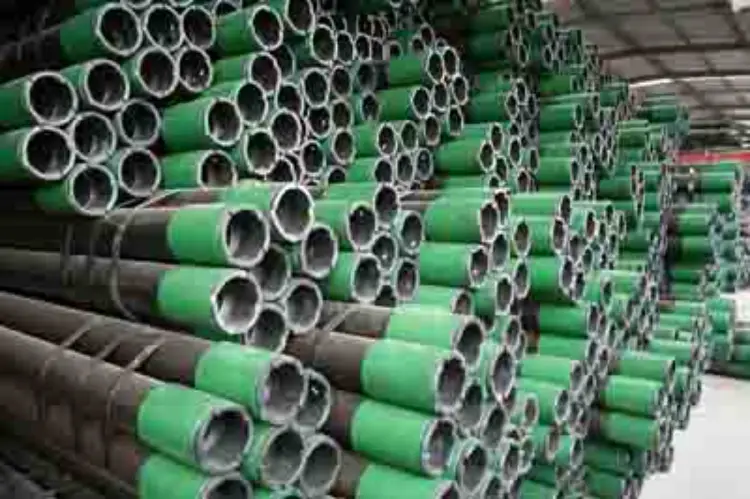
GB/T 9711-2011 PSL1 L210 ERW Pipe
GB/T 9711-2011 PSL1 L210 ERW Pipe: Full Material Data & Equivalent Grades
In-depth analysis of L210 grade steel pipe according to GB/T 9711-2011 PSL1 for ERW pipes, covering chemical composition, mechanical properties, thermal-electrical physical properties, international equivalents, similar substitutes, and application guidance.
Electric Resistance Welding (ERW), cold forming, normalizing (optional), end‑finishing
- Phone : +8618037372205
- Email : [email protected]
- WhatsApp: Contact via Whtsapp
- WeChat: +8618037372205
GB/T 9711-2011 PSL1 L210 ERW Pipe Introduction
L210 is a carbon‑manganese steel grade designed for ERW (Electric Resistance Welded) pipes under GB/T 9711‑2011 PSL1, primarily used in pipeline transportation systems for petroleum and natural gas. It offers a minimum yield strength of 210 MPa and good weldability, making it suitable for low‑pressure, non‑sour service applications. The material is supplied in the as‑welded or normalized condition and can be readily formed into various pipe components for oil and gas gathering, water transmission, and structural uses.
GB/T 9711-2011 PSL1 L210 ERW Pipe Chemical Composition
The chemical composition of L210 is controlled to ensure adequate weldability and strength. Limits are specified for carbon, silicon, manganese, phosphorus, sulfur, and micro‑alloying elements (V, Nb, Ti). The carbon equivalent value CEV or Pcm is further restricted to avoid hardenability and cracking in the weld zone.
| Element | Specified Value (max) | Remarks |
|---|---|---|
| Carbon (C) | 0.22 % | Typical for weldability |
| Silicon (Si) | 0.45 % | Deoxidation control |
| Manganese (Mn) | 1.20 % | Strength & toughness balance |
| Phosphorus (P) | 0.025 % | Impurity control |
| Sulfur (S) | 0.015 % | For improved cleanliness |
| Vanadium (V) | ≤ 0.15 % | Sum of V+Nb+Ti ≤ 0.15% |
| Niobium (Nb) | ≤ 0.15 % | See combined limit |
| Titanium (Ti) | ≤ 0.15 % | See combined limit |
| CEV (IIW) | ≤ 0.43 % | Carbon equivalent; alternative Pcm ≤ 0.25% |
GB/T 9711-2011 PSL1 L210 ERW Pipe Thermal and Electrical Physical Properties
The standard GB/T 9711‑2011 does not specify thermal or electrical properties. Typical values for low‑carbon steel grades similar to L210 are provided below for reference and should not be used for precise engineering design without verification.
| Property | Typical Value | Unit | Condition |
|---|---|---|---|
| Density (ρ) | ~ 7.85 | g/cm³ | Room temperature |
| Elastic modulus (E) | ~ 205 | GPa | Room temperature |
| Shear modulus (G) | ~ 80 | GPa | Calculated from E and ν |
| Poisson's ratio (ν) | ~ 0.29 | – | Room temperature |
| Mean thermal expansion (α) | ~ 12.0 × 10⁻⁶ | K⁻¹ | 20–100 °C |
| Thermal conductivity (λ) | ~ 45 | W/(m·K) | At 100 °C |
| Specific heat capacity | ~ 480 | J/(kg·K) | At 100 °C |
| Electrical resistivity (ρₑ) | ~ 0.22 | µΩ·m | Room temperature |
GB/T 9711-2011 PSL1 L210 ERW Pipe Mechanical Properties
Tensile tests are performed on the pipe body in either longitudinal or transverse direction. PSL1 does not require Charpy impact testing unless agreed. Bending tests (guided bend or flattening) are mandatory for ERW pipes to verify the soundness of the weld seam.
| Property | Requirement | Unit | Test Condition |
|---|---|---|---|
| Yield Strength (ReH or Rt0.5) | ≥ 210 | MPa | Transverse strip or full‑section specimen |
| Tensile Strength (Rm) | ≥ 335 | MPa | Transverse strip or full‑section specimen |
| Elongation after fracture (A) | Calculated per A = 1940·Aₓc⁰·²/Rm⁰·⁹ | % | Gauge length 50 mm or proportional; minimum value as per formula |
| Bend Test (guided bend or flattening) | No cracks or ruptures | – | 90° bend, D=6T for T≤12.7 mm; flattening to a certain height for D<60.3 mm |
GB/T 9711-2011 PSL1 L210 ERW Pipe Fully Equivalent Grades and Standards for L210 PSL1
| Region/Country | Standard | Grade | Remarks |
|---|---|---|---|
| International | ISO 3183:2007 (MOD) | L210 PSL1 | Identical technical basis as GB/T 9711‑2011 |
| USA | API 5L (46th and earlier editions) | Grade L210 PSL1 | Equivalent; also historically A25 or A may be used for lower strengths |
| Europe | EN 10208‑1 | L210 | Same designation for non‑alloy steel pipes |
| Japan | JIS G 3452 | SGP (carbon steel pipes for ordinary piping) – not exact equivalent, see similar grades | Often cross‑referenced for general utility pipelines |
GB/T 9711-2011 PSL1 L210 ERW Pipe Application Introduction
L210 ERW pipe is widely utilized in low‑ to moderate‑pressure pipeline systems for transporting oil, natural gas, water, and other non‑corrosive fluids. It is also employed in structural applications such as piling, bracing, and light‑duty frameworks. The material can be easily cut, threaded, and welded, and is often supplied in long lengths for field joint welding.
Product Applications: ERW line pipe in coils or straight lengths, Casing and tubing for shallow wells, Conduit for electrical cables (when adapted), Fire‑sprinkler risers and main piping
Processed into products: Pipe sections and spools, Weld‑on flanges and fittings, Branch connections (saddles, olets), Pipe sleeves for corrosion protection, End caps and closure plates, Structural hollow sections for framing
Application industries: Oil & Gas (gathering lines, flowlines), Water & Wastewater Treatment, Structural Engineering (piles, columns), Mechanical & Plant Piping (low‑pressure steam, air)
GB/T 9711-2011 PSL1 L210 ERW Pipe Similar and Alternative Grades
| Region/Country | Standard | Grade | Comparison / Remarks |
|---|---|---|---|
| China | GB/T 9711‑2011 | L245 (PSL1) | Higher strength (245 MPa min. YS); can replace L210 in many line‑pipe applications with increased wall thickness reduction capability. |
| USA | API 5L | Grade B (PSL1) | Yield strength ~240 MPa; slightly stronger; widely used and often interchangeable for general pipeline service. |
| Europe | EN 10208‑1 | L245 | European counterpart of L245, commonly used when moderate pressure ratings are required. |
| China | GB/T 8163 | 10# steel (for pipes) | Seamless carbon steel pipe with similar carbon content; not intended for high‑pressure welding but suitable for structural/fluid transmission. |
Notes:
PSL1 grade L210 is intended for non‑sour service and does not require impact toughness testing according to the base standard. For applications involving low temperatures or sour gas, consider PSL2 or higher grades (e.g., L245N or L245MS). When ordering, supplementary requirements such as chemical analysis for each heat, non‑destructive welding seam inspection, and hydrostatic testing can be specified. The CEV and Pcm limits help ensure weldability without pre‑heating under normal conditions.
- Share



