
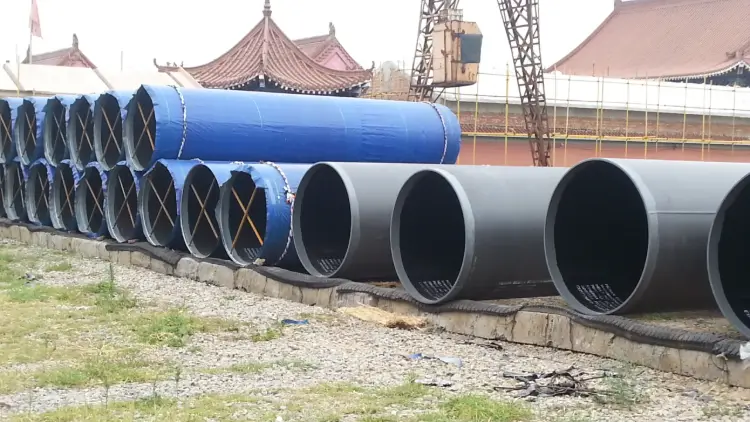
GB/T 9711-2011 L175P ERW Pipe
GB/T 9711-2011 PSL1 L175P ERW Pipe: Composition, Properties & Equivalents
Explore detailed data on L175P ERW pipe per GB/T 9711-2011 PSL1, including chemical composition, mechanical & physical properties, international equivalents, and application guidance for low-pressure fluid pipelines.
Electric resistance welding (ERW) from hot-rolled coils; cold bending, cutting, threading, and welding for fabrication
- Phone : +8618037372205
- Email : [email protected]
- WhatsApp: Contact via Whtsapp
- WeChat: +8618037372205
GB/T 9711-2011 L175P ERW Pipe Introduction
L175P is a low-strength grade of electric resistance welded (ERW) steel pipe for pipeline transportation systems, specified in the Chinese national standard GB/T 9711-2011 under Product Specification Level 1 (PSL1). It corresponds to legacy grade A25 in earlier standards. L175P is intended for non-critical, low-pressure fluid services such as water, air, and some gaseous media at ambient temperatures. The material is characterized by a minimum yield strength of 175 MPa, good weldability, and adequate ductility for field bending and joining. It is supplied in as-welded condition (without mandatory heat treatment) from hot-rolled strip or coil. Typical applications include utility pipelines, irrigation systems, and structural tubing where only modest strength is required.
GB/T 9711-2011 L175P ERW Pipe Chemical Composition per GB/T 9711-2011 PSL1
The following elements are specified for L175P grade. Values are based on heat analysis. Other elements may be present but are not restricted unless they affect the required mechanical properties. Note: No intentional addition of microalloying elements is required for this grade.
| Element | Specified Value (wt%) | Remarks |
|---|---|---|
| Carbon (C) | ≤ 0.21 | Heat analysis |
| Manganese (Mn) | ≤ 0.60 | Heat analysis |
| Phosphorus (P) | ≤ 0.030 | Heat analysis |
| Sulfur (S) | ≤ 0.030 | Heat analysis |
GB/T 9711-2011 L175P ERW Pipe Thermal and Electrical Physical Properties
These values are representative for carbon steel grades similar to L175P at room temperature unless stated otherwise. They are not mandatory per GB/T 9711-2011 but are useful for engineering calculations such as thermal expansion, heat transfer, and electrical resistance.
| Property | Typical Value | Unit | Test Condition / Remarks |
|---|---|---|---|
| Density (ρ) | 7.85 | g/cm³ | At 20 °C |
| Modulus of Elasticity (E) | 205 | GPa | At 20 °C |
| Shear Modulus (G) | 80 | GPa | Calculated from E and ν |
| Poisson's Ratio (ν) | 0.30 | - | At 20 °C |
| Coefficient of Thermal Expansion (α) | 11.7 × 10⁻⁶ | K⁻¹ | Range 20–100 °C |
| Thermal Conductivity (λ) | 50 | W/(m·K) | At 20 °C |
| Specific Heat Capacity (cp) | 480 | J/(kg·K) | At 20 °C |
| Electrical Resistivity (ρe) | 0.14 × 10⁻⁶ | Ω·m | At 20 °C |
GB/T 9711-2011 L175P ERW Pipe Mechanical Properties per GB/T 9711-2011 PSL1
Tensile testing is performed on longitudinal strip specimens taken from the pipe body. The yield strength is determined at 0.5% total extension if the yield plateau is not pronounced. Elongation is measured on a gauge length of 50 mm (2 in). Bending test is mandatory for PSL1 ERW pipe; the specimen shall withstand 180° bending without cracking. No impact test is required for this grade.
| Property | Specified Value | Unit | Test Condition |
|---|---|---|---|
| Yield Strength (ReH / Rt0.5) | ≥ 175 | MPa | Transverse or longitudinal specimen |
| Tensile Strength (Rm) | ≥ 310 | MPa | Transverse or longitudinal specimen |
| Elongation A50 | ≥ 33 | % | Wall thickness ≤ 5.0 mm |
| Elongation A50 | ≥ 28 | % | Wall thickness > 5.0 mm |
| Bend Test (C-form or strip) | Crack free | - | Bend angle 180°, mandrel diameter = 4 × wall thickness |
GB/T 9711-2011 L175P ERW Pipe Fully Equivalent Standard Grades and Substitutions
| Country / Region | Standard | Grade | Remarks |
|---|---|---|---|
| United States / International | API 5L (45th Ed. / earlier) | A25 PSL1 | Identical in yield, tensile, and chemistry limits; legacy designation |
| International (ISO) | ISO 3183:2012 (PSL1) | L175 | Equivalent to L175P; same minimum yield strength |
GB/T 9711-2011 L175P ERW Pipe Application Introduction
L175P ERW pipe is primarily used in low-pressure fluid transmission and lightweight structural applications. Its low strength makes it suitable for services where high internal pressure is not required and where ease of bending and joining are important. The material can be processed by cutting, threading, welding, and cold forming. Typical products include:
- Rural and municipal water mains
- Natural gas distribution lines (low pressure)
- Sewer and drainage piping
- Agricultural irrigation pipes
- Fencing and scaffolding tubes
- Conduit for electrical and communication cables
Product Applications: Water pipes, Gas pipes, Drainage pipes, Structural tubes, Fencing tubes, Conduit pipes
Processed into products: Pipe spools and straight sections, Flanges and blind flanges, Elbows, tees, and reducers, Couplings and nipples, Threaded end connections, Welded fabrications (frames, supports)
Application industries: Water supply and wastewater, Natural gas distribution, Agriculture and irrigation, Construction and infrastructure, Utility networks
GB/T 9711-2011 L175P ERW Pipe Similar or Comparable Materials
| Country / Region | Standard | Grade | Remarks |
|---|---|---|---|
| China | GB/T 9711-2011 | L210P (A) | Next strength grade; yield ≥210 MPa; for slightly higher pressure |
| International | API 5L / ISO 3183 | A / L210 | Corresponds to L210; widely used for general-purpose line pipe |
| China / International | GB/T 9711-2011 / API 5L | L245P / B | Common structural and pressure grade; yield ≥245 MPa |
| Europe | EN 10208-1 | L210GA | Similar low-strength gas supply pipe; not identical but comparable |
Notes:
L175P is a PSL1 grade, meaning no impact test or stringent chemical restrictions are required. It is typically manufactured by electric resistance welding from hot-rolled strip. The pipe is not intended for sour service or high-pressure transmission. For high-temperature applications, derating factors must be applied. Surface conditions and end finishes are subject to agreement at the time of order.
- Share



