
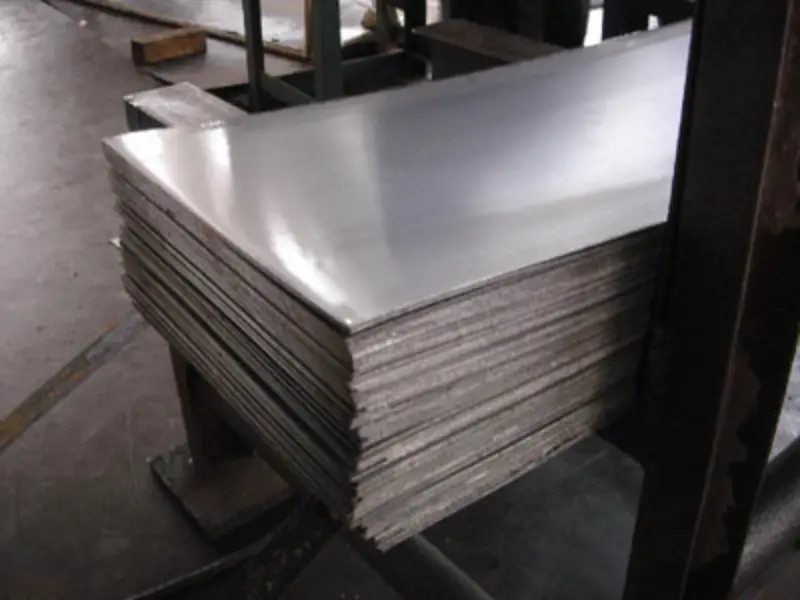
DIN 17102 TStE355 Automobile Structure Steel Plate
DIN 17102 TStE355 Automobile Structure Steel Plate - Normalized Fine Grain Weldable Steel
Technical data sheet for TStE355 steel according to DIN 17102: weldable fine grain steel with minimum yield strength 355 MPa, used in automotive structural parts.
Hot rolling, normalizing (+N), cutting, cold forming (bending, flanging), welding (all common methods), machining
- Phone : +8618037372205
- Email : [email protected]
- WhatsApp: Contact via Whtsapp
- WeChat: +8618037372205
DIN 17102 TStE355 Automobile Structure Steel Plate Introduction
DIN 17102 TStE355 is a normalized, weldable fine grain structural steel with a minimum yield strength of 355 MPa. It belongs to the category of thermomechanically rolled or normalized fine grain steels intended for heavy-duty welded structures. The steel exhibits excellent notch toughness at low temperatures (guaranteed down to -20°C), good weldability, and reliable mechanical properties across a wide thickness range. Key characteristics:
- High yield and tensile strength with good ductility
- Superior impact toughness for safety-critical applications
- Uniform properties through normalizing heat treatment
- Good formability and weldability using standard methods
TStE355 is widely used in the automotive industry for chassis components and load-bearing frames, as well as in general structural engineering, crane building, and transportation equipment. The material is typically delivered in the normalized condition (N), ensuring consistent grain structure and mechanical properties.
DIN 17102 TStE355 Automobile Structure Steel Plate Chemical Composition
The chemical composition of TStE355 is controlled to obtain fine ferrite-pearlite microstructure with good strength and toughness. Key elements: Manganese (up to 1.70%) strengthens the steel, while microalloying elements like niobium, vanadium, and titanium refine grain size. Total aluminium acts as a deoxidizer and grain refiner. The low carbon equivalent (CEV typically ≤0.45) ensures excellent weldability.
| Element | Standard Value (wt%) | Remarks |
|---|---|---|
| C | ≤ 0.20 | Max |
| Si | ≤ 0.50 | Max |
| Mn | 1.00 – 1.70 | As specified |
| P | ≤ 0.040 | Max |
| S | ≤ 0.035 | Max |
| Altotal | ≥ 0.020 | Soluble Al or total Al |
| Nb | ≤ 0.050 | Max |
| V | ≤ 0.12 | Max |
| Ti | ≤ 0.12 | Max |
| N | ≤ 0.025 | Max. nitrogen content may be controlled |
| Cr(a) | ≤ 0.30 | Residual element |
| Cu(a) | ≤ 0.50 | Residual element |
| Mo(a) | ≤ 0.10 | Residual element |
| Ni(a) | ≤ 0.30 | Residual element |
DIN 17102 TStE355 Automobile Structure Steel Plate Thermal and Electrical Physical Properties
Typical physical data for TStE355 at room temperature and elevated temperatures. These are approximate values for normalized fine grain structural steel and may vary slightly depending on exact composition and heat treatment. Thermal conductivity decreases with increasing temperature; the listed value is for ~100°C. Specific heat capacity increases with temperature.
| Property | Standard Requirement | Unit | Test Condition |
|---|---|---|---|
| Density (ρ) | 7.85 | g/cm³ | Room temperature |
| Elastic Modulus (E) | 210 | GPa | Room temperature |
| Shear Modulus (G) | ~81 | GPa | Room temperature |
| Poisson's ratio (ν) | ~0.3 | - | Room temperature |
| Coefficient of thermal expansion (α) | 12.0 × 10⁻⁶ | /K | 20 – 100°C |
| Coefficient of thermal expansion (α) | 12.5 × 10⁻⁶ | /K | 20 – 200°C |
| Coefficient of thermal expansion (α) | 13.1 × 10⁻⁶ | /K | 20 – 300°C |
| Thermal conductivity (λ) | ~50 | W/(m·K) | At 100°C |
| Specific heat capacity (c) | ~460 | J/(kg·K) | At 100°C |
| Electrical resistivity (ρe) | ~0.22 | μΩ·m | At 20°C |
DIN 17102 TStE355 Automobile Structure Steel Plate Mechanical Properties
Mechanical properties are obtained from the normalized condition (+N). Tensile testing is performed in the transverse direction unless otherwise agreed. The yield strength decreases with increasing thickness. The guaranteed Charpy-V impact energy at -20°C (longitudinal) is 27 J for thicknesses up to 70 mm; for thicker products, values may be agreed. Bend test: 180° bending over a mandrel with diameter 3a (a = specimen thickness) without cracking.
| Property | Standard Requirement | Unit | Test Condition |
|---|---|---|---|
| Yield Strength (ReH) | ≥ 355 | MPa | t ≤ 16 mm |
| Yield Strength (ReH) | ≥ 345 | MPa | 16 mm < t ≤ 35 mm |
| Yield Strength (ReH) | ≥ 335 | MPa | 35 mm < t ≤ 50 mm |
| Yield Strength (ReH) | ≥ 325 | MPa | 50 mm < t ≤ 70 mm |
| Yield Strength (ReH) | ≥ 315 | MPa | 70 mm < t ≤ 100 mm |
| Tensile Strength (Rm) | 490 – 630 | MPa | t ≤ 70 mm |
| Tensile Strength (Rm) | 470 – 610 | MPa | 70 mm < t ≤ 100 mm |
| Elongation (A) | ≥ 22 | % | Longitudinal, 5.65√So, t ≤ 16 mm |
| Elongation (A) | ≥ 22 | % | Longitudinal, 16 < t ≤ 35 mm |
| Elongation (A) | ≥ 21 | % | Longitudinal, 35 < t ≤ 50 mm |
| Elongation (A) | ≥ 20 | % | Longitudinal, 50 < t ≤ 70 mm |
| Elongation (A) | ≥ 20 | % | Longitudinal, 70 < t ≤ 100 mm |
| Charpy Impact Energy (KV) | ≥ 27 | J | Longitudinal, -20°C, V-notch, t ≤ 70 mm |
| Charpy Impact Energy (KV) | ≥ 20 (1) | J | Longitudinal, -20°C, V-notch, 70 < t ≤ 100 mm |
| Bend Test | No cracks after 180° bending | - | Mandrel diameter = 3a, a = thickness |
DIN 17102 TStE355 Automobile Structure Steel Plate Exact Equivalent Material Standards and Replaceable Designations
| Country/Region | Standard | Grade | Remarks |
|---|---|---|---|
| Europe | EN 10025-3 (current) | S355N | Normalized fine grain steel, identical technical delivery conditions |
| Europe | EN 10113-2 (withdrawn) | S355N | Former European standard, still accepted as equivalent |
| Germany | DIN EN 10025-3 | S355N | German adoption of EN standard, direct replacement for TStE355 |
| France | NF EN 10025-3 | S355N | French national adoption |
| United Kingdom | BS EN 10025-3 | S355N | British adoption; supersedes BS 4360 50EE |
| Italy | UNI EN 10025-3 | S355N | Italian national adoption |
| Spain | UNE EN 10025-3 | S355N | Spanish national adoption |
| Japan | JIS G 3106 (comparable) | SM490B/SM490C (modified) | Not identical; impact temperature and some chemistry differ |
| USA | ASTM A572/A572M (Grade 50) | Grade 50 [345 MPa] | Similar strength but lower yield (345 MPa); chemistry and impact testing differ; not a full equivalent |
DIN 17102 TStE355 Automobile Structure Steel Plate Application Introduction
TStE355 is a versatile steel suitable for demanding welded structures. Its balanced combination of strength, toughness, and weldability makes it ideal for the automotive industry and heavy engineering. Processing guidelines:
- Preheating is generally not required for thicknesses up to 30 mm; for thicker sections, a preheat of 50–100°C may be advised to avoid hydrogen cracking.
- Post-weld heat treatment is not typically needed, but stress relieving may be applied if requested.
- The steel can be cold formed with a minimum bending radius of 2t (where t = thickness) in the normalized condition; spring-back is moderate.
- Hot forming should be carried out in the normalizing temperature range and followed by controlled cooling to maintain grain size.
Product Applications: Automobile chassis and subframes, Truck frames and longitudinal beams, Crane booms and outrigger beams, Loader buckets and excavator arms, Pressure vessel shells (in cooperative standards), Structural tubular sections
Processed into products: Longitudinal chassis rails and cross members for trucks, Suspension brackets and spring hangers, Bumper reinforcement beams, Tow bars and coupling plates, Welded box sections for vehicle frames, Flanges and webs for welded beams, Base plates and mounting brackets
Application industries: Automotive and commercial vehicle manufacturing, Heavy machinery and equipment construction, Crane and lifting equipment, Bridge and structural steelwork, Offshore platforms and shipbuilding (secondary structures), Railway and transportation
DIN 17102 TStE355 Automobile Structure Steel Plate Similar or Alternative Materials Recommendation
| Country/Region | Standard | Grade | Remarks |
|---|---|---|---|
| Europe | EN 10025-2 | S355JR / S355J0 / S355J2 | Non-fine grain structural steel; impact toughness at +20°C (JR), 0°C (J0), -20°C (J2); lower cost, suitable where fine grain requirement is not mandatory |
| Europe | EN 10025-3 | S355NL | Normalized fine grain steel with improved low-temperature toughness (-50°C); ideal for cryogenic or safety-critical applications |
| USA | ASTM A572 Grade 50 / A709 Grade 50 | Grade 50 | High-strength low-alloy (HSLA) structural steel; yield 345 MPa; welding and toughness differ; often used in automotive and construction |
| China | GB/T 1591 | Q355D | Chinese fine grain structural steel with similar strength and -20°C impact energy; most common alternative in Asian markets |
| Russia | GOST 19281 | 10HSND / 16G2AF | Russian fine grain steels; chemistry and properties differ but can serve similar functions |
Notes:
Delivery conditions and certification: TStE355 plates are typically supplied in the normalized condition (+N) with inspection certificate 3.1 according to EN 10204. Edge condition: Products can be ordered with sheared, gas-cut, or machined edges. Surface quality: Standard surface treatment includes shot blasting and primer coating upon request. Thickness tolerances: In compliance with EN 10029 Class A or B. Welding consumables: Matching electrodes (e.g., E 50xx series for SMAW, ER70S-6 for GMAW) are recommended to maintain joint properties equivalent to the base metal. For demanding fatigue or dynamic load applications, a fully killed fine grain practice is required; verify that the material meets the requirements of the relevant construction code.
- Share



