
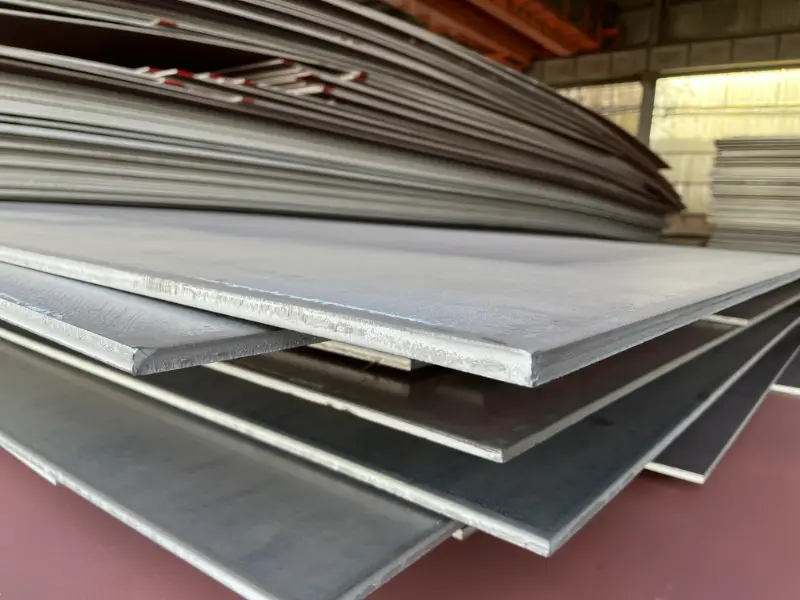
DIN 17102 EStE355 Automobile Structure Steel Plate
DIN 17102 EStE355 Fine Grain Structural Steel for Automobile Structures and Welded Components
EStE355 is a normalized fine-grain structural steel under DIN 17102, now superseded by EN 10113-2 and EN 10025-3. It offers minimum yield strength of 355 MPa and excellent weldability, making it ideal for automobile frames, chassis parts, and heavy structural applications.
Normalizing rolling or normalizing heat treatment, cold forming, welding, machining
- Phone : +8618037372205
- Email : [email protected]
- WhatsApp: Contact via Whtsapp
- WeChat: +8618037372205
DIN 17102 EStE355 Automobile Structure Steel Plate Introduction
DIN 17102 EStE355 is a weldable fine-grain structural steel delivered in normalized condition. It is primarily designed for automobile structures and other dynamically loaded welded components.
- Minimum yield strength of 355 MPa for thickness ≤16 mm
- Good notch toughness at -20°C (min. 27 J longitudinal)
- Excellent formability and weldability due to low carbon equivalent
- Fine grain microstructure achieved by aluminum grain refinement and controlled rolling/normalizing
This steel provides high strength-to-weight ratio and reliable performance in cold bending, flanging, and welding processes.
DIN 17102 EStE355 Automobile Structure Steel Plate Chemical Composition
The chemical composition of EStE355 is defined in DIN 17102:1983. The steel is a C-Mn steel with aluminum addition for grain refinement. Low phosphorus and sulfur contents ensure good ductility and toughness. The maximum carbon equivalent helps guarantee weldability.
- Tighter limits on residual elements (Cr, Ni, Cu) prevent hot shortness and temper embrittlement.
- Nitrogen is bound by aluminum to maintain fine grains.
| Element | Value (wt.%) | Remarks |
|---|---|---|
| C | ≤0.20 | max |
| Si | ≤0.50 | max |
| Mn | 0.90 – 1.65 | For thickness >30 mm, max Mn may be 1.70 |
| P | ≤0.035 | max |
| S | ≤0.030 | max |
| Al (total) | ≥0.020 | min, soluble aluminum |
| N | ≤0.015 | max |
| Cr | ≤0.30 | max, residual |
| Ni | ≤0.30 | max, residual |
| Cu | ≤0.20 | max, may be up to 0.35 by agreement |
| Nb | ≤0.05 | max, optional grain refining element |
| V | ≤0.10 | max, optional, combined with Nb+V ≤0.10 |
| Ti | ≤0.05 | max, optional |
DIN 17102 EStE355 Automobile Structure Steel Plate Thermal and Electrical Physical Properties
Physical properties are typical for low-carbon fine-grain structural steel. Data are based on room temperature unless noted. The linear thermal expansion coefficient is given for the range 20–100°C. Thermal conductivity decreases with increasing temperature.
- Density is standard for steel.
- Elastic moduli are typical for design.
| Property | Typical Value | Unit | Test Conditions / Remarks |
|---|---|---|---|
| Density (ρ) | 7.85 | g/cm³ | at 20°C |
| Modulus of elasticity (E) | 210 | GPa | at 20°C |
| Shear modulus (G) | 81 | GPa | calculated |
| Poisson's ratio (ν) | 0.3 | – | typical |
| Thermal expansion coefficient (α) | 11.1 × 10⁻⁶ | K⁻¹ | 20–100°C |
| Thermal conductivity (λ) | 51 – 54 | W/(m·K) | at 20°C; decreases to approx. 36 W/(m·K) at 400°C |
| Specific heat capacity (c) | 460 – 480 | J/(kg·K) | at 20°C |
| Electrical resistivity (ρ_e) | 0.20 – 0.25 | µΩ·m | at 20°C |
DIN 17102 EStE355 Automobile Structure Steel Plate Mechanical Properties
Mechanical properties vary with product thickness. The values below are for the normalized (+N) condition in accordance with DIN 17102. Tensile testing is performed in the longitudinal direction. Yield strength decreases as thickness increases; minimum values are guaranteed. Notch impact energy at -20°C ensures satisfactory brittle fracture resistance for automotive and structural use.
| Property | Required Value | Unit | Test Conditions / Remarks |
|---|---|---|---|
| Yield strength (ReH) | ≥355 | MPa | thickness ≤16 mm, longitudinal |
| Yield strength (ReH) | ≥345 | MPa | thickness 16 < t ≤35 mm |
| Yield strength (ReH) | ≥335 | MPa | thickness 35 < t ≤50 mm |
| Yield strength (ReH) | ≥325 | MPa | thickness 50 < t ≤70 mm |
| Tensile strength (Rm) | 450 – 610 | MPa | thickness ≤70 mm |
| Elongation after fracture (A) | ≥22 | % | thickness ≤16 mm, gauge length 5.65√So |
| Elongation after fracture (A) | ≥22 | % | thickness 16 < t ≤35 mm |
| Elongation after fracture (A) | ≥21 | % | thickness 35 < t ≤50 mm |
| Elongation after fracture (A) | ≥21 | % | thickness 50 < t ≤70 mm |
| Bend test (mandrel diameter) | No cracks | – | 180° bend, mandrel diameter = 2a (a=thickness) for t ≤16 mm; 2.5a for t >16 mm |
| Impact energy (KV, longitudinal) | ≥27 | J | at -20°C, average of 3 specimens, min individual 21 J, thickness ≥6 mm |
| Impact energy (KV, transverse) | ≥27 | J | at -20°C, when agreed, thickness ≥6 mm |
DIN 17102 EStE355 Automobile Structure Steel Plate Fully Equivalent Material Standards and Substitute Grades
| Country / Region | Standard | Grade | Remarks |
|---|---|---|---|
| Europe | EN 10113-2:1993 (withdrawn, replaced by EN 10025-3) | S355N | Identical concept; normalized fine grain steel, -20°C impact |
| Europe | EN 10025-3:2019 | S355N | Current standard; direct successor, same strength and toughness |
| Italy | UNI 7945 | Fe E 355 KGN | Equivalent fine grain steel |
| Spain | UNE 36080 | AE 355 KGN | Equivalent fine grain steel |
| United Kingdom | BS 4360:1990 (withdrawn) | 50 EE (Grade 355 C, D) | Fine grain normalized; closest to 50D with impact |
| International | ISO 630-2:2011 | FeE355KGN | International fine grain structural steel |
| Japan | JIS G 3136:2012 | SN400B | Approximate; SN400B provides 235-400 MPa yield, not identical; check toughness and chemical composition |
DIN 17102 EStE355 Automobile Structure Steel Plate Application Introduction
EStE355 steel is specifically designed for automobile structures such as truck chassis, side members, cross members, and reinforcement plates. Its good formability and fatigue resistance suit it for stamped, bent, and welded parts. With guaranteed impact toughness at -20°C, the steel can be used in cold climate environments without brittle fracture risk. Typical applications include:
Product Applications: Truck and trailer chassis frames, Side rails, longitudinal beams, Cross members and cross beams, Suspension arms and brackets, Dump truck body parts, Agricultural machinery frames, Welded pressure vessels and storage tanks (when impact properties are needed)
Processed into products: Welded chassis assemblies, Stamped and formed brackets, gussets, Bolted or riveted frame joints, Bent plates and flanges, Welded box sections, Machined adapters and spacers
Application industries: Automotive (commercial vehicles, trailers), Heavy machinery (construction, agricultural), Crane and lifting equipment, Shipbuilding (secondary structures, superstructures), Wind tower internal components, Railway rolling stock
DIN 17102 EStE355 Automobile Structure Steel Plate Similar / Alternative Materials for Substitution
| Country / Region | Standard | Grade | Remarks |
|---|---|---|---|
| Europe | EN 10025-2:2019 | S355J2+N | Structural steel, not fine grain, but similar strength; impact at -20°C; requires normalized delivery |
| USA | ASTM A572/A572M-21 | Gr. 50 [345] (Type 1) | Standard HSLA steel; yield 345 MPa, but toughness not guaranteed unless supplementary requirement S5 |
| USA | ASTM A516/A516M-17 | Gr. 70 | Pressure vessel steel, notched toughness; higher C, not intended for automotive but could substitute in some welded structures |
| China | GB/T 1591-2018 | Q355NE | High-strength low-alloy structural steel with -40°C impact, normalized; close mechanical properties |
| Russia | GOST 19281-2014 | 10G2B, 17G1S (categories 12/15) | High-strength structural steel, may be used with attention to impact requirements |
Notes:
Note: All data are sourced from the DIN 17102:1983 standard and superseding EN 10113-2/EN 10025-3 requirements. For critical applications, users should verify the material certification and perform supplementary impact or CTOD testing if required. When substituting with materials from other standards, ensure that the carbon equivalent, through-thickness properties, and heat treatment (normalized) are comparable to maintain weldability and toughness. EStE355 is not intended for use at temperatures below -20°C without additional agreement.
- Share



